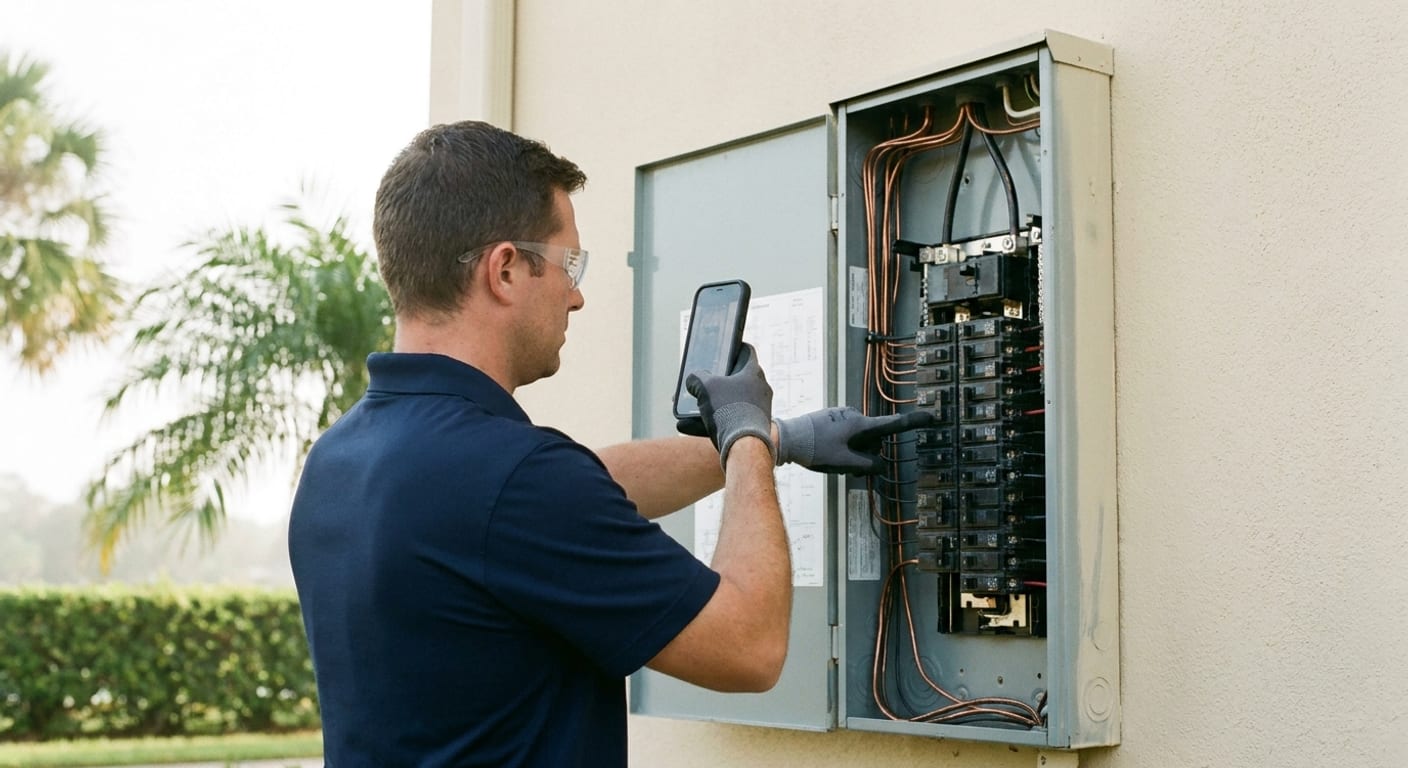
The electrical section of a Citizens 4-point inspection records panel capacity and condition, wiring types, listed hazards, and whether the system is satisfactory. It doesn’t automatically reject every older panel or every terminal holding two conductors. The inspector documents the electrical facts. Citizens underwriting then evaluates the property for eligibility.
Citizens requires a 4-point inspection for property owner, dwelling, and mobile home applications when the property is more than 20 years old. If another insurer requested the inspection, follow that company’s form and ask the agent what documentation it needs. Manufactured homes also have electrical requirements that differ from site-built houses; our mobile home electrical guide explains those distinctions.
What is a 4-point inspection?
A 4-point inspection documents four home systems: the roof, electrical, HVAC, and plumbing. It is narrower than a full home inspection. Citizens states that the report is used to determine insurability, not to warrant a system’s suitability or remaining life.
The current Citizens sample form must be completed, signed, and dated by a verifiable Florida-licensed professional. Its examples include a general, residential, or building contractor, a building code inspector, and a home inspector.
Can an electrician sign a 4-point inspection?
An electrician working under a trade-specific license may sign the electrical section, but that license alone does not qualify the electrician to sign the entire form. Citizens gives that division of responsibility in the form’s inspector instructions.
If the other three systems were accepted and the electrical section needs correction, ask the insurance agent what to submit next. The form allows an electrician to document the electrical section. That does not guarantee that every insurer will accept the same supplemental or revised paperwork.
Single-strand aluminum branch wiring has an additional documentation requirement. The Citizens form calls for separate remediation documentation certified by a licensed electrician.
What does the electrical section record?
The current form organizes the electrical review into four practical groups:
- Panel information: breaker or fuse type, total amps, whether amperage is sufficient for current use, panel age, year last updated, and brand or model. A second panel is recorded separately.
- Wiring types: copper, copper-clad aluminum, single-strand aluminum, multistrand aluminum, cloth knob-and-tube, cloth-jacket rubber-insulated wiring, and NM, BX, conduit, or another identified type.
- Visible hazards: blowing fuses, tripping breakers, empty sockets, loose or exposed wiring, improper grounding, corrosion, over-fusing, double taps, unsafe wiring, improper breaker size, scorching, and other explained conditions.
- Overall condition: satisfactory or unsatisfactory, with an explanation when required.
The form also requires panel and hazard photographs. Those requirements are for the licensed inspector. A homeowner should not remove the panel cover or reach into electrical equipment to prepare for the inspection.
What can make the electrical section unsatisfactory?
The electrical system must be working as intended without visible hazards or deficiencies to be marked satisfactory. Citizens also instructs agents not to submit applications when the electrical system is not in good working order or has an existing hazard or deficiency.
A checked item still needs accurate evaluation. Two conductors at one breaker terminal are not automatically an improper double tap. Some terminals are listed for two conductors, while others are not. The equipment label and the actual connection determine whether correction is needed.
Panel condition, circuit space, and service capacity are also separate questions. A panel can have no open breaker spaces while the service still has adequate capacity. A subpanel can create circuit space, but it does not add service capacity. The electrician must evaluate the actual loads and equipment rather than treating a full panel as proof that a service upgrade is required.
Does the form automatically reject Federal Pacific or Zinsco panels?
No. Federal Pacific and Zinsco do not appear as automatic rejection boxes on the current Citizens form. The form records the panel brand or model, visible hazards, and overall electrical condition.
The insurance decision is separate from the form itself. An insurer may apply underwriting requirements beyond the named checkboxes, so the agent should confirm what the carrier will accept. An electrician should assess the equipment’s condition and the scope of any correction. Our guides to Federal Pacific panels and Zinsco panels explain the equipment issues in more detail.
What documentation is needed for aluminum wiring?
The form asks whether branch-circuit aluminum wiring is present and how it is used. For single-strand aluminum branch wiring, it also requires details of remediation and separate documentation certified by a licensed electrician. COPALUM crimps and AlumiConn connectors are named on the form.
Missing paperwork does not prove that no repair was made. It means the required documentation is not available for the insurance file. A qualified electrician can inspect the actual branch wiring, build a complete connection inventory, identify the repair method used, and explain what can be documented. The correct method depends on the wire, connections, and equipment found. Our aluminum wiring remediation service and guide to aluminum wiring in Tampa homes cover those choices.
Which property details can change the electrical scope?
The scope should come from the property, not its neighborhood or age alone.
- Visible condition: corrosion, heat discoloration, scorching, loose wiring, or damaged equipment must be evaluated where found. A coastal address by itself does not prove corrosion. See our guide to corroded outdoor outlets and panels.
- Recurring symptoms: repeated trips, unexplained flicker, buzzing, burning odor, shocks, or hot and discolored plates call for prompt qualified inspection. Do not keep resetting a fault or open the panel to investigate it.
- Actual wiring: the inspector records the wiring that is present. A home’s construction date does not establish that it has aluminum, cloth, or knob-and-tube wiring.
- Current loads: air conditioning, pool equipment, EV charging, and other large loads matter when they are actually present. A load evaluation is different from counting breaker spaces. Our guide to home electrical capacity explains the distinction.
- Previous work: additions and altered circuits should be judged from the installation and available records, not assumed unsafe merely because they are newer than the original house.
For smoke or fire, leave the hazard area and contact emergency services.
What should you prepare before the inspector arrives?
Start with records and observations, not panel disassembly.
- Confirm which inspection form and submission process the insurance agent requires.
- Gather prior panel, rewiring, and aluminum-remediation documents.
- Note recurring electrical symptoms and where they occur.
- List major electrical equipment added since the last inspection.
- Leave panel-cover removal and internal photographs to the licensed professional.
If corrective work is proposed, verify the contractor through the Florida DBPR. The selected contractor should identify the property’s permitting jurisdiction and explain whether the planned scope requires a permit or inspection.
Frequently asked questions
How old must a property be for a Citizens 4-point inspection?
Citizens requires the inspection for property owner, dwelling, and mobile home applications on properties more than 20 years old. Another insurer may use different instructions, so confirm its requirement with the agent.
Can an electrician complete the entire 4-point form?
Not based only on an electrical trade license. Citizens says a trade-specific licensed professional may sign only the section for that trade. An electrician may sign the electrical section. Completing the entire form requires a professional who independently meets Citizens’ inspector requirements.
Is every two-conductor breaker terminal a double tap?
No. The breaker or equipment labeling determines whether a terminal is listed for two conductors. The inspector must evaluate the actual terminal and connection before calling it improper.
What happens when only the electrical section has a problem?
The electrical hazard or deficiency must be evaluated and corrected as needed. A licensed electrician can document the electrical work and sign that trade’s section. Ask the agent which revised form, photographs, or supporting documents the insurer will accept.
Do repaired aluminum connections still need paperwork?
Yes, when the form identifies single-strand aluminum branch wiring remediation. Citizens requires separate documentation certified by a licensed electrician. If old records are missing, an electrician must inspect the actual connections before stating what repair exists.
What affects the cost of correcting an electrical finding?
The finding and the equipment determine the scope. A properly listed two-conductor terminal may need no correction. An improper connection may involve a terminal, breaker, conductor, or damaged component. Aluminum remediation requires a complete connection inventory. Corrosion or heat damage may extend beyond the visible part, while a service-capacity problem is different from adding circuit space. The Tampa Bay electrician cost guide explains these scope factors.
Prepare the electrical section
If an inspection or renewal is approaching, gather the form, prior electrical records, and a clear list of symptoms first. Tampa Electrical Pro can connect you with a licensed and insured electrician who serves your part of Tampa Bay. Call (813) 850-0320. The selected contractor determines scheduling, scope, permits, workmanship, and price.