House rewiring cost in Tampa depends first on how much wiring actually needs replacement. A complete rewire reaches far more circuits and connection points than a targeted repair. Wall access, routing, finish restoration, occupied-home staging and related panel work can also change the scope substantially.
Tampa Electrical Pro connects homeowners across Hillsborough, Pinellas and Pasco with independent licensed and insured electricians. The selected contractor inspects the existing system, defines the work and provides the project price.
Start with the reason rewiring is being considered
A home’s age alone doesn’t establish that it needs a complete rewire. The useful questions are what wiring is present, where it runs, what condition its insulation and connections are in, and whether the problem affects one circuit or many.
An assessment may include:
- The wiring type found on each affected circuit
- Signs of damaged insulation, overheating or improper alterations
- Whether grounding is present where needed
- The location and condition of splices, receptacles, switches and other connection points
- Whether the problem is isolated or repeated across the home
- Whether planned appliances or renovations require different circuits
Cloth-covered wiring shouldn’t be declared beyond repair from its age or appearance alone. Its actual construction, condition, alterations and connections need to be examined. The same principle applies to older wiring systems generally: identify what is present before deciding how much must be replaced.
Full rewire, partial rewire or connection repair
These scopes solve different problems.
A full rewire replaces branch-circuit wiring throughout the home. It may be appropriate when defects or unsuitable wiring are widespread, but the decision should follow an inspection rather than a general assumption about the neighborhood or construction date.
A partial rewire replaces selected circuits or sections. This can be the more focused option when the problem is confined to a room, an addition, an altered circuit or another clearly defined part of the system.
The wiring type is its own scope split. Knob-and-tube, aluminum branch wiring, and cloth-covered wiring are different inspections, not one “old house” rewire. Knob-and-tube has its own access and connection questions. Aluminum branch-circuit wiring requires a complete inventory of the relevant connections because repairing only one visible device can leave other connections unaddressed. Cloth-covered wiring has to be judged by its actual construction, condition, alterations and connections. The CPSC discusses copper rewiring and approved connector-based repair methods, including COPALUM and AlumiConn under specified conditions. The correct method depends on the actual conductors, devices, connections and installation conditions. Read our aluminum-wiring overview for the distinctions, or consult the CPSC aluminum-wiring guidance.
Why wall access affects the scope
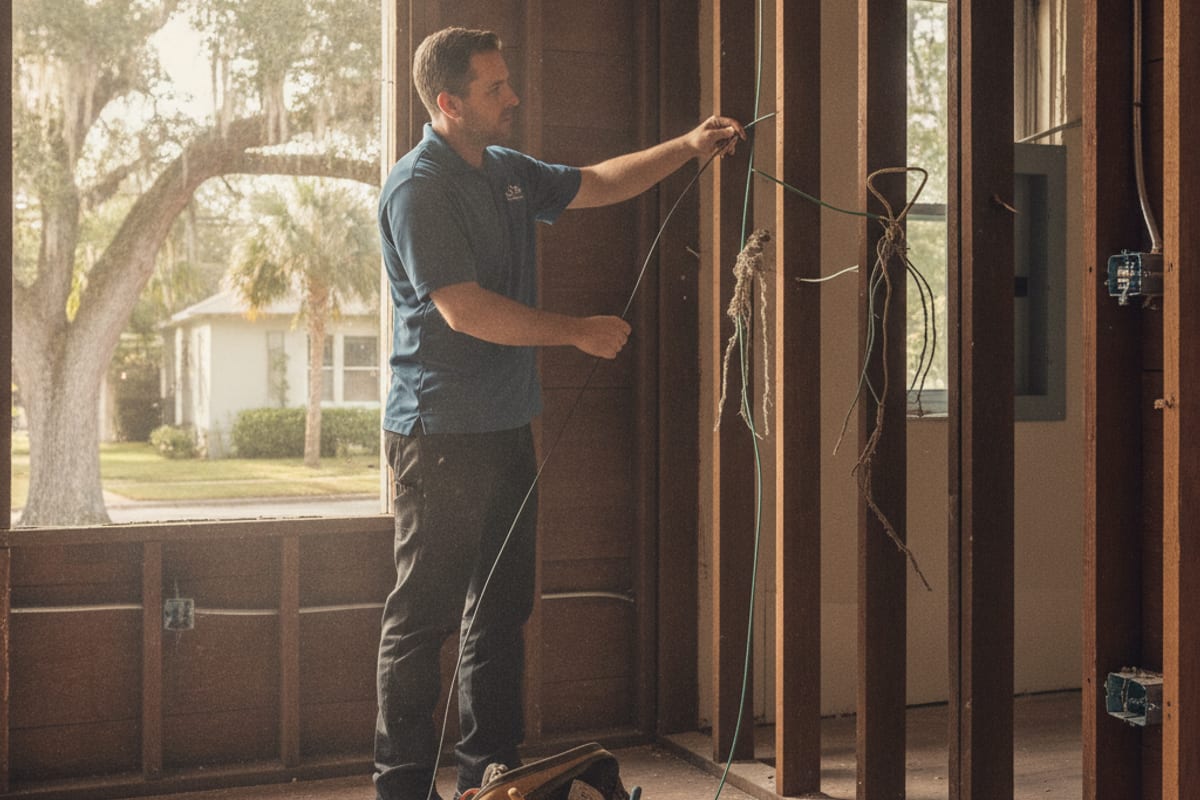
Routing new cable through open framing is different from fishing it behind finished walls and ceilings. Finished construction can require carefully located access openings, longer or less direct routes and coordination with whoever will restore drywall, plaster, tile, cabinets or trim.
Homes with original finishes, including properties in areas such as Hyde Park, may require a plan that protects the specific materials present. The neighborhood name doesn’t reveal the wiring condition, but the home’s actual finishes can affect access and restoration.
If a renovation will expose framing, have the electrical scope evaluated before the walls are closed. That allows the electrician and renovation contractor to coordinate cable routes, device locations and finish work while the relevant areas are accessible. An electrical repair assessment can also identify whether the concern is limited to the renovation area or extends elsewhere.
Square footage doesn’t define the job by itself
Two similarly sized homes can have very different rewiring scopes. Room use, circuit layout, previous additions, equipment loads, access paths and the number of connection points all matter.
Ask the contractor’s proposal to identify:
- Which circuits are being replaced and which will remain
- Whether new routes or access openings are expected
- Which devices, boxes and connections are included
- How grounding and existing alterations will be addressed
- Whether panel work is included or separate
- Who is responsible for wall and finish restoration
- How power interruptions will be staged
- Which permits and inspections apply to the property and scope
This makes competing proposals easier to compare than a single whole-house number with no written boundaries.
Does rewiring require a panel replacement?
Not automatically. Wiring condition, panel condition, circuit space and electrical service capacity are separate questions.
A panel may have physical breaker spaces yet still require an evaluation of the connected loads before adding substantial new demand. A subpanel can provide more circuit spaces, but it doesn’t increase the home’s utility service capacity. Conversely, replacing branch wiring doesn’t by itself prove that the existing panel must be replaced.
The electrician should evaluate the equipment that is actually installed, its condition, available circuit space, calculated loads and the proposed work. If panel replacement is recommended, ask which observed condition or project requirement makes it part of the scope. Our panel upgrade guide explains the issues that should be considered. Information about Federal Pacific and Zinsco equipment is available on the FPE and Zinsco replacement page.
Plan for access, power interruptions and finish repairs
Rewiring an occupied home requires a project-specific plan. It isn’t safe to assume that everyone can remain in the house or that particular rooms will always be completed in a set order.
Before work begins, confirm:
- Which rooms and circuits will be unavailable at each stage
- Whether refrigeration, medical equipment, internet access or other essential needs require special planning
- Which belongings or built-ins must be moved for access
- Whether any discovered hazard could change occupancy or shutdown plans
- Who will close and finish access openings
- How scope changes will be documented and approved
Scheduling and safe occupancy depend on the conditions found, the contractor’s work plan and any related construction. Those details should be settled for the specific home rather than inferred from a general timeline.
Treat warning signs as an inspection issue
Unexplained flickering or dimming, hot or discolored plates, buzzing or crackling, burning odors, shocks and frequent breaker trips call for prompt inspection by a qualified electrician. A general article can’t determine whether the cause is a damaged device, a connection problem, a circuit fault or something elsewhere in the electrical system.
Don’t remove panel covers, handle damaged or wet electrical equipment, or repeatedly reset a breaker that continues to trip. If there is smoke or fire, leave the hazard area and contact emergency services.
Insurance and inspection requests vary
An insurer or property inspection may raise questions about older wiring, panel equipment or previous alterations, but the required response isn’t universal. Ask for the concern and any requested documentation in writing. Then have the actual system evaluated so the contractor’s scope addresses the observed condition without promising a particular insurance decision.
How to compare rewiring proposals
A useful proposal should describe what will be changed, what will remain and what could change after concealed areas are opened. Compare the circuit list, connection points, access plan, included equipment, finish repairs, permit responsibilities and power-interruption plan.
Confirm the electrical contractor’s active license status and authorized scope through myfloridalicense.com. Florida recognizes different electrical contractor categories and scopes, so the relevant question is whether the selected business is properly licensed for the proposed work and jurisdiction.
Frequently asked questions
Is a partial rewire possible?
Yes, when inspection shows that the problem is limited to identifiable circuits or areas. The proposal should state what is being replaced and why the remaining wiring is outside the current scope.
Is rewiring easier during a renovation?
Open framing can reduce the difficulty of routing cable and locating connection points. Coordination still matters because the electrical plan, equipment loads, device locations and required inspections need to match the renovation scope.
Does aluminum wiring always require a full rewire?
No. CPSC guidance discusses copper rewiring and approved connector repair methods under specified conditions. The decision requires a complete connection inventory and evaluation of the actual branch-circuit wiring.
Does a full rewire always include a new panel?
No. Branch wiring, panel condition, circuit space and service capacity must be evaluated separately. A panel recommendation should be tied to the installed equipment and proposed loads.
Can I stay home while rewiring is underway?
That depends on the hazards found, the areas being opened, the planned shutdowns and the needs of the occupants. Get a room-by-room access and power plan from the selected contractor before work starts.
Define the scope before comparing cost
A reliable rewiring price starts with the circuits, connections, access conditions and related work found at the property. Call Tampa Electrical Pro at (813) 850-0320 to be connected with an independent electrician who can inspect the system and provide a written scope for the selected work.