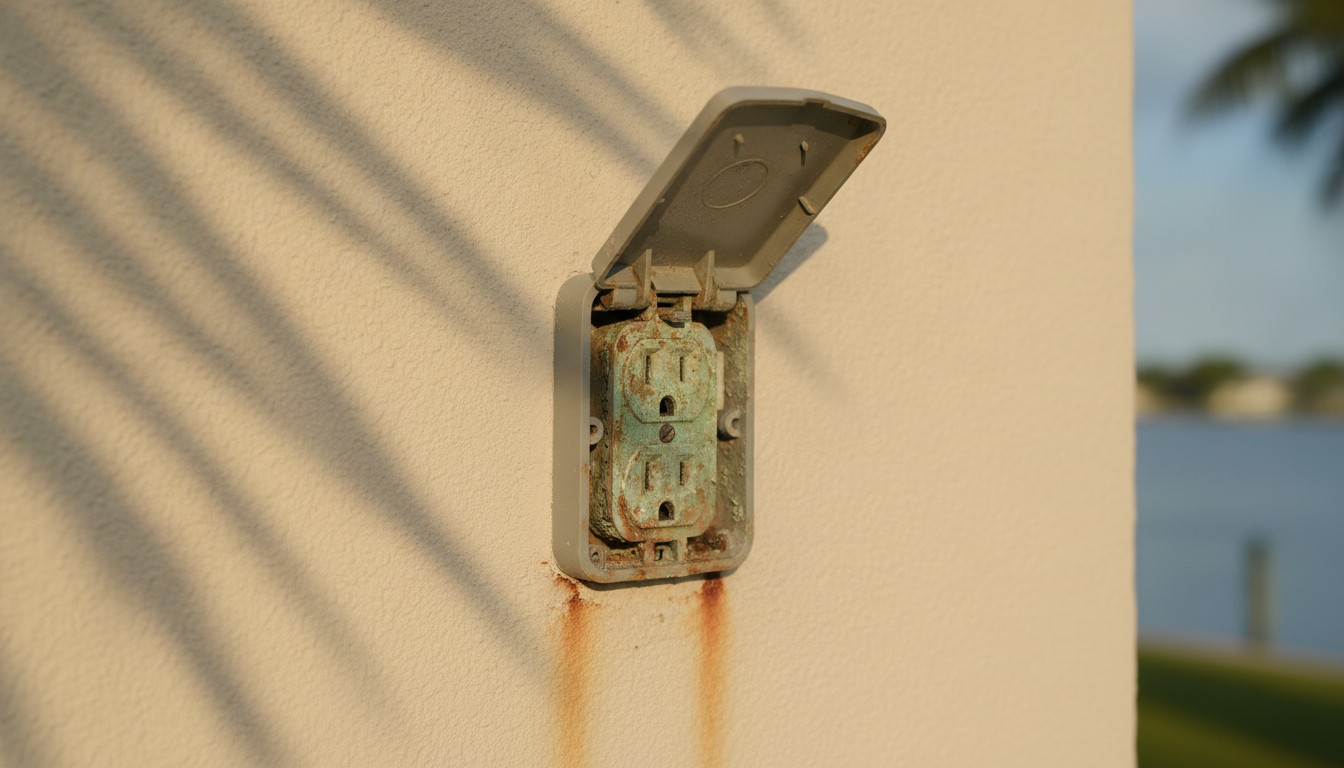
Corrosion on an outdoor outlet deserves more than a new cover. Moisture and contaminants can damage contacts, terminals, fasteners and protective components inside the assembly. That damage can contribute to poor connections, heat, arcing or loss of shock protection.
Do not touch or test an outlet that is wet, hot, cracked, buzzing, arcing or giving off a burning odor. Keep people away from the area and have a qualified electrician inspect it. If there is smoke or fire, leave the hazard area and contact emergency services.
Why outdoor outlets corrode
Outdoor electrical equipment faces moisture, sunlight and contaminants that indoor devices avoid. Salt carried through coastal air can add to that exposure near the water, but an address alone cannot reveal an outlet’s condition. The enclosure, cover, installation, drainage and direct exposure all matter.
Weather-resistant receptacles are built for these conditions. Testing under UL 498 evaluates weather-resistant devices for corrosion resistance, ultraviolet exposure, accelerated aging and cold impact. That listing does not make an outlet maintenance-free or repair damage that has already reached the wiring or box.
Properties in South Tampa, Davis Islands and inland communities should be evaluated by what is actually visible and measurable at the installation, not by a presumed neighborhood lifespan.
When corrosion becomes an electrical hazard
Surface staining on a cover and damage inside an energized connection are different problems. An electrician may need to examine the receptacle, terminals, conductors, box, gasket and cover to identify the affected parts.
Warning signs that call for prompt qualified inspection include:
- warmth or discoloration at the receptacle or cover
- buzzing, crackling or visible arcing
- a burning odor
- shocks or tingling
- repeated tripping
- cracking, missing cover parts or water inside the enclosure
- corrosion on the receptacle face, terminals or conductors
These symptoms do not establish one diagnosis. They can reflect damage at the device, its connections or another point on the circuit. See the broader signs of an electrical problem for other conditions that should not be dismissed.
A GFCI device can also fail to provide its intended protection. For a dry, undamaged device, a test is meaningful only if pressing TEST cuts power to a connected load. A button that moves or clicks while power remains on does not demonstrate protection. Do not attempt this check on equipment that is wet, visibly damaged, hot or producing other warning signs.
How to handle rust near a breaker panel
Rust near a panel should be judged by its location, cause and extent, not by a rule that every panel problem is automatically more urgent than every outlet problem. Exterior staining on an enclosure is different from moisture or corrosion affecting breakers, bus components, terminals or conductors.
Do not remove a panel cover or reach into wet or damaged equipment. Unexplained widespread flicker, buzzing, crackling, heat, arcing, burning odor, shocks or repeated trips call for prompt qualified inspection. Smoke or fire calls for leaving the hazard area and contacting emergency services.
An electrician can determine whether the problem is limited to an enclosure component, requires electrical repair or affects equipment covered by a panel upgrade evaluation.
What a compliant outdoor replacement needs
The correct replacement depends on the receptacle, circuit, exposure and rules adopted by the authority responsible for the property. A Tampa Bay mailing address does not by itself identify the permitting jurisdiction.
The 2020 NEC provisions relevant to this work include several important distinctions:
- NEC 406.9 applies the weather-resistant listing requirement to 15- and 20-ampere, 125- and 250-volt nonlocking receptacles in damp or wet locations. It should not be restated as a rule covering every outdoor receptacle of every rating.
- In a wet location, the enclosure must remain weatherproof whether or not a plug is inserted. When an outlet-box hood supplies that protection, NEC 406.9(B)(1) requires the hood to be listed and identified as extra duty. Other listed products, enclosures or assemblies that do not use an outlet-box hood are outside that marking rule.
- NEC 406.4(D) applies GFCI, tamper-resistant and weather-resistant replacement provisions where the location and device fall within their respective requirements. Replacing an old receptacle does not automatically preserve every feature of the old installation.
- GFCI protection may be provided upstream. A receptacle without its own TEST and RESET buttons is not proof that the location lacks GFCI protection.
The applicable jurisdiction and adopted rules should be confirmed for the actual property. For a closer explanation of location-based protection, see GFCI outlets: where Florida code requires them.
Is a screened lanai damp or wet?
A roofed open porch that is protected from direct weather is generally treated as a damp-location example under the 2020 NEC definitions. A receptacle there still needs equipment suitable for the exposure and a cover that provides the required protection when closed.
A location exposed to direct rain or washdown is a wet location and needs protection appropriate to that exposure, including an enclosure that remains weatherproof with a plug inserted. A covered or screened space is not automatically protected from wind-driven rain.
The classification depends on the actual installation. The local building department makes the final determination when the boundary is unclear. Equipment around pools also carries additional safety considerations, as discussed in pool light replacement.
Can a new cover fix a corroded outlet?
A cover cannot restore damaged contacts, terminals, conductors or a failed protective device. It may be possible to replace only a damaged cover when the receptacle, box and connections remain suitable, but that conclusion requires an inspection of the actual assembly.
The scope can expand when corrosion has reached the box or wiring, when the enclosure no longer keeps water out, or when the existing device and cover are not suitable for the exposure. A GFCI outlet installation may also involve checking whether protection is located at that receptacle or upstream on the circuit.
What changes the cost and scope of replacement?
No single Tampa price applies to every corroded outdoor outlet. A like-for-like replacement at an accessible, sound box is a different job from repairing deteriorated conductors or tracing a circuit whose protective device is elsewhere.
Useful scope questions include:
- Is the damage limited to the cover, or has it reached the receptacle, terminals, conductors or box?
- Is the location damp, wet or subject to direct washdown?
- Does the existing enclosure remain weatherproof for that exposure?
- Is GFCI protection provided at the receptacle, upstream or not at all?
- Is this an existing outlet replacement or a new outlet and circuit?
- Can the electrician reach the wiring without opening finished surfaces?
- Is corrosion also present at nearby disconnects, panels or other exterior equipment?
- Does the applicable jurisdiction require a permit or inspection for the actual scope?
These distinctions are more useful than an unseen flat estimate. The related GFCI outlet installation cost guide explains how device replacement, troubleshooting, access and circuit work differ without treating them as the same service.
How to reduce repeat damage
Match every component to its real exposure. The receptacle, enclosure, gasket and cover work as an assembly, so replacing one visible part does not correct water entry elsewhere.
An electrician can check for cracked covers, failed seals, unsuitable devices, damaged boxes and corrosion behind the receptacle. Where damage has reached the wiring, the job becomes electrical repair rather than a simple device swap. Similar exposure can also affect exterior connections used by landscape lighting, although those systems require their own diagnosis.
Frequently asked questions
Why does my outdoor outlet keep corroding?
Moisture, contaminants, direct weather, ultraviolet exposure and defects in the enclosure or cover can all contribute. Coastal salt exposure may add to those conditions, but the cause and extent need to be evaluated at the specific outlet.
Can I replace only the outdoor outlet cover?
Only when the receptacle, wiring, box and protective functions remain suitable. A new cover does not repair corrosion on contacts, terminals or conductors.
Does an outdoor replacement need GFCI protection?
Many residential outdoor receptacles fall within location-based GFCI requirements, and replacement rules can apply even when the old device lacked protection. The protection may be at the receptacle or upstream, so the circuit should be evaluated rather than judged from the faceplate alone.
Should I test a corroded GFCI outlet?
Do not touch or test it if it is wet, hot, cracked, arcing, buzzing or visibly damaged. For a dry and undamaged device, follow its instructions and confirm that the TEST function actually disconnects power from a connected load.
Do I need a permit for the replacement?
That depends on the work and the authority serving the property. A device replacement, new circuit and panel repair are different scopes. Confirm the jurisdiction from the property rather than relying only on the mailing address.
Get the damaged equipment evaluated
Tampa Electrical Pro connects Tampa Bay property owners with independent licensed and insured electricians. The selected electrician determines the diagnosis, repair scope, permitting needs, schedule and price.
Call (813) 850-0320 to request a connection. If the outlet is wet, hot, arcing, smoking or giving off a burning odor, keep away from it. For smoke or fire, leave the hazard area and contact emergency services.