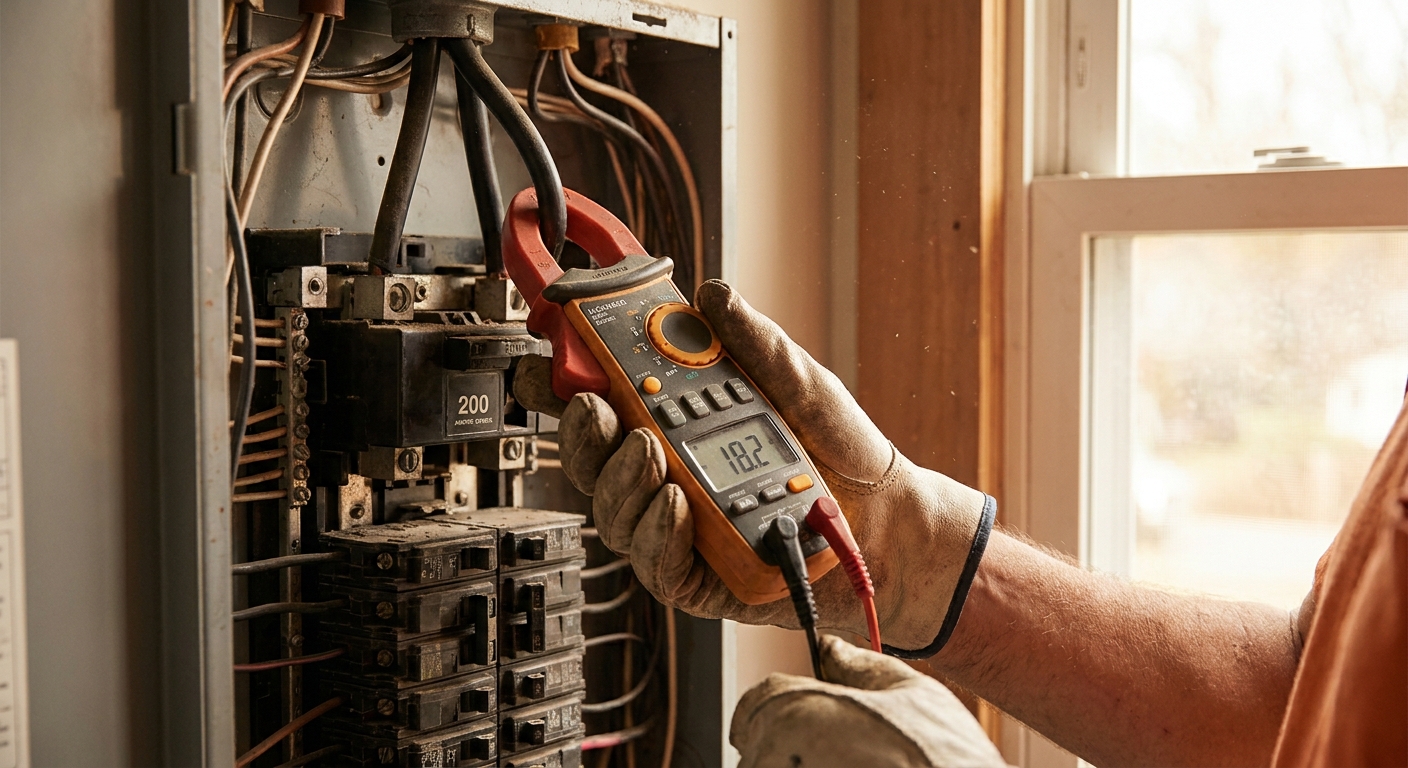
The right service size cannot be chosen from square footage, neighborhood, panel age, or the number of breaker spaces. An electrician needs to verify the existing service equipment, calculate the home’s electrical demand, and account for the loads you plan to add.
A 100-amp service is not automatically inadequate, and a 200-amp label does not guarantee room for another large circuit. The answer depends on the whole electrical system.
What an amperage rating tells you
Service amperage describes how much current the electrical service is designed to carry under its approved configuration. It is not a measurement of how much electricity the house is using at every moment.
The rating printed inside a panel can describe the panelboard’s maximum rating without proving the capacity of the complete service. A qualified electrician may need to verify the service conductors, meter equipment, main disconnect, panelboard, and other connected service components.
Adding together the numbers printed on all the branch-circuit breakers does not calculate the home’s demand. Those breakers protect individual circuits, and the circuits do not necessarily draw their maximum loads at the same time. A load calculation considers the actual system and the equipment being served.
How 100, 150, 200, and 400 amps differ
These ratings identify available service sizes, not fixed packages for particular types of homes.
100 amps may be adequate when the calculated demand fits within the existing service. It may become restrictive when substantial electric equipment is added, but the rating alone does not establish that an upgrade is necessary.
150 or 200 amps provides more service capacity, but neither rating guarantees support for every combination of air conditioning, water heating, cooking equipment, pool equipment, or vehicle charging. Existing demand and the proposed new load still have to be evaluated.
400 amps may be considered for a property with a calculated demand beyond a smaller service design. Square footage or the presence of several appliances does not establish that need by itself.
The goal is not to select the largest number. It is to identify a service design that fits the calculated load and the home’s realistic plans.
Capacity and breaker space are different problems
A panel can run out of physical breaker spaces while the service still has electrical capacity. In another home, open spaces may remain even though the calculated demand leaves no room for a proposed load.
A panel upgrade can involve replacing equipment, changing service capacity, or both. A panel may also need attention because of its condition or compatibility rather than its amperage.
A subpanel can provide additional circuit spaces, but it does not increase the capacity supplied by the utility. The load still passes through the existing service unless the service itself is changed.
Electrical symptoms need their own diagnosis
A breaker that trips does not automatically mean the entire service is undersized. The cause may involve the connected equipment, an individual circuit, a fault, or another condition that requires inspection. For example, a water-heater breaker that keeps tripping should be evaluated as its own electrical problem rather than treated as proof that the main service is too small.
Unexplained flickering or dimming, frequent trips, buzzing, crackling, hot or discolored plates, burning odors, or shocks call for prompt inspection by a qualified electrician. Do not remove panel covers or repeatedly reset a breaker to test a persistent fault. If there is smoke or fire, leave the hazard area and contact emergency services.
A fuse panel also does not reveal the home’s usable service capacity by itself. Its rating, condition, wiring, and connected loads have to be examined rather than inferred from its appearance or presumed installation date.
Evaluate planned loads before buying equipment
Large electrical additions should be considered before equipment is purchased or installation work begins.
For an EV charger, the vehicle, daily driving requirement, parked time, charging equipment, and available electrical capacity all affect the right approach. Level 1 charging can cover daily driving for some people when suitable dedicated power and enough parked time are available. Level 2 charging uses 240 volts and is a continuous electrical load.
A service upgrade is not automatic simply because a homeowner wants Level 2 charging. Depending on the verified load and charging need, the options may include a lower-power charging approach, an appropriately designed load-management system, or a service change. Timers, apps, and usage data on a smart charger do not by themselves prove that it manages the home’s service load.
Pool equipment and other planned electric loads should be evaluated in the same calculation. The electrical work associated with a pool also has safety requirements that are separate from the service-size question.
A standby generator supplies backup power during an outage. It does not add utility load merely by being installed. The electrician instead evaluates which existing loads will receive backup power, the transfer equipment, and the isolation between the generator and the utility.
What changes the scope of a service project
The work can differ substantially from one property to another. Important distinctions include:
- whether the project needs more circuit spaces, greater service capacity, replacement of deteriorated equipment, or a combination of those changes
- the verified ratings and condition of the panelboard, main disconnect, service conductors, and meter equipment
- the calculated existing demand and the specifications of the equipment being added
- access to the service equipment and the route required for new circuits or conductors
- whether utility coordination, permitting, or inspection applies to the property’s jurisdiction and final scope
The selected contractor determines the installation method, permitting responsibilities, schedule, and price after evaluating the property. Tampa Electrical Pro can connect homeowners with independent licensed and insured electricians who serve Tampa Bay.
Start with the actual electrical system
Before committing to an EV charger, pool project, electric water heater, range, or other substantial load, have the existing service and proposed equipment evaluated together. That separates three different questions: whether the panel has room for another breaker, whether the service has capacity for the load, and whether any existing equipment needs replacement for another reason.
That evaluation gives the homeowner a defensible plan instead of a recommendation based only on the number printed on the panel door.