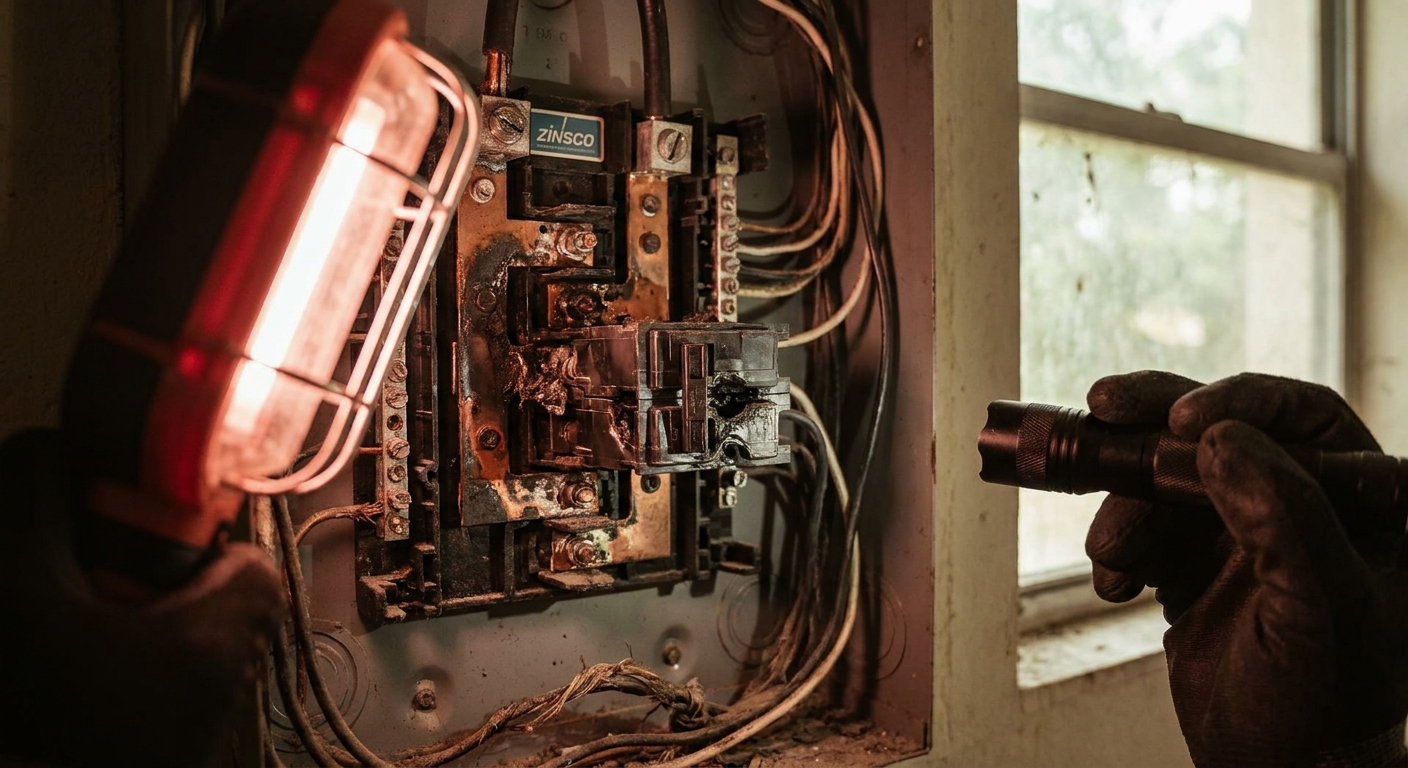
A Zinsco or Sylvania-Zinsco label identifies the panel family, but it doesn’t establish the condition of the equipment. The useful next step is a qualified inspection of the exact panel, its breakers, its connections, and the electrical demands of the home. You don’t need to remove a cover or touch anything inside the panel to start that process.
Why a panel connection can fail
A circuit breaker is meant to interrupt current when specified electrical conditions occur. The panel bus distributes power to the installed breakers. This site already treats Zinsco equipment as documented for breakers that fail to trip during an overload. Zinsco is out of business, and replacement breakers are increasingly hard to source. Damage, overheating, arcing, corrosion, poor contact, or an incompatible component can also interfere with how that assembly performs.
Those conditions can’t be confirmed from a brand name or a photo of the closed panel alone. The electrician still has to inspect the actual panel. Don’t investigate by removing the dead front or trying to move a breaker. A licensed electrician can evaluate the equipment under appropriate safety procedures and determine whether a compatible repair is available or panel replacement is the appropriate recommendation.
How to identify a Zinsco panel safely
Start with labels you can read without removing any cover. Depending on the installation, the accessible door or enclosure label may show Zinsco or Sylvania-Zinsco. Some panels have colored breaker handles, but color by itself isn’t reliable identification.
Record the wording on the accessible label and take a photo from a safe distance if the area is dry and undamaged. Don’t loosen screws, remove the dead front, touch breakers that appear damaged, or reach into the enclosure. If the label is missing or unclear, an electrician can identify the manufacturer and model during an electrical evaluation.
The same condition-based evaluation applies throughout the service area, including properties in St. Petersburg. A neighborhood, construction date, or architectural style doesn’t prove that a home contains a particular panel.
What an electrician should evaluate
The assessment should focus on the equipment that’s actually present, including:
- The manufacturer and model information on the panel label
- Whether the installed breakers are permitted for that panel
- Signs of heat, discoloration, arcing, corrosion, moisture, or physical damage
- The condition of the bus, breaker connections, enclosure, service conductors, and grounding and bonding components
- The home’s present loads and any planned additions
- Whether suitable listed components are available for the required work
A breaker that physically fits isn’t automatically compatible. The panel labeling and the component’s listing determine what may be installed.
Repair, panel replacement, and service upgrades are different decisions
A component repair, panel replacement, and electrical service upgrade aren’t interchangeable.
A repair addresses a specific correctable condition with a suitable component. A panel replacement changes the distribution equipment and may keep the existing service capacity when the evaluated load and service equipment support that choice. A service upgrade changes the available service capacity and can involve additional equipment and coordination.
Running out of breaker spaces doesn’t prove that the service lacks capacity. A subpanel can add circuit spaces, but it doesn’t increase the utility service capacity. Actual loads, equipment condition, planned circuits, and the service configuration determine which option fits the property.
Replacement may be recommended when damage affects the bus or enclosure, installed components aren’t compatible, or a suitable listed repair isn’t available. That recommendation should come from the observed condition of the panel, not from a blanket claim that every panel bearing the same name has failed.
Insurance and property transactions
An insurer, buyer, lender, or inspector may ask for information about the electrical panel. Their requirements can differ, so ask the requesting party exactly what documentation or corrective work it wants. Don’t assume that a particular label automatically produces the same decision from every carrier.
If a 4-point inspection is part of the transaction, review the actual report and follow up on the electrical findings it records. The inspection request and the electrician’s repair recommendation serve different purposes.
What changes the project scope
The work can vary substantially between replacing distribution equipment in place and changing service equipment or capacity. Relevant scope factors include:
- The condition and location of the existing enclosure
- Damage to the bus, conductors, or connected equipment
- Whether the service equipment is separate from or combined with the panel
- Grounding and bonding corrections identified during evaluation
- Access for routing or replacing conductors
- The home’s calculated load and planned electrical additions
- Utility isolation, permitting, and inspection steps that apply to the property
The selected contractor determines the project scope, scheduling, permits, workmanship, and price after evaluating the installation.
What to do if the panel appears damaged
Burning odor, buzzing or crackling, heat, discoloration, shocks, repeated tripping, visible arcing, or melted components call for prompt qualified inspection. Don’t remove the cover, force a breaker, repeatedly reset a fault, or touch a wet or damaged panel.
If there’s smoke or fire, leave the hazard area and contact emergency services. A generic article can’t determine from a symptom alone which component failed or whether the hazard is confined to the panel.
Zinsco and Federal Pacific require separate evaluations
Zinsco and Federal Pacific are different equipment families. A homeowner doesn’t need to rank one against the other. The practical question is whether the specific panel has damage, incompatible components, or another condition that calls for repair or replacement.
Call (813) 850-0320 to have Tampa Electrical Pro connect you with an independent licensed and insured electrician. The electrician will identify the equipment, evaluate its condition, and explain the options supported by the installation.