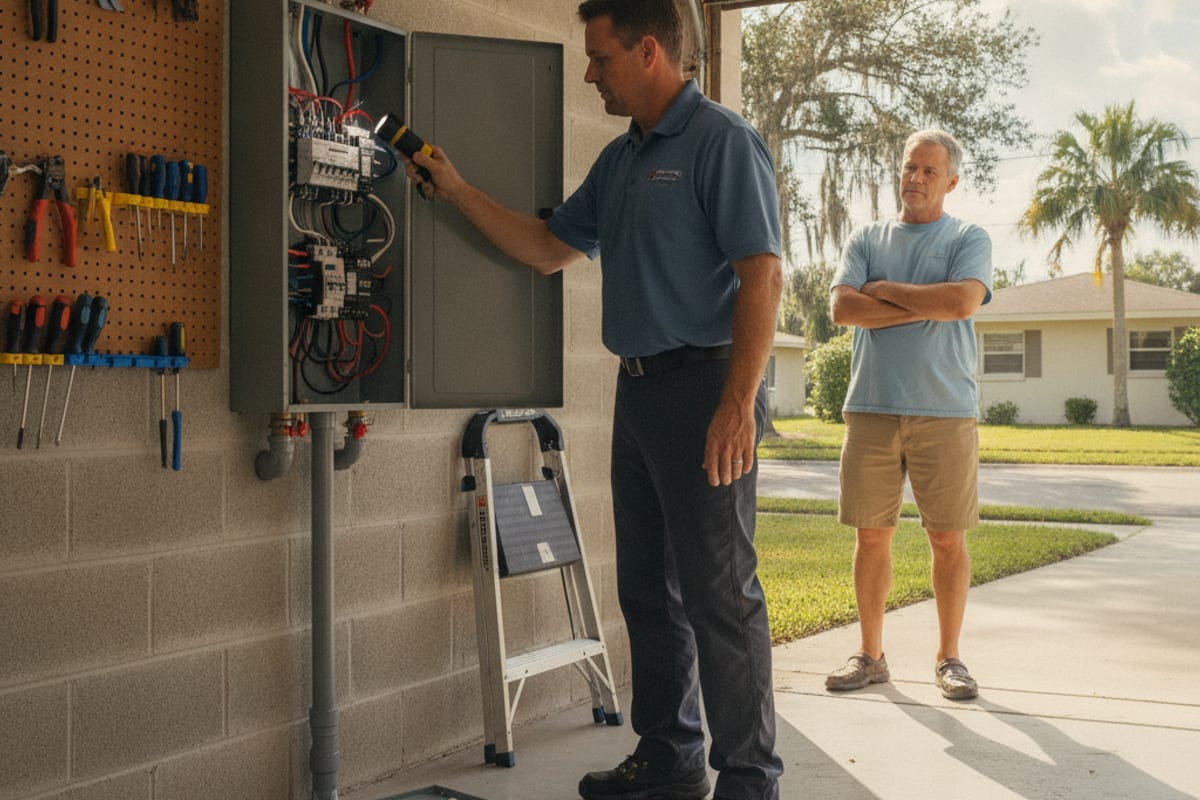
An electrical assessment, diagnostic visit, and Florida four-point inspection are different services. Their prices depend on who performs the work, what documentation is required, how much testing is needed, and whether the visit leads to repairs. Before scheduling, identify which service your insurer, buyer, seller, or electrician actually needs.
Tampa Electrical Pro refers Tampa Bay property owners to independent licensed and insured electricians. The selected contractor determines scheduling, inspection scope, repair recommendations, permits, and pricing.
Which type of inspection do you need?
An electrician may be asked to evaluate a panel, investigate a symptom, review electrical items before a purchase, or document corrections after an insurance inspection. A four-point inspection has a different purpose: it records information about the roof, electrical system, HVAC, and plumbing for an insurance company.
Those requests involve different professionals and deliverables:
| Request | What it helps establish | What affects the scope |
|---|---|---|
| Electrical assessment | The visible condition and configuration of specific electrical equipment | Equipment involved, access, documentation, and requested testing |
| Diagnostic visit | The cause and extent of an active electrical problem | Symptom location, recurrence, circuit tracing, and testing required |
| Pre-purchase electrical review | Electrical concerns beyond the general home inspection | Number of panels, accessible wiring, observed conditions, and requested documentation |
| Four-point inspection | Information requested by an insurer about four major home systems | The insurer’s current form, property conditions, and the eligible inspector’s service |
| Correction documentation | Evidence describing completed electrical work | The original finding, repair scope, permits when applicable, and the recipient’s documentation rules |
Ask what the quoted service includes. A visual assessment, diagnostic testing, written report, photographs, permit research, and repair proposal should not be assumed to be the same product.
What affects the cost of an electrical assessment?
This site’s published range for an electrician diagnostic visit, including electrical repair diagnosis, is $150 to $450. That is the electrician-assessment figure, not a four-point inspection price. Tampa Electrical Pro has no published four-point price. A four-point fee is set by the inspector or the insurer’s form, so those two products cannot be compared as one number.
A focused assessment of one accessible panel is different from tracing an intermittent problem through several circuits. Useful questions to ask when scheduling include:
- Is the request limited to the main panel, or does it include additional panels and accessible wiring?
- Is there an active symptom that requires diagnostic testing?
- Does a buyer, insurer, or property manager require photographs or a written report?
- Are panel labels, equipment model information, or records from prior work available?
- Is the electrician being asked only to assess the condition, or also to prepare a repair scope?
Company policies vary, so confirm whether the assessment has a visit fee and whether that fee includes documentation or diagnostic work. Tampa Electrical Pro does not set the selected electrician’s price.
How is a four-point inspection different?
A four-point inspection is an insurance document covering the roof, electrical system, HVAC, and plumbing. It is not simply a panel check performed for a repair estimate.
For a Citizens four-point inspection, a licensed electrician may complete the electrical section, but the electrician working only within that trade does not complete the entire four-system report. The full report must satisfy the insurer’s current form and signer requirements. Our guide to the electrical portion of a four-point inspection explains that division of responsibility.
Before paying for an inspection or repair, ask the insurer or agent:
- Which current form must be submitted?
- Do they need a complete four-point report or documentation for one electrical correction?
- Who may sign the required section or final report?
- Are photographs, permits, invoices, or other records requested?
The insurer decides whether the submitted documentation meets its requirements. An electrician can describe observed electrical conditions and completed electrical work, but cannot guarantee an insurance decision.
What if the electrical section is flagged?
The finding, not the inspection alone, determines the repair scope. A problem at one breaker termination is not automatically equivalent to a panel replacement. Likewise, a crowded panel does not by itself prove that the property’s electrical service must be upgraded.
An electrician should evaluate separately:
- The condition and compatibility of the existing equipment
- The specific connection, breaker, or circuit identified in the report
- Whether usable circuit space is available
- Whether additional circuit space could address the project
- Whether the electrical service has adequate capacity for proposed loads
- Whether wiring defects extend beyond the originally flagged location
- Whether the authority for the property requires a permit for the correction
A subpanel can provide additional circuit spaces, but it does not increase the capacity of the electrical service. Equipment replacement, additional circuit space, and a service-capacity change are separate decisions.
If the finding concerns the panel, see the panel upgrade guide for the questions that shape that work. If the report identifies aluminum branch-circuit wiring, the next step is a complete connection inventory and a qualified repair plan based on the actual conductors, connections, and equipment. The rewiring guide explains the broader scope considerations.
Does a pre-purchase electrical review have a standard price?
No single price or free-service policy applies to every electrician. Start by deciding what you need beyond the general home inspection.
A buyer may want clarification about the panel, an observed wiring condition, available circuit space, or the electrical implications of planned equipment. A targeted review may be narrower than troubleshooting an active fault, while a written assessment covering several areas may require more work than a quick visual visit.
Ask whether the electrician will provide verbal observations, photographs, or written findings. If a concern may affect the purchase, confirm with the appropriate real estate, insurance, or lending professional what documentation they will accept.
When does an inspection become diagnostic work?
A general assessment describes visible conditions. Diagnostic work investigates why something is happening. Flickering or dimming, hot or discolored plates, buzzing or crackling, a burning odor, shocks, and frequent breaker trips call for prompt inspection by a qualified electrician.
Do not remove panel covers, reach into electrical equipment, or repeatedly reset a breaker that continues to trip. If there is smoke or fire, leave the hazard area and contact emergency services. The electrical repair page explains how electricians approach fault investigation, while the emergency electrical service page covers situations needing immediate attention.
The cost of diagnostic work depends on the testing and access needed to locate the problem. A visible symptom does not establish the cause, and a generic description cannot determine whether the repair is confined to one device or involves a larger part of the system.
What records should you prepare?
Clear access and relevant records help the electrician understand the request. Before the visit:
- Remove stored items that block safe access to the panel without opening or touching the equipment.
- Keep the insurer’s current request or inspection report available.
- Gather permits, invoices, photographs, and other records from prior electrical work if they exist.
- Note where a symptom occurs, what was operating at the time, and whether it has happened more than once.
- Have equipment labels or model information available when the concern involves a specific appliance or planned installation.
Missing paperwork does not prove that a repair was never completed. It may, however, mean the electrician or insurer needs other evidence to identify the present condition and determine what documentation is acceptable.
Does the neighborhood predict what an inspection will find?
No. A Tampa Bay neighborhood, the apparent age of a house, or its distance from the coast does not establish which panel, wiring method, or electrical defect is present. The electrician must identify the actual equipment and observed conditions at the property.
This applies in St. Petersburg, Seminole Heights, Gulfport, and throughout the service area. Property-specific evidence should guide the assessment and any repair recommendation.
Frequently asked questions
Is an electrician’s panel assessment the same as a four-point inspection?
No. A panel assessment focuses on electrical equipment and the reason for the visit. A four-point inspection documents the roof, electrical system, HVAC, and plumbing for an insurer.
Can an electrician complete the entire Citizens four-point report?
An electrician working in that trade may complete the electrical section. The complete four-system report must meet Citizens’ current form and eligible-signer requirements.
Is a panel assessment free?
Do not assume it is. Fees and inclusions vary by company. Ask whether the visit includes only a visual assessment or also diagnostic testing, photographs, or written documentation.
Does a flagged panel always need replacement?
No. The electrician must identify the actual condition and separate equipment condition, circuit space, and service capacity. A specific connection correction, panel replacement, subpanel, and service-capacity change are different scopes.
Can an electrician guarantee that an insurer will accept a correction?
No. The electrician can document the electrical condition and completed work. The insurer determines whether that documentation satisfies its requirements.
Arrange the right electrical assessment
Start with the document or concern that prompted the request. Tampa Electrical Pro can connect you with an independent licensed and insured electrician who can evaluate the electrical scope and explain the available next steps. Call (813) 850-0320 to request a referral.