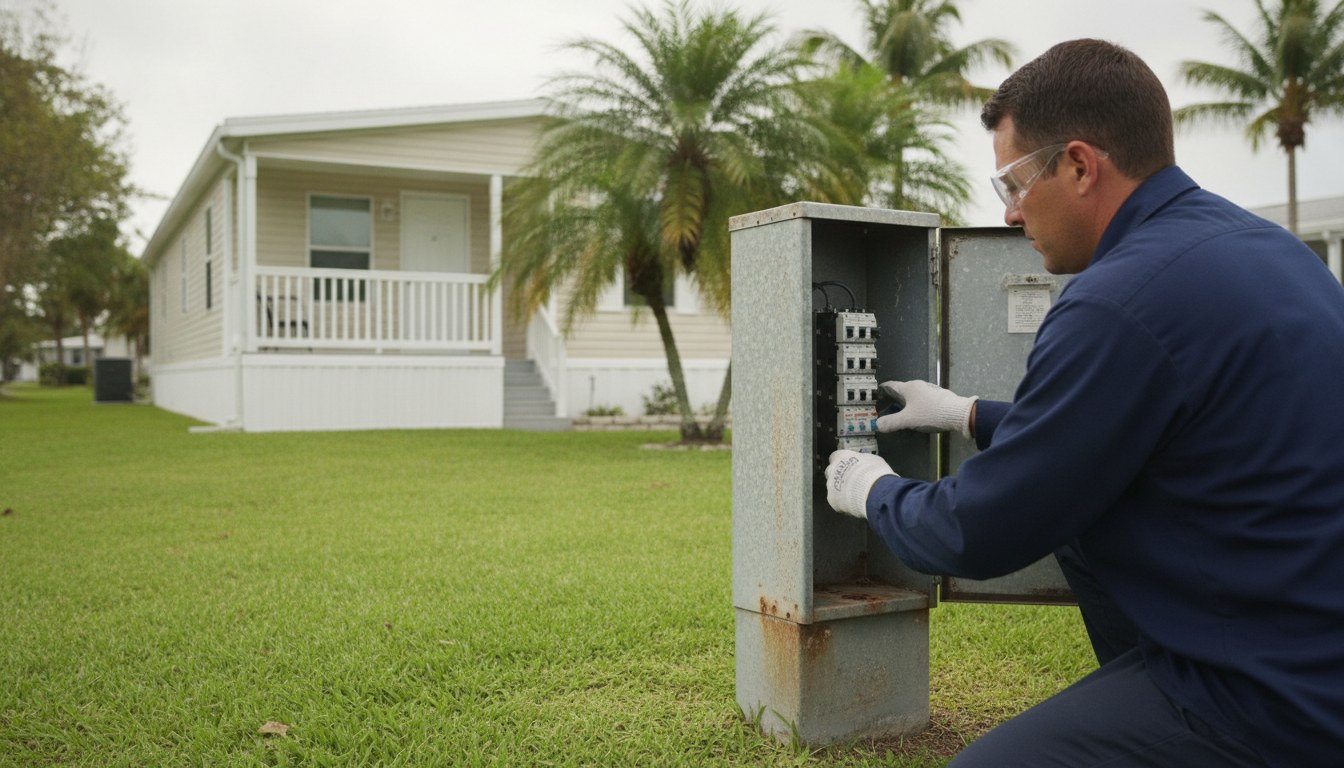
A manufactured home’s electrical system sits across two areas of responsibility. Federal HUD standards govern the home’s construction, including electrical equipment installed within or on the home and the conductors connecting it to a power supply. The pedestal, utility connection, permits, placement and other site work involve Florida and the authority responsible for the property.
That distinction affects how an electrician evaluates the supply, feeder, panel, grounding and neutral. It also explains why the person licensed to install the home generally can’t complete its electrical hookup in Florida.
Why is manufactured-home electrical different?
A site-built Tampa Bay house is constructed under the building requirements that apply at its location. A manufactured home is constructed under HUD’s federal Manufactured Home Construction and Safety Standards.
Under 24 CFR 3282.11, a state can’t impose a different manufactured-home construction or safety standard on an aspect governed by the federal standards. That preemption applies to the home’s covered construction and safety standards. It doesn’t eliminate state or local authority over matters such as permits, placement, anchoring and the site connection.
The practical question is therefore not simply whether an item is inside or outside the walls. An electrician must identify whether the work involves:
- Factory-installed equipment within or on the manufactured home
- The cord or feeder connecting the home to its electrical supply
- Service equipment mounted on the home under an allowed configuration
- A pedestal, disconnect or other site-side equipment
- A later alteration or repair that must be evaluated under the rules applicable to that work
The property jurisdiction and actual scope determine which permit office and review process apply. A mailing address alone may not identify the correct authority.
What does the HUD label establish?
For manufactured homes built in the United States after June 15, 1976, each transportable section must contain a manufacturer’s certification label. The exterior label is commonly called the HUD tag or red certification label.
The label certifies that the section was built in accordance with HUD’s Manufactured Home Construction and Safety Standards. A multi-section home should have a label for each transportable section.
The label does not prove that the present pedestal, feeder, panel or later electrical alterations are compliant or in good condition. Those items must be evaluated as they exist today.
A home built before June 15, 1976 falls outside that original post-date certification-label requirement. Its age alone does not identify what electrical work has occurred since construction or establish whether the current installation is safe. The label, available records and installed equipment should be considered separately.
Where does the federal electrical standard end?
The federal electrical subpart reaches farther than the home’s interior. Under 24 CFR 3280.801(a), it covers electrical conductors and equipment installed within or on the home, along with the conductors that connect the home to its electrical supply.
That means the cord or permanent feeder is part of the federal discussion. The pedestal or other site service equipment must also be evaluated under the requirements that apply to the property and the specific installation.
This boundary matters when planning a repair. A damaged receptacle, a feeder problem, a failing pedestal and a panel defect are different scopes even when they produce similar symptoms inside the home. An electrical repair assessment should locate the affected part of the system before anyone assumes that the panel or entire service needs replacement.
Why are neutral and grounding paths important?
Under 24 CFR 3280.809, the grounding bus in a manufactured home’s distribution panel is connected through the grounding conductor in the supply cord or feeder wiring to the service ground. The home’s frame and appliance frames are not connected to the neutral conductor.
The neutral is normally kept insulated from grounding conductors, equipment enclosures and other grounded parts within the home. There is a specific exception: when service equipment is installed on the manufactured home, the neutral and ground bus may be connected in the distribution panel.
That exception is why the panel’s role must be identified before judging a neutral-to-ground connection. A panel supplied as downstream distribution equipment isn’t evaluated the same way as service equipment installed on the home. A qualified electrician can trace the supply and determine which configuration is present without relying on the panel’s appearance alone.
The chassis is also bonded to the distribution panel’s grounding terminal. The federal rule specifies a bonding conductor of at least No. 8 copper or an equal conductor between each distribution panelboard and an accessible terminal on the chassis. This bond places the chassis on the grounding path back to the service ground. It isn’t a separate path to earth.
These connections belong inside a professional inspection. Covers, bonding components and conductors shouldn’t be altered as a homeowner test.
What is the difference between the pedestal, feeder and panel?
The pedestal is site-side equipment that supplies the home. The feeder is the cord or permanently installed wiring that carries power from the supply to the home. The distribution panel divides that supply among the home’s branch circuits.
A problem in one part does not automatically require replacing all three:
- Pedestal work may involve the enclosure, disconnect, grounding arrangement, weather exposure or the connection point supplying the feeder.
- Feeder work depends on whether the home uses a listed cord or permanent wiring, along with its condition, route and compatibility with the installed equipment.
- Panel work depends on the panel’s condition, equipment compatibility, neutral and grounding arrangement, branch circuits and available circuit space.
- A branch-circuit problem may be limited to wiring, a protective device, a receptacle or connected equipment rather than the main supply.
An RV outlet or pedestal on the same property is separate equipment serving a different use. Its presence does not identify how the manufactured home itself is supplied.
Service capacity, circuit space and panel condition are also separate questions. A panel can run out of usable spaces without proving that the service lacks capacity. A subpanel may add circuit spaces, but it does not increase the electrical service capacity. Major additions require evaluation of the actual loads and supply, not a decision based only on the number printed on the panel or the number of occupied breaker positions.
How is a cord-supplied home connected?
Under 24 CFR 3280.803, the power supply may be a listed manufactured-home power supply cord or a permanently installed circuit. That section has an exception for manufactured homes with more than one independent dwelling unit. The exception covers multiple independent dwelling units, not a single dwelling built from more than one transportable section, so an ordinary double-wide or other multi-section home is not excluded on that basis. The standard permits one listed 50-ampere cord. A home factory-equipped with gas- or oil-fired heating equipment and cooking appliances may instead use a listed 40-ampere cord.
The cord has four conductors. One is identified continuously in green, or green with one or more yellow stripes, for grounding. The cord is marked for manufactured-home use with its applicable rating.
The federal standard also sets the cord’s dimensions. Overall length must be at least 21 feet and no more than 36 1/2 feet, with at least 20 feet measured from the face of the plug cap to the point where the cord enters the home.
Those details apply to the cord configuration described by the rule. They should not be carried over automatically to a permanent feeder or service equipment mounted on the home.
What changes when the home has a permanent feeder?
When the calculated load exceeds 50 amperes, or when a permanent feeder is used instead of a cord, 24 CFR 3280.803 describes three supply methods:
- A mast weatherhead arrangement containing four continuous, insulated and color-coded feeder conductors, including an equipment grounding conductor
- A listed metal raceway or rigid nonmetallic conduit running from the home’s disconnect to the underside of the home
- Service equipment installed in or on the manufactured home under the rule’s stated conditions
The conduit provision does not eliminate the grounding path. The federal grounding rule still requires the home’s grounding bus to connect through the feeder wiring to the service ground when the home is feeder-supplied, and the neutral-isolation requirements still apply. The conductors, raceway, equipment instructions and complete installation must be evaluated together.
The third method is also the condition that may change where the neutral and ground are connected. An electrician must first verify that the equipment on the home is actually service equipment and that the installation meets the applicable conditions. A panel mounted on the home should not be treated as service equipment based on location alone.
Who may connect a manufactured home in Florida?
Florida’s Department of Highway Safety and Motor Vehicles draws a clear line in its Mobile Home Installer FAQ. A licensed mobile home installer may install electrical crossovers on a multi-section home. Other electrical work on the home must be performed by a licensed electrician.
The same FAQ says a licensed installer may connect plumbing as part of the installation process. That permission does not extend to the main electrical hookup beyond the crossover exception.
Before scheduling a connection or relocation, ask who is responsible for the pedestal, feeder, electrical crossover and final hookup. Those may be separate parts of the project. The contractor’s active license, authorized scope and applicable jurisdiction should match the work being performed. See choosing a licensed electrician in Tampa for practical vetting questions.
What determines repair or replacement scope?
There is no single manufactured-home electrical price that applies to every Tampa Bay property. The selected contractor determines pricing after identifying what equipment and work are actually involved.
Useful scope questions include:
- Is the problem at the site pedestal, feeder, distribution panel or a branch circuit?
- Does the home use a listed cord, a permanent feeder or service equipment mounted on the home?
- Is the existing equipment damaged, overheated, corroded or incompatible with the required configuration?
- Is the neutral isolated where required, and is the grounding path complete?
- Does the work change the calculated load or only restore existing equipment?
- Will the feeder route, access or site equipment also need work?
- Which authority has jurisdiction over the property, and what review applies to this scope?
A panel upgrade is not interchangeable with a pedestal or feeder replacement. Likewise, replacing site equipment does not by itself correct defects in the home’s distribution panel or branch circuits. A useful proposal should identify each affected component rather than grouping the entire electrical system under one line item.
When should the system be inspected promptly?
Unexplained flickering or dimming, hot or discolored plates, buzzing or crackling, a burning odor, shocks and frequent breaker trips call for prompt inspection by a qualified electrician. These symptoms do not identify one specific cause from a distance.
Do not repeatedly reset a breaker that continues to trip, open a panel, approach damaged or wet electrical equipment, or alter neutral and grounding connections to test them. If there is smoke or fire, leave the hazard area and contact emergency services.
Frequently asked questions
Are manufactured homes covered by the same construction code as site-built houses?
No. The manufactured home’s covered construction and safety standards are federal. Site permits, placement, anchoring and electrical supply work still involve Florida and the local authority responsible for the property.
Does a HUD label prove the electrical system is currently compliant?
No. It certifies that the labeled section was built to HUD’s manufactured-home standards. It does not establish the present condition of the pedestal, feeder, panel or later alterations.
Can the neutral and ground be connected in the home’s panel?
They are normally isolated in the manufactured home’s distribution panel. The federal rule allows them to be connected there when service equipment is installed on the manufactured home. An electrician must identify the panel’s actual role before deciding whether the connection is correct.
Does every manufactured home use a four-wire cord?
No. A cord-supplied home uses the four-conductor cord described by the federal standard. A home may instead have a permanent feeder or qualifying service equipment installed on the home. Those configurations still require the correct grounding and neutral arrangement.
Can a mobile home installer complete the electrical hookup in Florida?
Only in a limited respect. A licensed installer may install electrical crossovers on a multi-section home. Florida’s installer guidance says other electrical work must be done by a licensed electrician.
What does a pre-1976 home require?
The post-June 15, 1976 HUD certification-label requirement does not establish how an earlier home was originally regulated or what has been changed since. The current equipment, supply method, records and condition need to be evaluated directly.
Request a manufactured-home electrical referral
Tampa Electrical Pro connects Tampa Bay property owners with independent licensed and insured electricians. The selected contractor determines the inspection findings, work scope, permitting responsibilities, schedule and price.
Call (813) 850-0320 to request help with a manufactured-home pedestal, feeder, panel or electrical connection.