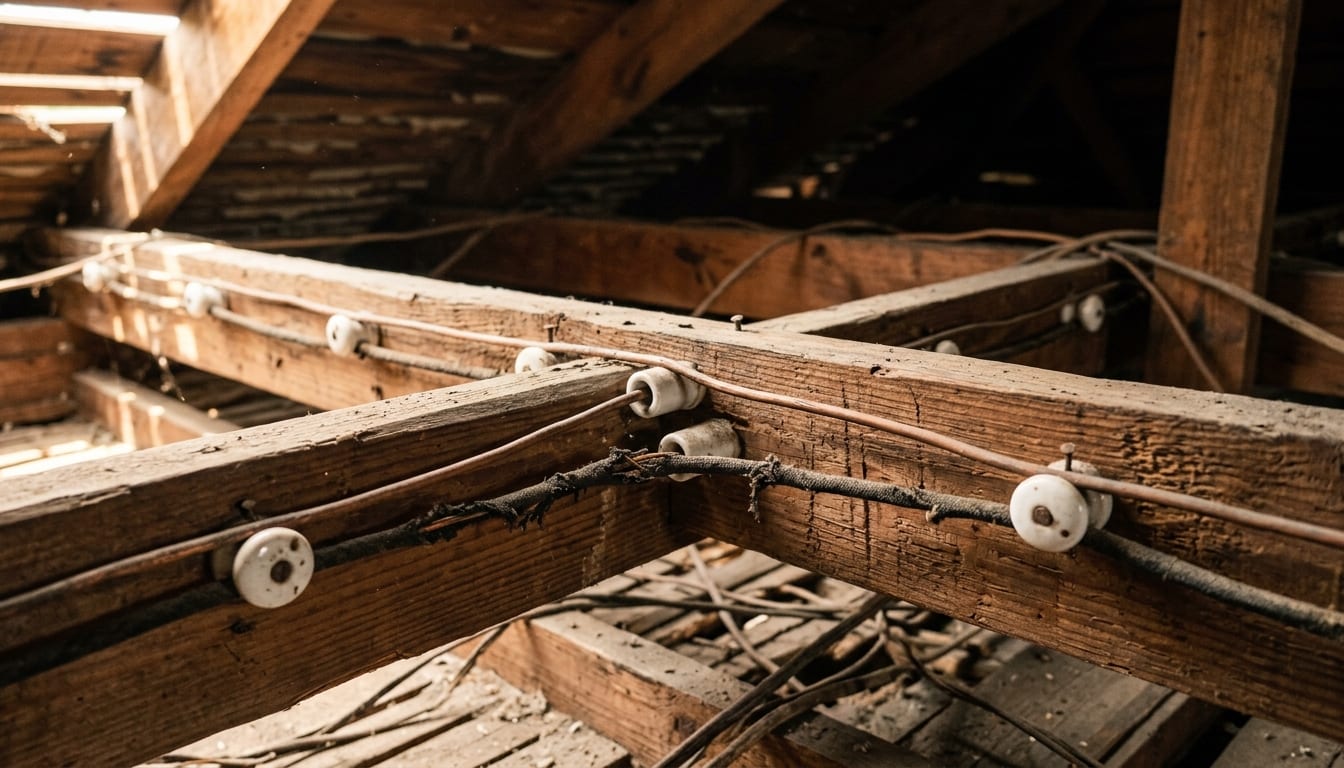
Knob-and-tube wiring uses separate hot and neutral conductors supported by ceramic knobs and protected by ceramic tubes where the wires pass through framing. It does not include an equipment grounding conductor.
Finding this wiring does not answer every safety, repair, insurance, or code question by itself. Its condition, later modifications, whether it remains energized, and whether surrounding insulation envelops the conductors all matter. A qualified electrician needs to identify the active circuits and inspect accessible connections before recommending repair or replacement.
What knob-and-tube wiring looks like
The recognizable parts are individual conductors rather than a single sheathed cable. Ceramic knobs support the wires along framing, while short ceramic tubes protect them as they pass through wood members.
Do not enter a tight attic or crawl space, move insulation, or touch old conductors to identify the system. An inspection report or photographs taken from a safely accessible area can help an electrician prepare, but they cannot establish whether a circuit is energized or sound. That requires appropriate testing without disturbing the wiring.
A home’s age or neighborhood is not proof that it contains knob-and-tube wiring. Previous owners may have replaced all, part, or none of the original system. The actual circuit paths and connections determine the scope.
Can existing knob-and-tube wiring remain in service?
There is no responsible yes-or-no answer based only on the wiring type. The applicable requirements depend on the installation, its present condition, alterations made over time, the surrounding materials, and the authority reviewing the work.
An electrician may find intact sections, abandoned sections, concealed splices, damaged conductor covering, or newer cables connected to older circuits. Those are different conditions and should not be grouped under a blanket claim that all existing knob-and-tube wiring is acceptable or that all of it must immediately be removed.
A panel replacement also does not correct the branch wiring inside the house. Conversely, finding knob-and-tube wiring does not prove that a panel upgrade is required. Panel condition, circuit space, service capacity, and branch-circuit condition are separate questions that should be evaluated separately.
Why insulation around the wiring matters
Knob-and-tube wiring was installed with open space around its individual conductors. Covering those live conductors with building insulation is a different condition from leaving that open space intact.
A June 2024 U.S. Department of Energy professional weatherization job aid tells crews to identify live knob-and-tube wiring before insulating an attic and to arrange separation where possible or replacement. That’s professional preparation guidance, not homeowner electrical work and not a Florida code citation.
It does not mean every piece of insulation anywhere in a home creates the same condition. The electrician and insulation contractor need to know where active conductors run and whether the proposed material would surround them. Do not move insulation or expose wiring yourself to make that determination.
When active knob-and-tube circuits cross an area planned for insulation, the electrical work should be resolved before the insulation covers the area. The options depend on the actual layout and may include replacing affected circuit sections, rerouting new wiring, or confirming that old conductors have been properly disconnected and abandoned. An electrical repair electrician can define the electrical scope before the insulation work begins.
Wire covering and building insulation are different
The word “insulation” describes two different materials in this discussion.
The first is the covering directly around each electrical conductor. That covering separates the conductor from surrounding materials. Its condition can vary along a circuit, especially near connections or areas altered after the original installation.
The second is building insulation placed in an attic, ceiling, or wall to control heat transfer. That surrounding material, not the conductor covering, is what the DOE attic-preparation guidance is addressing when live knob-and-tube wiring is in the work area.
An intact conductor covering does not make it acceptable to bury an active knob-and-tube circuit in building insulation. Likewise, seeing building insulation near one location does not reveal the condition or route of the entire circuit. Both questions require an inspection of the actual installation.
What warning signs need prompt attention?
Knob-and-tube wiring should not be declared safe or unsafe from age alone. Observable electrical symptoms provide more useful information.
Buzzing or crackling, a burning odor, shocks, hot or discolored plates, unexplained flickering, or breakers that repeatedly trip call for prompt inspection by a qualified electrician. Do not keep resetting a breaker or disturb wiring to search for the fault. The Electrical Safety Foundation International identifies these as electrical warning signs that should not be dismissed.
If there is smoke or fire, leave the hazard area and contact emergency services. Do not approach wet, damaged, or exposed electrical equipment.
How an inspection finding differs from an insurance decision
An electrical inspection records observable conditions for the form and version being used. An insurer then applies its own underwriting requirements. Those are separate decisions.
Citizens is one insurer, and its form should not be described as the universal Florida inspection form. If a policy application or renewal requires a 4-point inspection, ask the inspector which form and version will be completed. Then ask the agent or carrier how an active knob-and-tube finding will be evaluated. Do not assume that another carrier will reach the same result or that an electrical repair automatically satisfies a particular underwriting rule.
Our guide to the electrical portion of a 4-point inspection explains why the condition documented by an inspector and the decision made by an insurer should be treated separately.
Partial replacement versus a full rewire
The useful starting point is a circuit inventory. An electrician needs to determine which circuits remain active, what they serve, where newer wiring begins, whether accessible connections are sound, and how the wiring passes through finished areas.
A partial replacement can be practical when affected circuits can be isolated and new routes are accessible. It leaves any remaining original circuits in place, so the electrician should identify exactly what the completed scope will and will not address.
A broader rewire may make more sense when knob-and-tube circuits serve several areas, connections are difficult to isolate, planned insulation affects multiple routes, or renovation work already provides access. Wall and ceiling access, finish protection, circuit mapping, and the amount of newer wiring already present all change the work. Our house rewiring guide covers those scope factors in more detail without treating one house as a template for another.
Knob-and-tube wiring is also different from aluminum branch wiring. Aluminum branch-circuit remediation focuses on the actual aluminum conductors, connections, equipment, and an approved repair method. Knob-and-tube evaluation involves a different wiring design, no equipment grounding conductor, and the insulation restriction described above.
Does GFCI protection solve the grounding issue?
GFCI protection and equipment grounding perform different functions. A GFCI can provide shock protection without creating an equipment grounding conductor, but installing one does not turn an ungrounded circuit into a grounded circuit.
Whether a receptacle can remain, needs replacement, or should receive a new grounded circuit depends on the location, connected equipment, existing wiring, and applicable requirements. A GFCI installation electrician can evaluate that question as part of the circuit scope. There is no basis for assuming every room involved in a rewire needs the same device or that a GFCI alone resolves every limitation of knob-and-tube wiring.
Questions to ask before deciding on the work
Ask the electrician to identify:
- Which knob-and-tube circuits are still energized
- Which rooms, outlets, lights, or fixed equipment they serve
- Whether later splices or extensions are present
- Where conductor covering or supports are damaged
- Whether planned insulation would envelop active conductors
- Which circuits can be replaced independently
- What wall, ceiling, attic, or crawl-space access the proposed route requires
- Whether the panel has suitable condition and circuit space for the proposed work
- Whether the service capacity needs a separate load evaluation
These answers make partial repair and full rewiring proposals easier to compare because they tie each recommendation to an observed condition.
Get the wiring identified before planning around it
If an inspection, renovation, or insulation project uncovers knob-and-tube wiring, pause work around the affected area until its condition and circuit status are known. Tampa Electrical Pro can refer you to an independent licensed and insured electrician who can inspect the installation and explain the available scope.
Call (813) 850-0320 to request a connection with an electrician serving Tampa Bay.