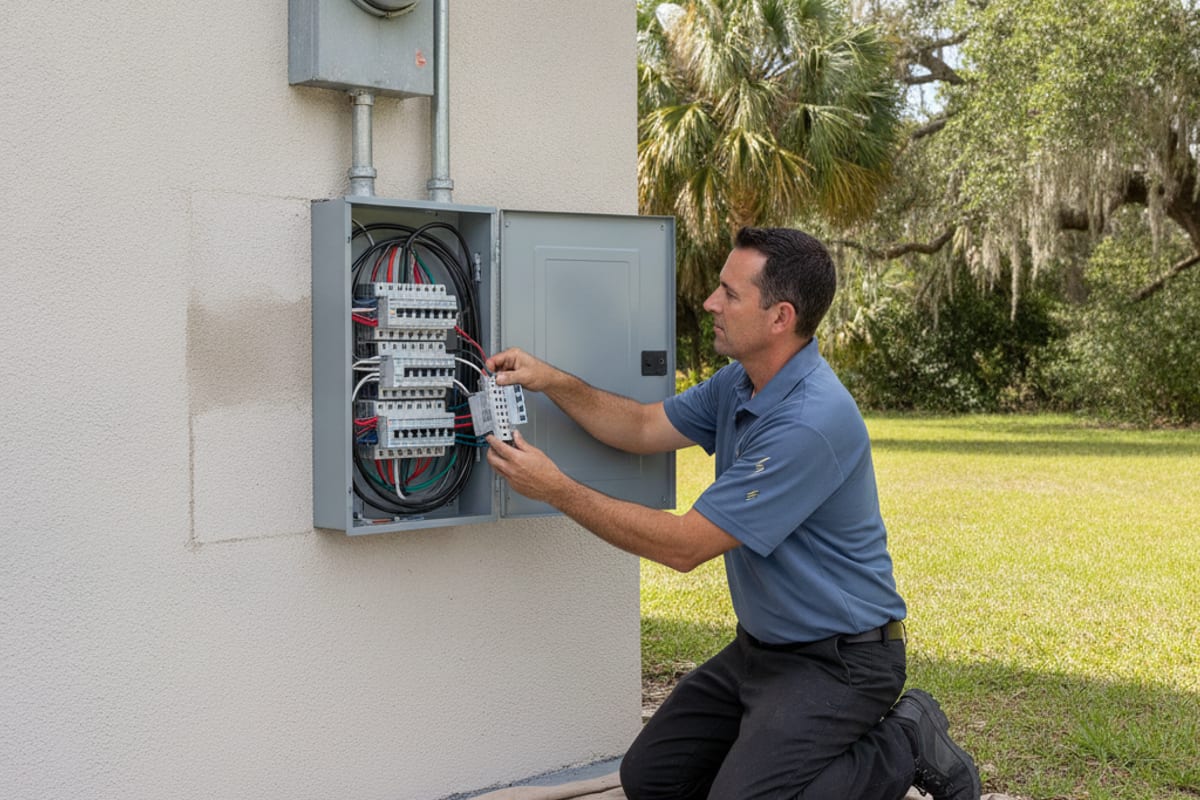
The cost of an electrical panel project in Tampa depends first on what is actually changing. Replacing a panel at the existing service capacity, increasing the home’s service capacity, relocating equipment and adding circuit space are different scopes. Meter equipment, service conductors, access, finish repairs and utility coordination can also change the proposal.
This site’s published range for a 100-amp to 200-amp panel upgrade is $2,500 to $4,500. That is a published site figure, not a quote for every house. Same-capacity replacement, a service-capacity change, adding circuit space, and relocating a panel remain different scopes.
Tampa Electrical Pro refers homeowners to independent licensed and insured electricians. The selected contractor evaluates the property and determines the work, permits, schedule and price.
Start by identifying the actual project
“Panel upgrade” is commonly used for several kinds of work:
- Panel replacement: The distribution equipment is replaced while the existing service capacity may remain unchanged.
- Service-capacity upgrade: The electrical service is evaluated and changed to support additional calculated load. This may involve more than the breaker panel.
- Circuit-space expansion: A panel may be out of usable breaker positions even when the service still has adequate capacity.
- Panel relocation: Moving the equipment requires evaluation of conductor routes, access, clearances and repairs to surrounding finishes.
- Equipment-specific work: A new circuit or transfer equipment may be the real need, without requiring a broader service upgrade.
An electrician should confirm which of these scopes applies before treating the job as a single standard package.
What changes a panel-upgrade proposal?
Existing service and calculated load
The number printed on the panel is only one part of the evaluation. The electrician also needs to consider the existing service equipment, actual electrical loads and planned additions. The actual equipment and system being proposed determine how those existing and planned loads are evaluated, which is a different question from whether the panel has open breaker spaces.
Available breaker space and available electrical capacity are not the same thing. A full panel does not automatically prove that the home needs a larger service. A subpanel may provide additional circuit positions when the overall design and load calculation support it, but a subpanel does not increase the service capacity supplied to the property.
Meter and service-entrance work
A project becomes broader when the existing meter equipment, service conductors or service entrance must also change. The electrician needs to inspect the actual arrangement and determine whether coordination with the electric utility is part of the work.
Panel location and access
A like-for-like replacement in an accessible location differs from moving a panel or routing conductors through finished areas. Wall construction, ceiling access, working space and the route between equipment can affect labor and restoration needs.
Historic finishes do not create an automatic price premium. The relevant questions are whether plaster, brick, trim or other finished surfaces limit access and what restoration the proposed route requires.
Existing conditions found during evaluation
The proposal may change when the electrician identifies damaged equipment, incompatible components or wiring conditions that require a different scope. Photos of the panel label and surrounding area can help with an initial conversation, but they cannot establish conductor condition, calculated load or every condition behind a closed enclosure.
Do not remove a panel cover or reach into electrical equipment to collect information for a quote.
Permits, inspections and jurisdiction
The applicable authority depends on the property’s jurisdiction, not only its mailing address. The selected contractor should identify which approvals apply to the proposed work and show permit, inspection and utility-coordination responsibilities in the written scope.
Ask whether those items are included in the quoted total or listed separately. Tampa Electrical Pro does not pull permits or perform the electrical work.
How planned equipment affects the decision
Tell the electrician about realistic additions before the panel is selected. The useful question is not simply whether another device needs a breaker. It is whether the existing service has capacity for the calculated load and whether the panel has suitable circuit space.
A Level 2 EV charger uses 240-volt power and creates a continuous electrical load. The vehicle, daily driving needs, parked time, charger requirements and the home’s electrical capacity all affect the installation choice. An EV circuit can require panel or service work, but panel amperage alone does not prove that an upgrade is necessary.
A whole-home generator is different. Standby equipment supplies backup power during an outage; it does not add utility load merely by being present. Generator planning instead considers transfer isolation, the loads selected for backup, fuel and the particular equipment. A generator is not, by itself, a reason to increase the home’s service capacity.
Other planned equipment should be evaluated from its actual labeling and electrical requirements. Avoid sizing a project around guesses about future loads.
Does the neighborhood determine the scope?
No. An address in Seminole Heights, Hyde Park or Apollo Beach does not establish the home’s panel size, wiring type, service condition or permitting authority.
Property-specific evidence matters more than neighborhood assumptions. Useful information includes the equipment label, visible location, recurring symptoms, planned loads, access constraints and any written request from an insurer or other party.
What if an insurer asks for replacement?
Start with the insurer’s written notice and the exact equipment or condition it identifies. A replacement requested during underwriting is not automatically the same scope or price as a service-capacity upgrade.
Some homes may have equipment discussed in guides about Federal Pacific panels or Zinsco panels, but the panel must be identified at the property. The insurer determines its own documentation and acceptance requirements, so neither the referral service nor an electrician should promise an underwriting outcome.
How to compare electricians on cost and timeline
Comparing Tampa electricians means looking at cost and schedule together, not cost alone. A useful proposal should make both understandable. Compare:
- whether the job is a panel replacement, service upgrade, relocation or circuit-space project;
- the service capacity and panel configuration being proposed;
- whether meter or service-entrance work is included;
- which circuits or related equipment are included;
- who handles applicable permits, inspections and utility coordination, and how long each step typically takes;
- the estimated start date and on-site labor time versus the time the permit and inspection steps add before the job is closed out;
- whether wall, stucco, trim or other finish repairs are included;
- what conditions could require a revised scope or push the timeline back; and
- the equipment and workmanship terms offered by the selected contractor.
A lower total may represent a narrower scope rather than the same work at a better price, and a faster-sounding timeline may be quoting labor only, without permit or utility-coordination time. Ask each contractor to put both cost and schedule in writing before comparing totals.
Florida has different electrical-contractor license categories with different geographic and work scopes. Confirm the business’s active license status, authorized jurisdiction and applicable scope at myfloridalicense.com.
When the issue needs prompt inspection
Unexplained flickering or dimming, hot or discolored plates, buzzing or crackling, a burning odor, shocks or frequent breaker trips call for prompt inspection by a qualified electrician. These symptoms cannot be diagnosed reliably from timing or location alone.
Do not repeatedly reset a breaker, open electrical equipment or approach a wet or damaged panel. If there is smoke or fire, leave the hazard area and contact emergency services. For more context, read the guide to panel warning signs.
Frequently asked questions
Does a full breaker panel mean I need a service upgrade?
Not automatically. A full panel describes circuit space, not necessarily service capacity. An electrician should evaluate the existing loads, proposed loads and equipment before recommending a larger service. A subpanel can add circuit positions in an appropriate design, but it does not increase service capacity.
Is replacing a panel the same as upgrading the service?
No. A panel can be replaced without increasing service capacity. A service upgrade can involve the panel as well as meter or service-entrance equipment and utility coordination.
Does adding a generator require a larger electrical service?
Not merely because the generator is being installed. A standby generator is a backup supply. Its design depends on transfer isolation, selected backup loads, fuel and equipment requirements rather than treating the generator as a new utility load.
Can a panel project be priced from a photograph?
Photographs can help identify visible labels, location and access, but they do not establish calculated load, conductor condition or the complete project scope. The contractor may need an on-site evaluation before issuing a firm proposal.
Is the permit included in the quote?
That depends on the contractor’s written proposal and the applicable jurisdiction. Ask the selected electrician to identify required approvals and state whether permit, inspection and utility-coordination items are included or separate.
Get a scope-based panel proposal
Call Tampa Electrical Pro at (813) 850-0320 to be connected with an independent licensed and insured electrician. Be ready to describe the existing panel, planned electrical loads, access concerns and any recurring symptoms or written insurance request. The electrician can then evaluate the property and prepare a proposal based on the work it actually needs.