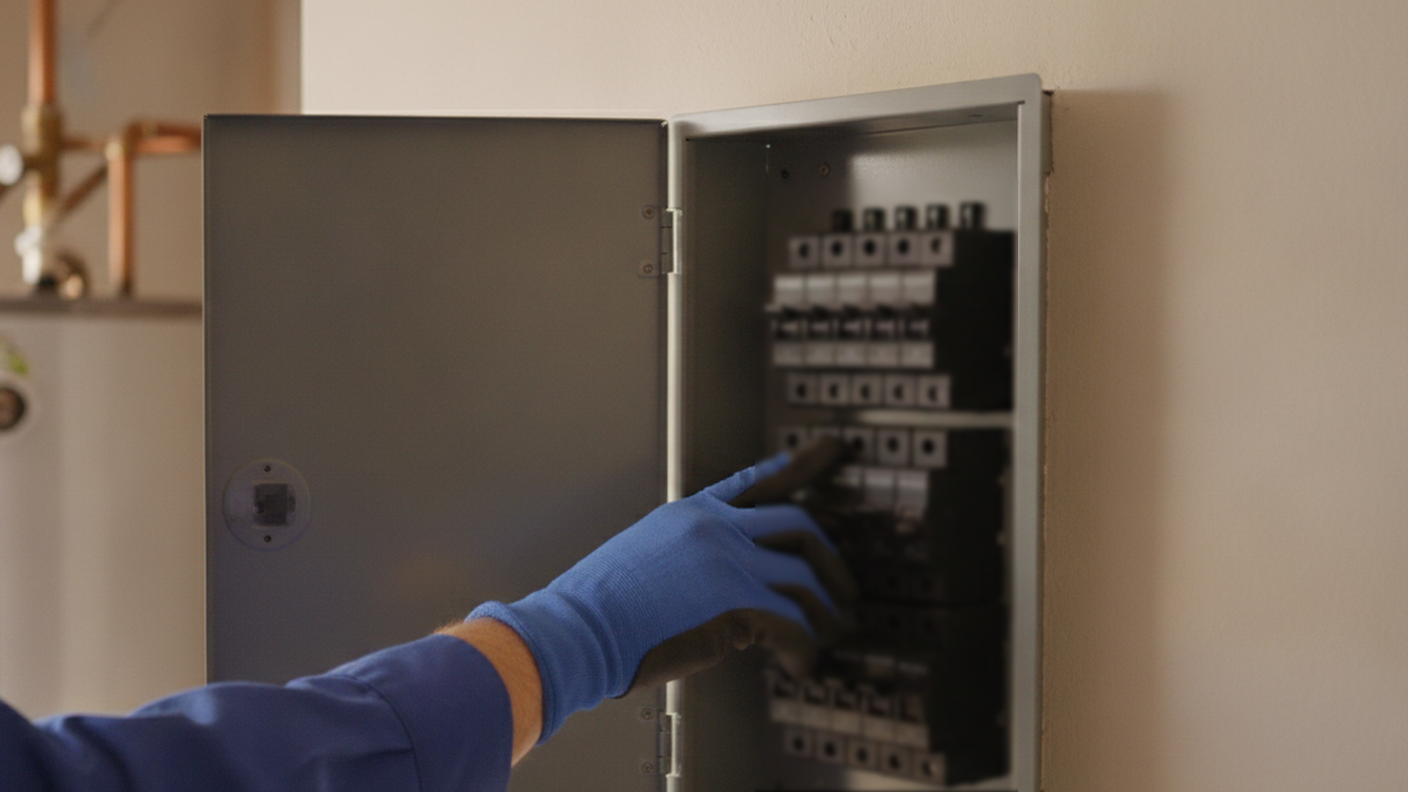
A water-heater breaker that keeps tripping needs diagnosis before anyone replaces a part. The cause may be within the heater, along its branch circuit, at a connection, or in the breaker or panel. The trip alone doesn’t identify which one is responsible.
Avoid repeatedly resetting the breaker. If the panel or nearby equipment is hot, wet, damaged, buzzing, crackling, arcing, or producing a burning odor, don’t open it or remove a cover. For smoke or fire, leave the hazard area and contact emergency services.
What does a tripping water-heater breaker mean?
A breaker opens the circuit when it responds to an electrical condition it is designed to detect. The breaker can also be damaged or unsuitable for continued service. Testing is needed to distinguish among the possibilities.
| Area to evaluate | What testing needs to clarify |
|---|---|
| Water heater | Whether a heating element, thermostat, or wet connection at the equipment is contributing to the trip. An electrician or the other trade sorts those items on site. |
| Branch circuit | Whether the conductors or connections show damage, looseness, an overload, or a ground fault |
| Breaker and panel | Whether the breaker is faulty and whether the panel connection and equipment remain suitable |
No single symptom proves which area is responsible. The timing and recurrence help describe the problem, but they don’t replace electrical testing.
An electrical repair visit can evaluate the breaker, panel, branch circuit, and electrical connections at the equipment. If the findings point to work outside the electrician’s scope, the selected contractor can explain what needs to be handled by another qualified trade.
Our guide to why breakers keep tripping in Tampa covers the broader circuit issue. If the affected equipment is a well pump, see the well pump breaker guide.
Will replacing the breaker fix it?
Only if testing shows that the breaker itself is the problem and the replacement is correct for the circuit and panel.
A compatible breaker replacement doesn’t remove circuit protection. The dangerous shortcut is bypassing the protection or installing a breaker that isn’t appropriate for the circuit in an attempt to stop the trips. That can leave damaged wiring, loose connections, overloads, or ground faults unresolved.
The panel’s condition can also change the repair. Our circuit breaker replacement cost guide explains why identifying the panel and inspecting the affected connection come before selecting a replacement.
When should I stop using the water heater?
Leave the breaker off and request qualified help when it trips again after a reset or when you notice heat, discoloration, buzzing, crackling, a burning odor, shocks, or visible damage.
Don’t approach or operate wet or storm-damaged electrical equipment. Don’t remove the panel cover or keep resetting a circuit that won’t remain on. Those actions can expose you to the condition the breaker is interrupting.
For smoke or fire, leave the hazard area and contact emergency services. Other warning signs still call for prompt inspection by a qualified electrician, but a generic page can’t determine the cause or severity at a particular property.
Why can this appear in two parts of a Citizens 4-point inspection?
The current Citizens Property Insurance 4-Point Inspection Form, Sample Form Insp4pt 03 25, addresses the water heater under plumbing while listing breaker conditions under electrical hazards.
The plumbing section includes the water heater, its temperature-pressure relief valve, and its age. In the electrical section, the Hazards Present grid includes “Tripping breakers,” “Improper breaker size,” “Double taps,” and “Over fusing.” The form requires a Florida-licensed inspector to certify the condition of the roof, electrical, HVAC, and plumbing systems.
That means a water heater with a repeatedly tripping breaker may require documentation in both the plumbing and electrical sections. It doesn’t prove that the heater itself is defective, establish which trade must perform every part of the repair, or predict an insurance decision.
Citizens instructs: “Agents may not submit applications for properties with electrical, heating or plumbing systems not in good working order or with existing hazards/deficiencies.” Our Florida 4-point electrical inspection guide explains the electrical portion in more detail.
Does Hillsborough County require a permit?
Permit requirements depend on the work performed, not merely on the fact that a breaker tripped.
Hillsborough County’s published exempt-work list carries one electrical exemption: “The installation or repair of a low-voltage system in an existing single-family residence when the work is performed by the property owner or the work is performed by a non-owner, provided the total cost of labor and materials does not exceed $5,000.” Work that alters, replaces, or relocates a water-heater branch circuit isn’t low-voltage work and doesn’t fit that exemption.
The county’s published HB 803 disqualifier is: “The work includes electrical, plumbing, structural, mechanical or gas work.” A water-heater replacement can be both electrical and plumbing, so no dollar amount makes that job exempt. The contractor should identify the actual scope and determine the applicable permit process before work begins.
Testing that locates the fault isn’t the same thing as assuming every possible repair has an identical permit requirement. The authority depends on the property’s jurisdiction, so a Tampa Bay mailing address alone isn’t enough to apply Hillsborough County’s rules to a property in another jurisdiction.
The referral network also serves Brandon and other Tampa Bay communities.
What changes the repair scope and cost?
This site’s published diagnostic range is $75 to $150, usually credited toward the repair. Electrical repair including that diagnostic visit is published at $150 to $450. If testing shows the panel itself is the constraint, a 100A to 200A panel upgrade is published at $2,500 to $4,500. None of those bands is a water-heater-circuit price. The largest difference is still where testing locates the problem.
- A loose or damaged connection may keep the work focused on the affected electrical connection.
- A branch-circuit fault can require tracing the route and evaluating accessible conductors and terminations.
- A failed breaker requires a compatible replacement and an evaluation of the panel connection.
- A fault within the water heater can change the required parts and may involve another qualified trade.
- Heat or damage at the panel can expand the work beyond the original water-heater circuit.
Access matters too. A visible equipment connection and an accessible panel present a different scope from concealed wiring, restricted access, or damage extending beyond one termination.
A diagnosis should identify the affected area before the contractor prices the repair. A breaker-only price isn’t useful when the breaker hasn’t been shown to be the cause.
When does this become a panel problem?
A tripping water-heater circuit becomes a panel project only when inspection and testing identify a panel-related issue, such as damage at the connection, incompatible equipment, or a service-capacity constraint supported by a load evaluation.
Breaker space and electrical capacity are different questions. Open spaces don’t prove that the service can support another load. A full panel also doesn’t automatically prove that the service needs an upgrade, and adding a subpanel creates circuit space without increasing service capacity.
The useful decision follows the findings:
- Repair the affected circuit or connection when the rest of the equipment remains suitable.
- Replace the breaker when testing confirms it is faulty and a compatible replacement is available.
- Address the water heater when the fault is traced to the equipment.
- Evaluate broader panel work when the panel itself is damaged, incompatible, or the verified constraint.
Our guide to how many amps a home needs explains why actual connected loads and service capacity matter more than a visual count of breaker spaces. More information about broader panel work is available on the panel upgrade page.
Who should I contact first?
Start with a licensed electrician when the breaker, branch circuit, electrical connections, or panel need testing. The electrician can document where the fault was found and whether the electrical repair is within the selected contractor’s scope. A problem traced to the water heater may also require a qualified plumbing or appliance professional, depending on the equipment and repair.
Tampa Electrical Pro is a referral service. It connects homeowners across Hillsborough, Pinellas, and Pasco with independent licensed and insured electricians. Call (813) 850-0320 to request a referral for the electrical diagnosis.
Frequently asked questions
Why does my water heater keep tripping its breaker?
The cause may be within the heater, along the branch circuit, at a connection, or in the breaker or panel. The trip alone can’t identify which area needs repair.
Is it safe to keep resetting the breaker?
No. Repeated resets don’t correct the underlying condition. Leave the breaker off if it trips again, and don’t operate or open electrical equipment that is hot, wet, damaged, buzzing, crackling, arcing, or producing a burning odor.
Will a new breaker solve the problem?
Only when testing confirms that the breaker is faulty and the replacement is compatible with the panel and circuit. A new breaker won’t correct damaged wiring, loose connections, overloads, or ground faults elsewhere on the circuit.
Does the repair require a Hillsborough County permit?
It depends on the work performed. Hillsborough’s limited low-voltage exemption doesn’t cover alteration, replacement, or relocation of a water-heater branch circuit. The contractor should identify the repair scope and confirm the applicable process for the property’s jurisdiction.
Can this affect a Citizens 4-point inspection?
It can appear in two sections. The form addresses the water heater under plumbing and lists tripping breakers among the electrical hazards. That distinction doesn’t predict the insurer’s decision or identify the cause of the trip.