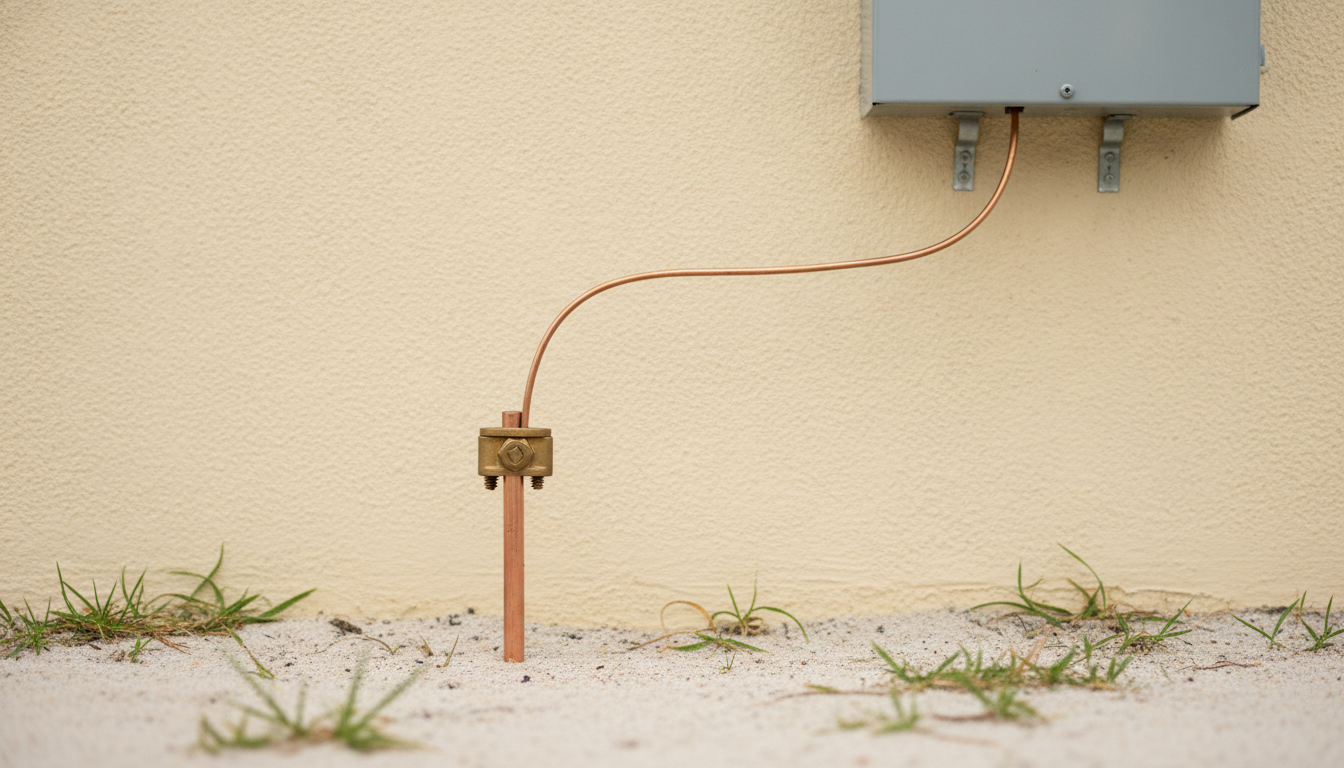
Tampa Electric publishes that a ground rod is not the only grounding electrode, and that it accepts any electrode that satisfies the NEC and the AHJ. Those Standard Electrical Service Requirements apply in Tampa Electric territory. Duke Energy Florida customers must confirm the electrode rules with Duke. A driven rod may be one component of a house grounding electrode system. Existing electrodes, resistance testing when applicable, the serving utility and local review determine what the property needs.
What should be checked before adding a ground rod?
A visible rod does not reveal the entire system or confirm that every connection is intact. A qualified electrician can evaluate:
- Which grounding electrodes are present
- Whether their connections and grounding electrode conductor are intact
- Whether resistance testing applies to a single made electrode
- Whether the conductor, clamp, meter equipment or service equipment is also involved
- Which utility and permitting authority govern the property
Tampa Electrical Pro refers homeowners to independent licensed and insured electricians. The selected contractor determines scheduling, scope, permits, workmanship and pricing.
What does Tampa Electric’s published manual say?
Tampa Electric’s 2019 Standard Electrical Service Requirements warns in its front matter that requirements may have changed. Section VII states:
“The NEC allows several methods of supplying a grounding electrode. A ground rod is not the only means of supplying the grounding electrode.”
“Tampa Electric accepts any grounding electrode that satisfies the NEC and the AHJ.”
The eight-foot rod options:
The rod or pipe electrode may be a listed 1/2” x 8’ stainless steel or nonferrous rod, a 5/8” x 8’ steel or iron rod, or a 3/4” x 8’ galvanized pipe, all driven eight (8) feet into the earth.
On a single made electrode over 25 ohms:
If its resistance to ground is more than 25 ohms, it shall be supplemented by and bonded to an additional “made” electrode, installed not less than six (6) feet away.
For a single meter, the manual identifies the meter enclosure as one conductor-connection location. It also recognizes a qualifying concrete-encased electrode.
Those SESR lines apply in Tampa Electric territory. They are not Duke Energy Florida rules. Duke customers must confirm electrode requirements with Duke. Neither one visible rod nor a blanket two-rod rule settles the question. The 2019 manual is not a complete 2026 installation specification. The electrician should confirm current requirements with the serving utility and the local authority before work begins.
Why can a foundation electrode matter?
A foundation alone does not establish a qualifying electrode. The installed materials, placement and connections must form a recognized, connected part of the electrode system.
Can homeowners inspect the connection themselves?
A homeowner can look from a safe distance for exterior damage, a detached conductor or disturbed soil near a known electrode. Do not remove a meter or panel cover, open electrical equipment, touch a loose conductor or attempt a connection.
An electrode evaluation may lead to a narrow repair, resistance testing, a supplemental electrode or work involving service equipment. Those scopes are not interchangeable and cannot be determined from the sidewalk.
Will a ground rod protect the house from lightning?
A service grounding electrode is not a substitute for surge protection. Grounding is essential, but a visible rod does not promise that electronics will survive a lightning event.
A University of Florida report published in 2002 described triggered lightning strikes at a simulated home at Camp Blanding equipped with a lightning-protection system. More than 80 percent of the strike current entered the test electrical system. In two of three reported tests, meter-mounted surge protection prevented damage.
That small experiment did not measure an ordinary home’s service ground rod, and it does not establish current losses or costs for Florida homes today. It supports a narrower conclusion: the grounding electrode system and surge protection have different jobs.
The Tampa surge protection guide explains this layered approach. The surge protection service page covers the property and equipment questions an electrician evaluates.
How are grounding and bonding different?
Grounding and bonding work together, but they are not interchangeable. The grounding electrode system connects the service to earth. Equipment grounding conductors and bonding connect conductive parts into an effective fault-current path so protective devices can operate when a fault occurs.
Pool bonding has another specific purpose: limiting voltage differences among conductive parts around the pool. It does not replace equipment grounding or the service grounding electrode system. The Tampa pool bonding guide explains those distinctions.
What changes the project scope?
Useful questions include:
- Is a qualifying electrode already present?
- Can its connection be identified and inspected safely?
- Does a single made electrode require resistance testing?
- Are the conductor, clamp or service equipment damaged or missing?
- Is the work part of a panel, meter or broader service project?
- Is there an obstruction that affects electrode placement?
- Which utility and local authority must accept the installation?
These answers are more useful than assuming a rod count from what is visible outside. A project involving only an electrode differs from one involving damaged service equipment, inaccessible connections or other parts of the grounding system.
Homeowners in Brandon and across Tampa Bay can call Tampa Electrical Pro at (813) 850-0320 to be connected with an independent licensed and insured electrician.