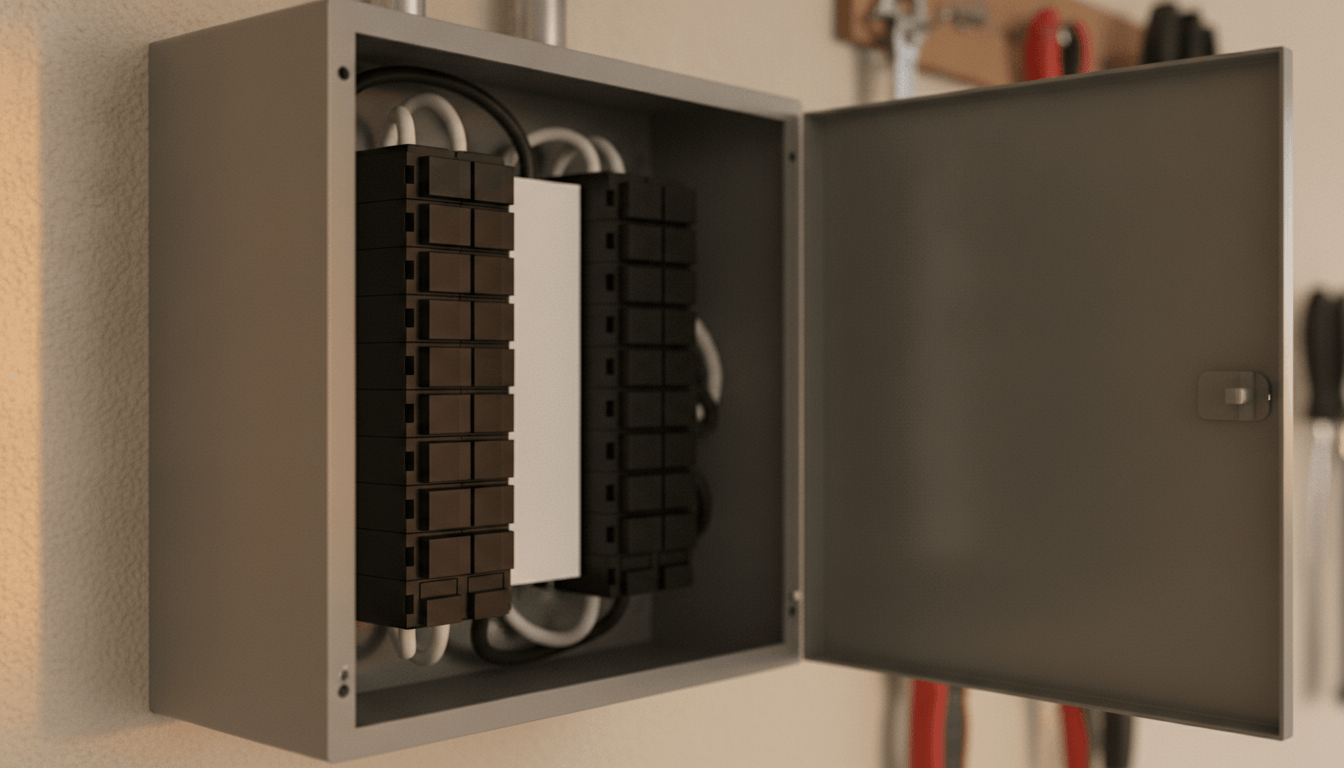
A double tapped breaker has two branch-circuit conductors secured beneath one breaker terminal. That arrangement is not automatically permitted or automatically defective. The breaker’s listing and labeling determine whether its terminal accepts both conductors.
This distinction matters when a Tampa Bay homeowner receives an electrical or 4-point inspection report. The report may identify the visible arrangement, but a qualified electrician still needs to evaluate the installed breaker, conductors, terminal, and panel before recommending a correction.
What is a double tapped breaker?
A double tapped breaker has two conductors sharing one breaker terminal. Inspectors may also call the arrangement a double tap or double lug.
The term describes where the conductors terminate. It does not establish whether the breaker is overloaded, whether the conductors are compatible with the terminal, or whether the entire panel needs replacement.
A double tap can be found even when the breaker has not been tripping. That differs from a breaker that keeps tripping, which requires an evaluation of why the protective device is operating.
Counting conductors is only the first observation. The important next question is whether that specific breaker terminal is listed for the conductors connected to it.
What decides whether two conductors are allowed?
The installed breaker’s listing and labeling determine whether its terminal may hold two conductors. An electrician checks the equipment information and the conductors rather than deciding from appearance alone.
Miami-Dade County’s electrical inspection guidelines direct inspectors to verify that equipment was installed according to its listing and labeling. The same guidelines call for checking overcurrent devices for compatibility with conductors, terminals, ratings, and ampacities during a residential final inspection.
Those checks explain why there is no reliable blanket answer for every double tap. A terminal may be listed for the installed arrangement, or it may not be. The result depends on the actual equipment and conductors in the panel.
A photograph can help identify the panel and the visible termination, but it may not show all the labeling or conductor information needed for a conclusion. Homeowners should not remove the panel cover to look for those details. That inspection belongs with a qualified electrician.
How does a double tap affect a Citizens 4-point inspection?
The current Citizens 4-Point Inspection Form lists “Double taps” in its electrical Hazards Present grid. It also defines acceptable condition as a system working as intended without visible hazards or deficiencies.
That form entry does not replace the equipment evaluation. An inspector can record the visible arrangement, while an electrician evaluates whether the terminal and conductors match the equipment listing and whether corrective work is necessary.
Citizens instructs writing agents not to submit applications for properties with existing hazards or deficiencies. The form also says a trade-specific licensed professional may sign only the section for that trade. An electrician signing the electrical section does not sign off on the roof, plumbing, or HVAC sections.
The form does not establish what another carrier uses or predict an underwriting decision. If a double tap appears on a 4-point report, the practical next step is to obtain an equipment-specific electrical evaluation and give the resulting documentation to the inspector or agent handling the file.
Our guide to 4-point inspection electrical requirements in Tampa explains the other electrical items that may appear during that inspection.
What affects the cost of correcting a double tap?
There is no supported flat local price for correcting a double tapped breaker. The scope depends on what the electrician finds inside the panel.
A correction may remain limited to the existing equipment when the panel has a compatible, listed arrangement available. The scope can widen when the installed breaker is not listed for both conductors, the conductors are not compatible with the terminal, or the panel lacks an approved way to accommodate the circuits.
Useful scope questions include:
- Is the installed terminal listed for both conductors?
- Are the conductor materials and sizes compatible with the terminal?
- Does the existing panel provide an approved arrangement for the circuits?
- Is the work limited to a termination correction, or does equipment need replacement?
- Which permitting authority serves the property?
These questions are more useful than treating every double tap as the same repair. They also prevent an inspection note from becoming an automatic recommendation for a new panel.
For related work, see the site’s electrical repair service and panel upgrade service explanations.
Does a double tap mean the panel needs more capacity?
No. A termination problem does not by itself prove that the electrical service lacks capacity.
Three separate questions often get mixed together:
| Question | What it addresses |
|---|---|
| Is the terminal compatible? | Whether the breaker is listed for the connected conductors |
| Is circuit space available? | Whether the panel supports another approved circuit position or arrangement |
| Is service capacity adequate? | Whether the service can support the property’s calculated electrical load |
An empty-looking position does not prove usable circuit space. The panel labeling and installed equipment determine what arrangements are permitted.
A subpanel can provide additional circuit spaces when it is suitable for the property, but it does not increase the electrical service capacity. A service-capacity decision requires a separate load evaluation. Likewise, a panel upgrade should not be recommended solely because an inspection report contains the words “double tap.”
The electrician should first determine whether the existing equipment supports a compatible correction. Panel replacement becomes a separate consideration only when the observed conditions and required work justify it.
Does Hillsborough County require a permit for this work?
Hillsborough County’s work-exempt-from-permits list includes a limited exemption for certain low-voltage work. It does not list branch-circuit conductor work inside an electrical panel as exempt.
The property’s actual jurisdiction still matters. Tampa, Temple Terrace, incorporated Pinellas municipalities, unincorporated county areas, and other local authorities may handle permits through different departments. A mailing address alone does not always identify the permitting authority.
The selected electrician should identify the jurisdiction and confirm the permit scope for the proposed correction. Permitting and a 4-point inspection remain separate processes: a permit determination does not predict an insurance decision, and an insurance-form entry does not determine what the breaker labeling permits.
What should a Tampa Bay homeowner do next?
Start with an evaluation of the terminal, breaker labeling, conductors, and panel. Do not authorize a panel replacement based only on the wording of an inspection report.
Ask the electrician for clear answers to these questions:
- Are two conductors secured beneath one breaker terminal?
- Is that terminal listed for the installed conductors?
- If it is not compatible, can the correction remain within the existing panel?
- Does the proposed work require a permit in this property’s jurisdiction?
- What documentation should go back to the inspector or insurance agent?
Do not remove the panel cover or attempt to reposition conductors yourself. If the panel is hot, discolored, buzzing, crackling, arcing, producing a burning odor, or associated with shocks or repeated trips, arrange prompt qualified inspection. If there is smoke or fire, leave the hazard area and contact emergency services.
Tampa Electrical Pro is a referral service that connects homeowners with independent licensed and insured electricians serving Hillsborough, Pinellas, and Pasco counties. Contact Tampa Electrical Pro to request help evaluating a panel termination.
Frequently asked questions
Is a double tapped breaker always a violation?
No. The breaker’s listing and labeling determine whether its terminal accepts the installed conductors. The arrangement requires an equipment-specific evaluation rather than a blanket answer.
Can a double tap affect a Citizens 4-point inspection?
It can appear on the electrical section because the current Citizens form lists “Double taps” in its Hazards Present grid. The form entry does not determine whether a particular breaker terminal is listed for two conductors or predict the final insurance decision.
How does an electrician determine whether it is allowed?
The electrician checks the breaker’s listing and labeling along with the conductor and terminal compatibility. Florida inspection guidance directs inspectors to compare installations with equipment listing and labeling and to examine conductor compatibility at overcurrent-device terminals.
Does a double tap require a panel upgrade?
Not automatically. The electrician first determines whether the existing panel supports a compatible correction. Circuit space, equipment compatibility, and service capacity are separate questions.
Is a double tapped neutral the same issue?
No. A double tapped breaker concerns conductors sharing a breaker terminal. A double tapped neutral concerns conductors sharing a neutral terminal and requires its own evaluation.