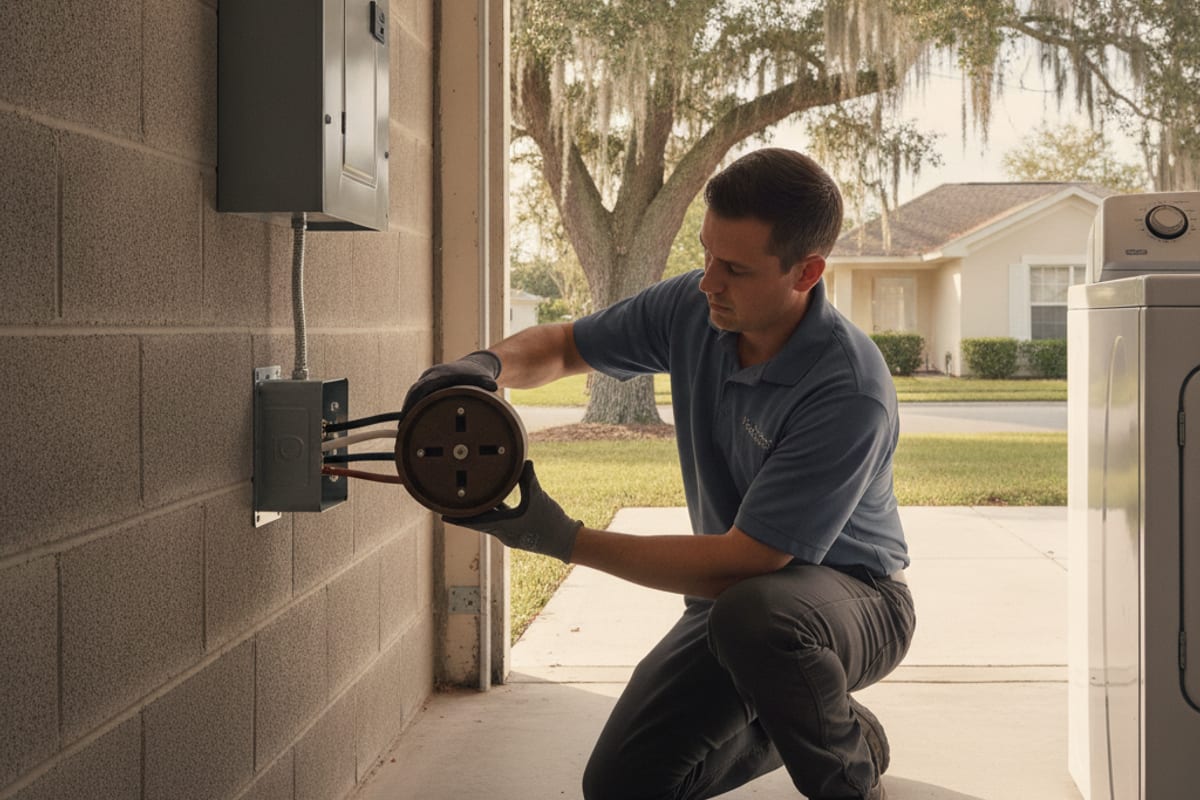
The cost of a 240-volt outlet in Tampa depends on what the equipment requires, whether a suitable circuit already exists, the wiring route, access, panel compatibility, service capacity, and the permit authority serving the property. An open breaker position alone does not establish that the electrical system can support the new load.
A dryer, range, EV charger, and RV connection may all use 240 volts, but they are not automatically the same installation. Their circuit ratings, receptacles, connection methods, equipment instructions, locations, and wiring routes can differ.
What affects the cost of a 240-volt outlet?
The most important distinction is whether the work involves an existing circuit or a new one. Replacing a damaged receptacle on a qualifying existing circuit is different from installing a new branch circuit from the panel.
For a new circuit, the electrician needs to determine:
- The equipment’s required voltage, circuit rating, and connection method
- Whether the connection will be a receptacle or a hardwired installation
- The distance and accessible route between the panel and equipment
- Whether walls, ceilings, exterior areas, or underground sections affect the route
- Whether the panel accepts the required breaker arrangement
- Whether the electrical service has capacity for the added load
- Which permit and inspection process applies to the property
A full panel does not automatically require a service upgrade. In some installations, a subpanel can provide more circuit spaces, but it does not increase the electrical service capacity available to the property. Conversely, empty breaker positions do not prove that enough capacity remains for a new load.
An electrician can examine the actual equipment and electrical system before recommending a new circuit, a subpanel, or a panel upgrade.
Is there a published cost benchmark?
For home charging, Tesla’s US home-charging guidance, reviewed in September 2026, lists an estimated installation cost of $750 to $1,500 for its Wall Connector and Universal Wall Connector. Tesla gives the same estimate for installing a new 240-volt outlet.
That is a national manufacturer estimate for Tesla home charging, not a Tampa average, a dryer or range estimate, or a quote from an electrician in this referral network. Tesla identifies long wiring routes, panel work, trenching, pedestal installation, and concealed routing as additional sources of complexity. Charger hardware is separate from the installation estimate.
This site’s published range for a 240-volt EV charger circuit with adequate panel capacity is $1,200 to $2,000. That is the adjacent published local number for a new 240-volt circuit. It does not become a dryer or range price, and it is not a quote for every 240-volt outlet.
A local proposal should identify the equipment, route, panel work, permit handling, and other included scope so the figures can be compared on the same basis.
Why do some dryers and ranges have three-prong outlets?
The 1996 NEC required a separate equipment grounding conductor for new electric range and clothes-dryer branch circuits. That produced the four-wire arrangement used for new circuits. Older three-wire installations were not automatically outlawed when that requirement changed.
The age or location of a house does not establish which wiring is present or whether it qualifies to remain. The receptacle, cable, panel connection, appliance connection, and condition of the circuit need to be inspected.
Can an existing three-prong outlet remain?
An existing three-wire range or dryer branch circuit may continue connecting the appliance frame to the grounded conductor only when every applicable condition in the 2020 NEC 250.140 exception is satisfied:
- The supply circuit is 120/240-volt single-phase three-wire, or 208Y/120 from a three-phase four-wire wye system.
- The grounded conductor is not smaller than 10 AWG copper or 8 AWG aluminum.
- The grounded conductor is insulated, or it is uninsulated and part of a Type SE service-entrance cable whose branch circuit originates at the service equipment.
- Grounding contacts of receptacles furnished as part of the equipment are bonded to the equipment.
The fourth condition concerns a receptacle built into the appliance, such as a convenience receptacle furnished as part of an older range. It does not refer to the three-slot wall receptacle supplying the appliance.
The rule applies to qualifying existing installations. It is not permission to install a new three-wire dryer or range circuit. It can allow replacement of a damaged 10-30R or 10-50R receptacle on a qualifying existing circuit, but only after the circuit and appliance connection have been evaluated.
Those four conditions are the 2020 NEC exception. The 2023 NEC revised and expanded the provision at 250.140(B), so the list above does not exhaust the later edition. The edition and requirements governing a particular job depend on the applicable jurisdiction. A qualified electrician providing electrical repair can inspect the complete circuit under the applicable edition instead of judging it from the receptacle face alone.
Common 240-volt receptacle configurations
These configurations are not interchangeable:
| Configuration | Slots | Rating | Common application |
|---|---|---|---|
| 10-30R | 3 | 30A | Older dryer circuits |
| 14-30R | 4 | 30A | Four-wire dryer circuits |
| 10-50R | 3 | 50A | Older range circuits |
| 14-50R | 4 | 50A | Four-wire range circuits and some EV charging equipment |
A 10-30R or 10-50R is limited to a qualifying existing three-wire circuit. A new dryer or range circuit uses a separate equipment grounding conductor.
The receptacle pattern is only part of the decision. The electrician also needs to match the circuit to the connected equipment, its labeling, and its installation instructions. Installing a receptacle with the desired slot pattern does not change the capacity or condition of the wiring behind it.
Does the panel have room for the circuit?
Circuit space and electrical capacity answer different questions.
Circuit space concerns whether the panel can accept the required breaker arrangement. Service capacity concerns whether the existing electrical system can support the added load along with the property’s other loads. A panel can have empty positions but insufficient capacity, or it can be crowded while the service still has capacity.
For an existing installation, a proposed large circuit requires evaluation of the actual existing and planned electrical loads, the service, the proposed equipment, and applicable equipment requirements. The panel upgrade guide and home electrical service guide explain these distinctions in more detail.
Is a 240-volt outlet the same as an EV charger outlet?
Sometimes, but not always. Level 2 home charging uses 240 volts, and some charging equipment connects through a NEMA 14-50 receptacle. Other chargers are hardwired.
EV charging is a continuous electrical load. The vehicle, daily driving needs, parked time, charger requirements, and available electrical capacity all affect the appropriate setup. Smart features such as timers, usage data, or an app do not by themselves establish that a charger manages the property’s service load.
An existing 14-50 receptacle should not be assumed suitable merely because the plug fits. Its circuit, receptacle, connections, condition, location, and equipment instructions still matter. Outdoor charging also requires equipment rated for the actual exposure.
An electrician providing EV charger installation can compare a receptacle installation with a hardwired connection. The EV charging cost guide covers that narrower decision, while the RV outlet guide addresses circuits intended for recreational vehicles.
Who handles permits for a new circuit?
The authority depends on the property’s jurisdiction, not simply the city printed in the mailing address.
For properties under Hillsborough County jurisdiction, the county’s exempt-work list does not exempt a new 240-volt branch circuit. Its stated electrical exemption is limited to qualifying low-voltage work in an existing single-family residence.
Pinellas County states that work changing a home’s electrical system requires a permit. Municipalities within Hillsborough and Pinellas counties may administer their own processes, so the property jurisdiction must be identified before relying on a county procedure or fee.
The selected contractor determines the job scope and can explain the applicable filing, inspection, and permit responsibilities before work begins.
Frequently asked questions
How much does a 240-volt outlet cost in Tampa?
There is no supported flat Tampa price for every 240-volt outlet. Tesla publishes a national estimate of $750 to $1,500 for a new 240-volt home-charging outlet, but that figure is not a Tampa average and does not apply automatically to dryer, range, RV, or other equipment. This site’s published EV-charger circuit range of $1,200 to $2,000 is the adjacent local number for a new 240-volt circuit when the panel already has capacity; it is still not a dryer or range price. The existing circuit, route, access, panel work, service capacity, and permit scope determine the local proposal.
Can I keep an existing three-prong dryer outlet?
It may remain when the existing three-wire circuit satisfies every applicable condition in NEC 250.140 and the equipment is connected correctly. The exception does not authorize a new three-wire circuit. An inspection of the wiring and connections is needed because the receptacle face alone cannot establish compliance.
Does a full panel mean I need a service upgrade?
No. A full panel is a circuit-space issue, while a service upgrade concerns electrical capacity and system condition. A subpanel may add circuit spaces, but it does not add service capacity. The decision requires an evaluation of the proposed load and the existing electrical system.
Can the same 14-50 outlet serve a range or an EV charger?
A NEMA 14-50R is used for four-wire range circuits and some EV charging equipment. That does not make every existing 14-50 installation suitable for every appliance or charger. The circuit, receptacle, equipment instructions, condition, and location all need to match the intended use.
Does a new 240-volt circuit need a permit?
For properties under Hillsborough County jurisdiction, a new 240-volt branch circuit is not covered by the county’s low-voltage exemption. Pinellas County also requires permits for work that changes a home’s electrical system. A city may administer its own permit process, so confirm the authority serving the job address.
Get the actual circuit evaluated
Call Tampa Electrical Pro at (813) 850-0320 to be connected with an independent licensed and insured electrician serving your area. The selected contractor determines the installation method, scope, permit handling, schedule, workmanship, and price after evaluating the equipment and electrical system.