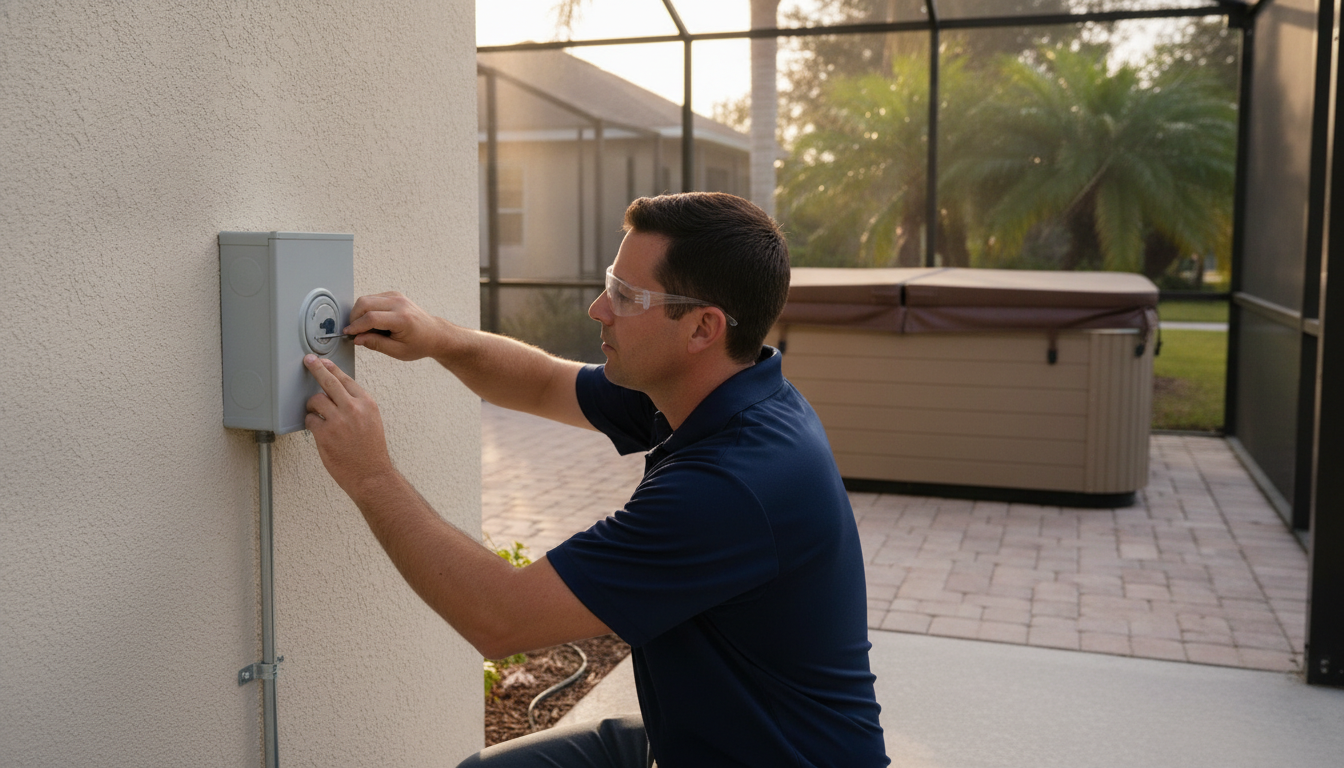
The cost of wiring a hot tub in Tampa depends on the spa’s electrical instructions, the condition and capacity of the home’s electrical system, and the route between the panel and the installation site. A nearby panel with usable capacity and accessible routing is a different project from a long outdoor run that needs trenching, repairs or other panel work.
Start with the spa’s model number, nameplate and installation manual. Those documents tell the electrician whether the unit is designed for a plug-in connection or hardwired power and identify the electrical requirements that must guide the installation.
What changes the cost of hot tub wiring?
A useful estimate separates the required installation from complications that may only become clear after the site is inspected.
The spa’s listed requirements. Voltage, circuit size, connection method and required protective equipment vary by model. The estimate should be based on the exact spa rather than its physical size or a typical installation.
Existing circuit versus new circuit. A spa designed for a plug-in connection may still need an appropriate receptacle and circuit. A hardwired model usually involves a new branch circuit, conductors, routing and equipment selected for that installation.
Panel capacity and circuit space. An open breaker position does not prove that the electrical service can support the spa. A full panel also does not automatically mean the service must be upgraded. A subpanel can provide additional circuit positions, but it does not add service capacity. The electrician must evaluate both space and the home’s actual electrical load before recommending panel work.
Route and access. Distance matters, but so do wall access, attic or crawlspace access, finished surfaces, outdoor transitions, trenching and the location of the spa pad. Two runs of similar length can require very different work.
Protection and installation equipment. GFCI protection, disconnecting means, grounding, bonding, enclosures and wiring methods have to match the equipment, exposure and applicable requirements. Existing defects found along the route may create a separate electrical repair scope.
Permit and inspection requirements. The authority responsible for the property determines the process. Ask the selected contractor which jurisdiction applies, what documents are needed and who will handle each step.
These factors provide a better comparison than a broad local price range. No honest flat hot-tub wiring price exists without seeing the panel and the run. Adjacent published numbers on this site are a new 240-volt circuit with adequate panel capacity at $1,200 to $2,000, the same class of work as the EV charger circuit; a 100A to 200A panel upgrade at $2,500 to $4,500 if required; and electrical repair including the diagnostic visit at $150 to $450 if existing wiring is damaged. Spa GFCI hardware and outdoor run length still have to be priced on site. A written estimate should identify the spa model, planned route, panel assumptions and any work that is excluded or conditional.
120-volt plug-in and 240-volt hardwired spas
Some smaller spas are designed for a 120-volt cord-and-plug connection. Larger models are often designed for a hardwired 240-volt supply, but the product instructions control. A standard-looking plug does not make every household receptacle suitable, and a hardwired spa should not be adapted to an ordinary outlet.
The two configurations also behave differently. Available power affects how the heater and pumps operate, so a plug-in unit may heat or recover temperature differently from a hardwired model. Climate, water volume, insulation and simultaneous pump use can also affect performance. Review the manufacturer’s operating information rather than assuming voltage alone predicts the experience.
Before buying the spa, give the electrician the complete model information. That makes it possible to compare the product’s requirements with the existing panel, circuit and proposed location before delivery.
What the electrician evaluates
A proper site review should answer several practical questions:
- Is the spa listed for plug-in or hardwired installation?
- Does an existing circuit actually match the equipment requirements, or is a new circuit needed?
- Does the panel have both usable circuit space and sufficient electrical capacity?
- What route avoids unnecessary disturbance while remaining suitable for the location?
- Will the wiring or equipment be exposed to rain, irrigation, standing water or other outdoor conditions?
- What GFCI protection, disconnecting means, grounding and bonding details apply to this model and site?
- Which permitting authority has jurisdiction over the property?
The answers determine the scope. They should not be inferred from the spa’s appearance, the age of the neighborhood or the number printed on the panel cover.
GFCI protection is not the same as grounding
A GFCI monitors current imbalance and helps protect people from ground-fault shock. It does not create an equipment grounding path or replace overcurrent protection by itself. The CPSC’s GFCI guidance explains these distinctions and notes that different GFCI devices can protect properly connected downstream equipment.
For a spa installation, the electrician should follow the equipment instructions and applicable requirements when selecting and locating GFCI protection. The same careful distinction matters when evaluating other GFCI installations.
Test protective devices only as directed by their manufacturers. Do not handle or test wet, damaged or exposed electrical equipment.
Disconnecting means, grounding and bonding
A spa installation may involve a disconnecting means so power can be isolated for service. Its type and location must be determined from the equipment instructions and the rules that apply to the property. A generic distance or placement statement cannot replace that review.
Grounding and bonding also perform different jobs. Grounding provides a fault-current path through the electrical system. Bonding connects specified conductive parts to reduce voltage differences between them. Which parts must be included depends on the spa, surrounding construction and installation details.
A pool installation and a self-contained hot tub can involve different conditions, so a pool bonding guide should not be treated as a substitute for the spa manufacturer’s instructions or a site-specific electrical design.
Does hot tub wiring need a permit in Tampa?
The answer depends on the authority that serves the property and the work being performed. A Tampa mailing address does not by itself identify the permitting jurisdiction.
For property under Hillsborough County’s authority, the county’s published exemption list provides a narrow electrical exemption for qualifying low-voltage work in an existing single-family residence. A new 240-volt branch circuit is not low-voltage work and does not fall within that exemption.
Properties within a city may be handled by that city’s building department. Confirm the jurisdiction before work begins, then ask the selected contractor how the permit and inspection will be managed. Do not assume the referral service or every contractor follows the same administrative process.
When a spa breaker trips
A GFCI trip indicates that the protective device detected a condition it is designed to respond to, but the article cannot determine the cause. Possible faults can occur in the spa equipment, connections, wiring or protective device, and moisture may complicate the inspection.
Do not replace the breaker with a larger one, bypass the GFCI or keep resetting a circuit that will not remain on. Stop using the spa and have a qualified electrician or the appropriate spa service professional inspect it. Keep away from wet, damaged or exposed electrical equipment. If there is smoke, fire, arcing or a burning odor, leave the hazard area and contact emergency services.
Questions to ask before accepting an estimate
Ask the contractor to identify:
- The exact spa model and electrical instructions used for the design
- Whether the estimate assumes an existing circuit or includes a new one
- The planned wiring route and any trenching or access work
- How panel space and electrical capacity were evaluated
- The GFCI, disconnecting, grounding and bonding scope
- The enclosure and equipment choices for the site’s actual exposure
- Permit and inspection responsibilities
- Repairs, restoration or equipment that are not included
This makes competing estimates easier to compare because each contractor is describing the same job.
Get matched with an electrician
Tampa Electrical Pro is a referral service. We can connect you with an independent licensed and insured electrician who can review the spa instructions, panel and proposed location. The selected contractor determines the design, price, scheduling, permit responsibilities and workmanship for the project.