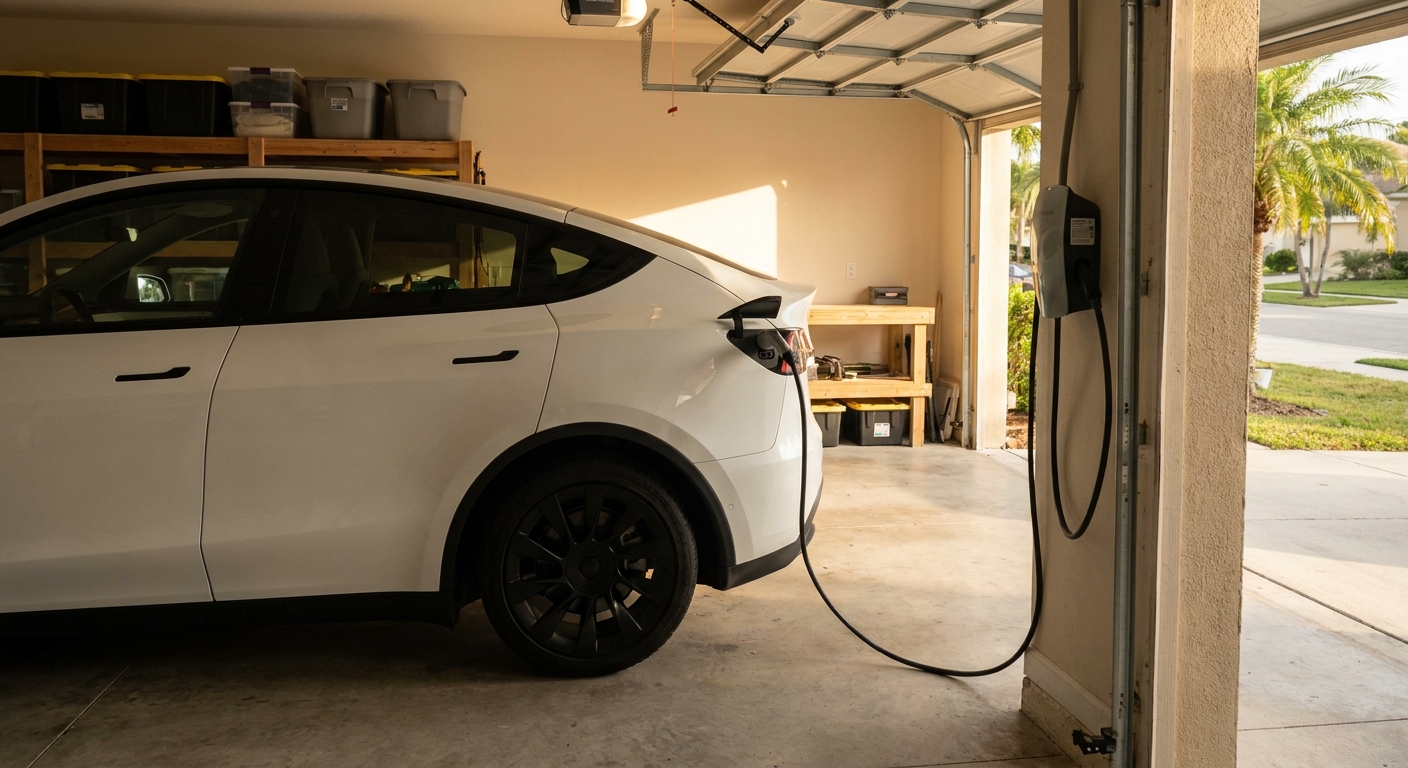
The EV charger installation cost in Tampa depends on the charger, electrical capacity, circuit route, mounting location, permits, and any required panel or service work. A contractor must inspect the property before setting a price. An open breaker space alone doesn’t prove the home has enough electrical capacity.
Homeowners in Tampa, Wesley Chapel, and nearby communities can use these factors to prepare for an accurate proposal.
A published installation benchmark
Tesla’s U.S. home-charging guide estimates $750 to $1,500 for installation of a Wall Connector or Universal Wall Connector. Hardware is sold separately; Tesla Shop prices change, so check that page for the current Wall Connector figures. Those are Tesla’s numbers, not a Tampa average or a Tampa Electrical Pro quote.
Tesla describes standard labor, materials, permitting, inspection, and an installation warranty within that installation scope. A long wire route, panel changes, trenching, a pedestal, or concealed wiring can add cost. Compare that scope with the electrician’s proposal for your property.
This site’s published Tampa range for a Level 2 charger with adequate panel capacity is $1,200 to $2,000. If a panel upgrade is required, the published 100A to 200A band is $2,500 to $4,500. Permit fees typically run $75 to $150 depending on the municipality. Those figures are not a quote for a specific house.
What determines EV charger installation cost in Tampa?
The largest cost differences usually come from the equipment selected and the electrical work needed to support it. The vehicle, daily driving, and time parked at home also affect the right charging setup.
According to the U.S. Department of Energy’s home-charging guidance, Level 1 charging can cover some drivers’ daily needs when suitable power and enough parked time are available. Level 2 charging uses 240 V and can provide more charging power. The electrician evaluates whether the proposed load fits the home’s electrical system.
| Cost area | What the contractor evaluates | Why it changes the proposal |
|---|---|---|
| Charger hardware | Vehicle compatibility, connector, cord placement, product listing, and indoor or outdoor rating | Equipment features and installation requirements vary by model |
| Circuit and route | Panel location, cable path, access, mounting surface, and whether exterior or underground work is needed | Longer or less accessible routes require different materials and labor |
| Compatible service load management | Whether the charger and control equipment provide a verified load-management function | A phone app or charging schedule alone doesn’t prove the system manages service load |
| Panel or service changes | Existing loads, equipment condition, service capacity, and the proposed charging load | Spare breaker spaces aren’t the same as available electrical capacity |
| Permits and inspection | Property jurisdiction, project scope, and the authority’s current process | Requirements and fees depend on the actual property and work performed |
How should charging needs affect the project?
Start with the energy the vehicle must recover during its usual parked period. A driver with a short daily route may not need the highest charging power available. A household with longer daily travel or multiple vehicles may need a different plan.
The vehicle’s supported charging rate also matters. Installing equipment capable of delivering more power doesn’t make a vehicle accept energy faster than its onboard system allows.
No charger should be promised to take every vehicle from empty to full overnight. Battery size, remaining charge, vehicle limits, selected charging power, and parked time all affect the result.
Why isn’t an open panel slot enough?
An open slot only shows that a breaker position may be available. It doesn’t show how much additional load the electrical service can safely support.
The electrician needs the charger specifications and the home’s actual electrical loads. The panel’s condition, labeling, installed equipment, and service configuration also matter. Read our guide to preparing an electrical panel for an EV charger before the site evaluation.
A panel upgrade isn’t automatically required because a home has limited space or an older panel. The decision should follow an evaluation of the existing system and the proposed load.
When does load management matter?
Compatible load-management equipment can adjust charging in response to other electrical demand. That may provide an option when unrestricted charging would exceed the available capacity. The equipment must be designed, listed, and configured for that purpose.
A charger described as smart may only offer timers, usage data, or app controls. Those features can be useful, but they don’t automatically provide service load management. Ask the contractor to identify the exact control method and compatible equipment in the proposal.
How do the circuit route and location affect scope?
A charger near the panel may require a simpler route than one across a finished house or detached parking area. The contractor should inspect access, structural support, wiring protection, and the intended mounting surface.
Outdoor equipment must be rated for outdoor use. Actual exposure matters, including whether water can reach the charger or its connections. Product instructions and the site conditions determine the suitable equipment and mounting method.
Who handles permits and association requirements?
The selected contractor determines which electrical permits and inspections apply to the work. Jurisdiction depends on the property, so a mailing address or county name may not identify the correct authority.
Association approval is a separate issue. Homeowners should review current architectural rules before choosing a visible exterior location. Don’t assume an exemption, approval, or required mounting method without checking the documents that apply to the property.
Tampa Electrical Pro connects customers with independent licensed and insured electricians. The selected contractor determines scope, permits, scheduling, workmanship, and price.
What about incentives and tax credits?
Don’t include an incentive in the project budget until current eligibility is confirmed. Program dates, locations, property requirements, and taxpayer circumstances can limit eligibility.
The IRS alternative-fuel refueling property credit guidance states that the individual credit applied to eligible property placed in service from January 1, 2023, through June 30, 2026, subject to location and other restrictions. That installation deadline has passed for a new September 2026 project. Filing for a previously qualifying installation is a separate tax matter.
Should generator plans be discussed at the same time?
Yes, tell the electrician about planned or existing backup equipment. An EV charging load and a whole-home generator involve different operating conditions, but both can affect how the electrical system is evaluated.
A charger’s app features don’t establish generator compatibility. The contractor should review the transfer equipment, controlled loads, charger settings, and manufacturer instructions before proposing how the systems interact.
Frequently asked questions
Does every Level 2 charger require a service upgrade?
No. The electrician must evaluate the home’s existing loads, service capacity, equipment, and proposed charger. Panel amperage or spare slots alone can’t answer the question.
Is Level 2 always the right choice?
No. The right choice depends on the vehicle, daily driving, available power, and parked time. Level 1 may cover daily needs for some drivers, while others benefit from Level 2 charging.
Does a smart charger automatically manage electrical load?
No. App access, timers, and energy reports don’t prove service load management. Confirm that the specific charger and control equipment support a compatible load-management method.
Can an outdoor charger use the same equipment as a garage charger?
Only when the equipment is rated for the actual location and exposure. The electrician should follow the product listing, manufacturer instructions, and site conditions.
How can I request an installation proposal?
Call (813) 850-0320 or review EV charger installation in Tampa Bay. Tampa Electrical Pro will connect you with an independent licensed and insured electrician who can evaluate the property and define the project scope.