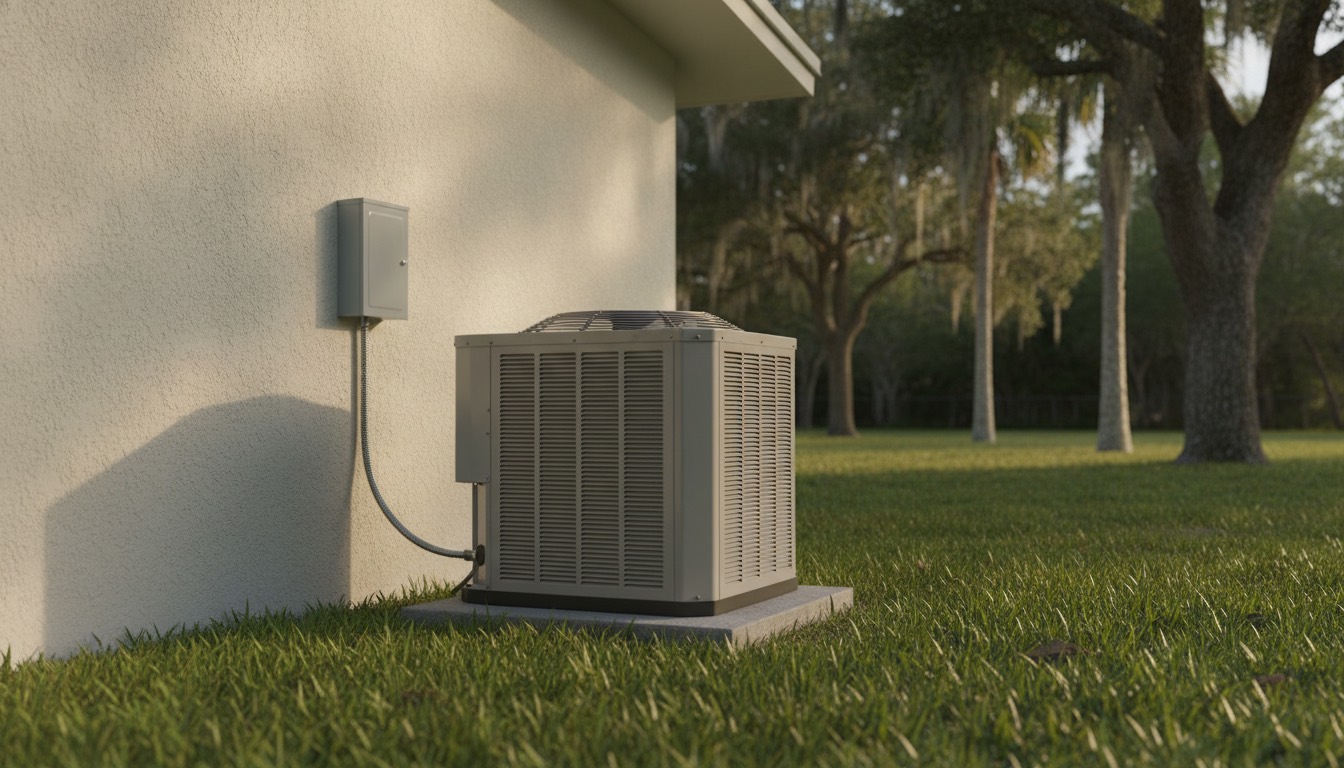
A quick, slight dip in brightness as the AC compressor starts can reflect ordinary starting current. Flickering that continues, becomes more noticeable, affects different parts of the house unevenly, or appears with heat, arcing sounds, shocks, or a burning odor calls for prompt professional inspection.
Is it normal if lights flicker when the AC turns on?
A momentary dim can happen when the compressor starts. That change alone does not establish that the electrical panel is failing or that the home needs more service capacity.
The useful distinctions are what the lights do, where it happens, and whether the effect stops after startup. Without opening the panel or AC disconnect, note whether the flicker:
- Ends as soon as the AC finishes starting
- Continues while the system runs
- Affects one room, several circuits, or the whole house
- Makes some lights brighter while others dim
- Appears with buzzing, crackling, visible discoloration, noticeable heat, shocks, or a burning odor
These observations help a qualified professional investigate the right part of the system. They do not identify the fault by themselves. Our guide to electrical warning signs in Tampa homes covers other symptoms that deserve attention.
Why does an air conditioner draw more current at startup?
An AC compressor needs more current to begin moving than it needs while running.
Tampa Electric’s Standard Electrical Service Requirements, version 1.0 (October 2025), describes this starting-current effect. Starting a motor takes more current than keeping it running after it reaches speed. If that inrush isn’t limited, voltage can fluctuate on the home using the motor and on other customers’ wiring. Starting more often makes those fluctuations worse. The manual notes that National Electrical Code Article 430 classifies motors by locked-rotor, or starting, input.
Hot outdoor conditions can add to the operating load because the condenser has more difficulty shedding heat. Our guide to an AC breaker that keeps tripping explains that mechanism and why a tripping breaker should not be repeatedly reset.
The same manual defines flicker as a brief change in voltage when a load switches on or off. A voltage dip is a brief drop in voltage.
What limit does Tampa Electric publish?
For customer equipment in its territory, Tampa Electric may require disconnection of equipment that causes a voltage dip of 4 percent or more of nominal voltage, flicker it treats as a problem, or radio, TV, or similar high-frequency interference. That 4 percent figure is a utility service-limit right, not a homeowner safety threshold. A smaller dip does not establish that the condition is safe.
Table VIII-2 in that October 2025 manual lists maximum starting-current steps for single-phase, 230-volt air-conditioning equipment in Tampa Electric territory:
| Equipment size | Maximum starting-current step at 230 V |
|---|---|
| 1 ton / 12,000 BTU | 34 amps |
| 1 1/2 ton / 18,000 BTU | 51 amps |
| 2 ton / 24,000 BTU | 68 amps |
| 3 ton / 36,000 BTU | 102 amps |
| 4 ton / 48,000 BTU | 136 amps |
| 5 ton / 60,000 BTU | 170 amps |
The figures assume sized, maintained equipment and no more than four starts an hour. The amp limits are coincident starting current from the compressor, condenser fan motor, and air-handler blower motor together, not compressor current alone.
If starting current is above those values, the customer should look into manufacturer-recommended equipment that reduces starting current and how long it lasts. The manual does not name a particular product, and no method is guaranteed to correct flicker in a given home.
The table also notes that two smaller units can sometimes perform better than one larger unit. That is not a sizing recommendation for a particular house, and it is not a performance guarantee.
These figures are that manual’s requirements for the equipment the table covers in Tampa Electric territory, not a statewide Florida rule. Confirm present property and equipment requirements with the utility that serves the meter. Duke Energy Florida serves other parts of the Tampa Bay area, including portions of Pinellas and Pasco counties. Duke customers should confirm the applicable requirements with Duke rather than applying Tampa Electric’s figures automatically.
When does flickering need prompt attention?
Arrange a prompt inspection when flickering continues beyond startup, changes noticeably, or appears with another electrical warning sign. Do not remove covers, reach into electrical equipment, or approach equipment that is wet or visibly damaged.
Warning signs include:
- Some lights becoming brighter while others dim
- A burning odor near a panel, receptacle, switch, or other equipment
- Buzzing or crackling from electrical equipment
- Visible heat damage or discoloration
- Shocks or tingling from switches, appliances, or fixtures
- Frequent breaker trips
- Flickering that continues after the AC finishes starting
Uneven brightening and dimming across the house can involve the service or neutral, but the visible pattern cannot establish the exact cause. The half-house power loss guide explains related symptoms and safe next steps.
If there is smoke or fire, leave the hazard area and contact emergency services. For other warning signs, avoid repeated resets or contact with the affected equipment and request qualified electrical inspection.
Should I call an electrician or my AC company?
Start with an HVAC contractor when the symptom appears confined to the AC equipment, its existing disconnect, or its dedicated HVAC circuit. Contact an electrician when the panel, service, neutral, or unrelated circuits may be involved. Whole-house symptoms may require the two trades to coordinate.
Florida law gives air-conditioning contractors a specific but limited electrical scope. F.S. 489.105(3)(f) includes the authority “to replace, disconnect, or reconnect power wiring on the line or load side of the dedicated existing electrical disconnect switch on single phase electrical systems; to repair or replace power wiring, disconnects, breakers, or fuses for dedicated HVAC circuits with proper use of a circuit breaker lock; to install, disconnect, and reconnect low voltage heating, ventilating, and air-conditioning control wiring”.
The same provision excludes general “electrical power wiring” from that scope. Class B air-conditioning contractors receive the same narrow electrical allowances, although their broader HVAC scope has separate limits. These provisions do not authorize an HVAC contractor to work generally on a home’s panel, service, neutral, or unrelated branch circuits.
The practical division is:
- AC equipment, the existing disconnect, and the dedicated HVAC circuit may begin with a properly licensed HVAC contractor.
- The panel, electrical service, neutral, and unrelated circuits belong with an electrician whose license covers that work.
- Symptoms affecting the whole house may require coordinated HVAC and electrical evaluation.
Tampa Electrical Pro can connect homeowners with independent licensed and insured electricians for electrical repair when the concern extends beyond the AC equipment and its dedicated circuit.
What can correct AC-start flickering?
The right response depends on what testing finds. The flicker itself does not reveal whether anything needs replacement.
| What you observe | Sensible next step |
|---|---|
| A slight dip that ends with compressor startup and has no other warning signs | Note whether it changes or begins affecting other circuits |
| Flicker confined to AC startup or the dedicated HVAC circuit | Ask an HVAC contractor to evaluate the equipment and dedicated circuit |
| Flicker affecting unrelated circuits or producing uneven brightness | Ask a qualified electrician to inspect the electrical system |
| Flicker with heat, odor, arcing sounds, shocks, or repeated trips | Stop interacting with the affected equipment and seek prompt qualified help |
For an AC-side issue, the equipment manufacturer may specify a method for reducing starting current and duration. A hard-start kit is one possible example, but Tampa Electric does not recommend that product by name, and it is not a guaranteed solution for a particular home.
If testing identifies a failed connection, neutral problem, or another electrical defect, the repair should address that finding. If a load calculation shows that service capacity is inadequate for the home’s actual loads, a panel or service upgrade may be part of the solution. Flickering alone does not prove that conclusion, and available breaker spaces do not establish adequate service capacity.
The panel upgrade guide explains the difference between warning signs and actual capacity needs. Our guide to home electrical service size covers load evaluation in more detail.
Frequently asked questions
Should my lights dim every time the AC starts?
A quick, slight dim can occur during compressor startup. Have the condition evaluated if it grows stronger, continues after startup, affects unrelated circuits, or appears with another warning sign.
Does flickering mean I need a new electrical panel?
No. Flickering alone does not prove that the panel or service is undersized. Starting current, AC equipment, circuit connections, service conditions, and the home’s actual load are separate parts of the evaluation.
Will a hard-start kit stop the flickering?
It cannot be promised. A hard-start kit is one example of equipment that may be considered when the manufacturer recommends reducing starting current and duration. An HVAC contractor should evaluate the AC equipment before recommending a product.
Should an HVAC contractor check the problem first?
Start with HVAC when the symptom appears limited to the AC equipment, existing disconnect, or dedicated HVAC circuit. Contact an electrician when the panel, service, neutral, or other circuits may be involved.
What if some lights brighten while others dim?
Treat that pattern as a warning sign and arrange a prompt electrical inspection. It can involve a service or neutral problem, but a professional needs to determine the actual cause. Do not open the panel or attempt live electrical tests.
Find the right electrical help in Tampa Bay
Tampa Electrical Pro refers homeowners to independent licensed and insured electricians serving Hillsborough, Pinellas, and Pasco counties.
Call (813) 850-0320 when AC-start flickering affects other circuits or appears with electrical warning signs. If the concern remains confined to the AC equipment and its dedicated circuit, begin with a properly licensed HVAC contractor.