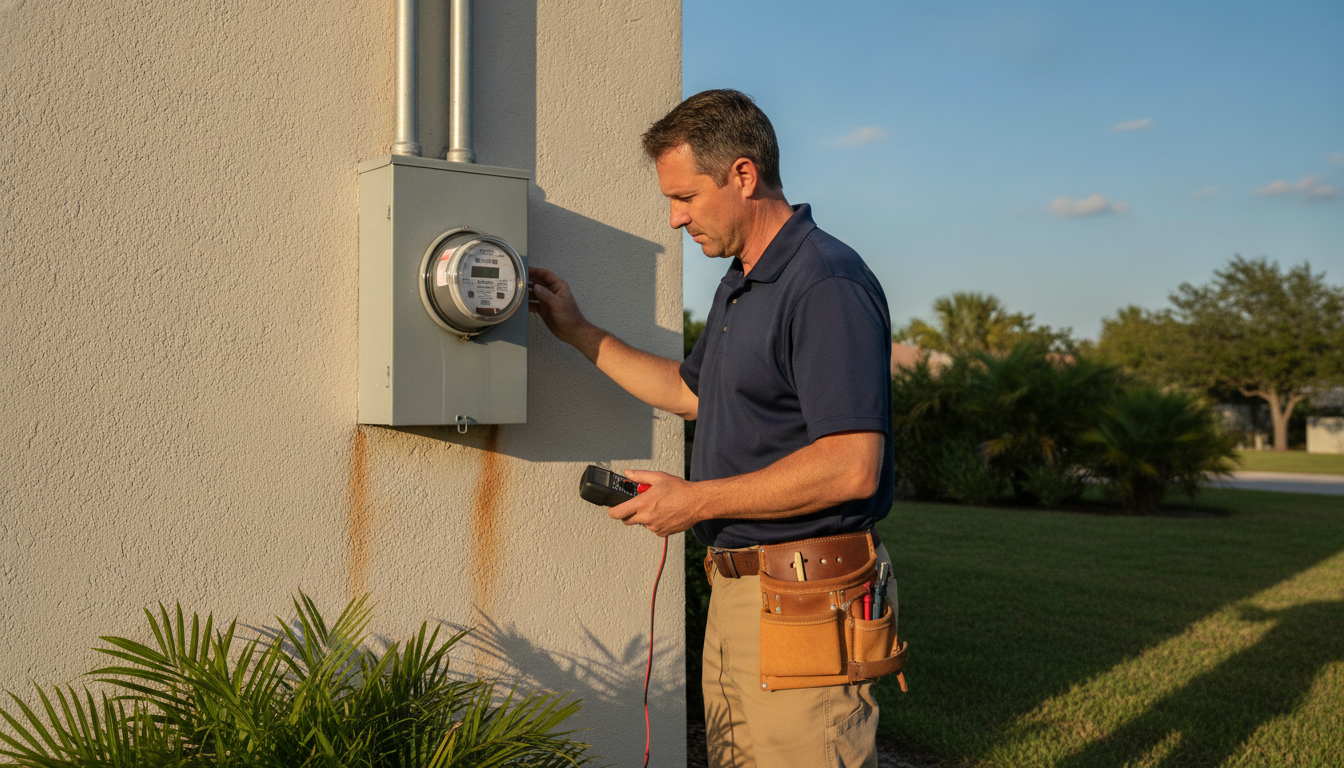
When a large part of your house loses power at once, report the partial outage to your electric utility and avoid trying to diagnose it by operating breakers or opening electrical equipment. The fault could be on the utility supply, in customer-owned service equipment, at the main breaker or panel, or on a feeder serving part of the home.
Changing brightness, heat, discoloration, buzzing, crackling, a burning odor, shocks, or repeated trips call for prompt qualified inspection. If there is smoke or fire, leave the hazard area and contact emergency services. Stay away from downed lines and from any wet, damaged, hot, or displaced electrical equipment.
What can make part of a house lose power?
Most Tampa Bay homes receive two 120-volt supply legs. Ordinary 120-volt circuits are distributed between them, while many 240-volt appliances use both. If one supply leg is interrupted, numerous lights and receptacles may stop working and 240-volt equipment may fail to operate correctly.
That is one possible explanation, not a diagnosis. Other possibilities include:
- A utility-side service problem
- A loose or failed connection in service equipment
- A problem at the main breaker or panel
- An open or compromised neutral
- A feeder or double-pole breaker problem affecting a subpanel or another group of circuits
- More than one branch-circuit fault after a storm or other damaging event
An open or compromised neutral can produce abnormal voltage. Lights that brighten or dim as loads change are an important warning sign, but the pattern alone cannot identify the failed component or show which side of the meter contains the fault.
If only one circuit is affected, the guide to a breaker that keeps tripping explains the separate branch-circuit questions an electrician may investigate.
What should you do now?
- Report the partial outage to the electric utility shown on your bill. The utility can check for a supply problem and explain whether customer-side work is needed.
- Stop using equipment that is behaving abnormally. Do not create additional load to test which lights or appliances change.
- From a safe distance, note which areas lost power and whether you observed flicker, unusual brightness, odors, sounds, heat, visible damage, or storm damage. Share those observations without treating them as a diagnosis.
- Do not remove a meter, open a panel, touch service conductors, or approach damaged or wet equipment. Parts of the service can remain energized even when the main breaker is off.
- Do not repeatedly reset a breaker. A breaker that trips again is signaling a fault that needs evaluation.
Turning off the main breaker is not a universal instruction for a partial outage. If the panel or surrounding area is wet, damaged, hot, buzzing, crackling, smoking, or difficult to reach safely, do not approach it. Follow instructions from the utility, emergency responders, or a qualified electrician based on the actual conditions.
Is the utility or the homeowner responsible?
The answer depends on where the fault is and how the property is supplied. Utility-owned equipment and customer-owned equipment meet near the service entrance, so a symptom inside the house does not establish responsibility.
For an overhead service, the utility generally distinguishes its incoming service line and meter from customer-side mounting, enclosure, mast, riser, attachment, disconnect, and panel equipment. Underground services and individual properties can be arranged differently. Tampa Electric provides electrical and service-safety guidance on its home safety page, but the utility should confirm the responsibility boundary for the specific address and damage.
A downed or damaged utility line should be reported directly to the utility while everyone stays well clear. If the utility identifies a customer-side defect, a licensed electrician can inspect the service equipment and coordinate the applicable repair, jurisdictional review, and reconnection steps. Tampa Electrical Pro can refer homeowners to licensed and insured electricians for that customer-side assessment.
What information helps when you call?
You do not need to perform an electrical test. Useful observations include:
- Whether the utility has already opened an outage report
- Which rooms or fixed appliances lost power
- Whether the problem is steady or intermittent
- Whether lights changed brightness before or during the outage
- Whether there was a storm, falling limb, water intrusion, or visible exterior damage
- Whether the affected area is supplied by a subpanel
- Whether there is heat, odor, buzzing, crackling, smoke, or discoloration
These details help the utility or electrician decide what must be inspected. They do not safely prove a lost leg, open neutral, failed breaker, or damaged connection from a distance.
When is a partial outage especially hazardous?
Keep away from the equipment and seek immediate help if you see a downed line, displaced meter enclosure, damaged service mast, smoke, fire, arcing, or water around electrical equipment. Burning odors, hot or discolored plates, buzzing, crackling, shocks, repeated trips, and unexplained brightening or dimming also require prompt professional attention.
A quiet or steady-looking outage is not remotely cleared as safe. Some connection failures produce little visible evidence. Report the outage and let the utility or electrician determine the next step instead of waiting for the symptom to worsen.
What changes the repair scope and cost?
The decisive question is where the fault is located. Utility-side work follows the utility’s process. Customer-side work can range from correcting an accessible connection or breaker problem to replacing damaged service equipment or repairing a feeder.
The scope may change based on:
- Whether the fault is before or after the utility’s responsibility boundary
- The condition of the meter enclosure, service mast, disconnect, panel, and feeders
- Whether storm or water damage is present
- Whether utility disconnection and reconnection are required
- The property’s permitting jurisdiction and any required inspection
- Access to the equipment and the amount of damaged material
- Whether testing identifies a separate panel or service-capacity issue
A partial outage by itself does not prove that the panel is obsolete, that the electrical service is undersized, or that a panel upgrade is necessary. Circuit space, equipment condition, and service capacity are separate questions that must be evaluated from the installed system and actual loads.
Can a generator solve a partial outage?
A generator does not repair a failed utility connection, neutral, meter enclosure, service conductor, panel, or feeder. Fixed standby equipment uses transfer isolation from the utility, but whether it can operate safely during service damage depends on the installed system and the location of the fault.
Never connect a portable generator to house wiring by backfeeding a receptacle. Portable generators may supply individual appliances through properly rated outdoor cords, but they must remain outdoors far from the home and away from openings because fuel-burning equipment creates carbon monoxide, fire, and electrical hazards. Do not improvise generator use as a test or workaround for an unexplained partial outage. A qualified electrician must evaluate any connection to house wiring. Learn more about properly installed standby generator systems.
Frequently asked questions
Can one breaker leave a large section of the house without power?
Yes. A double-pole breaker or feeder problem can affect a subpanel or a large group of circuits. A main-breaker or panel fault can also create broad symptoms. That is why the pattern of dark rooms alone cannot prove the problem is outside the panel.
Do bright and dim lights prove the neutral is open?
No. They are warning signs of abnormal electrical conditions and justify prompt inspection, but they do not identify the failed part from a distance. Stop operating loads to test the pattern and report what you observed.
Should I leave the power on while waiting?
There is no reliable remote answer based only on whether lights appear steady. Do not touch wet, damaged, hot, noisy, or displaced electrical equipment. Report the outage immediately and follow case-specific instructions from the utility, emergency responders, or a qualified electrician.
Who should I call first?
Call the electric utility shown on your bill to report the partial outage. The utility can investigate its supply and identify whether a licensed electrician needs to inspect customer-owned equipment. Call emergency services for smoke or fire, and stay away from downed lines.
Can I run extension cords from the working rooms?
Do not use the energized part of the house as a workaround while the cause remains unknown. Additional loads can complicate an abnormal-voltage condition, and routing cords through the home introduces other hazards. Ask the utility or electrician what equipment, if any, can remain in use.
Get the fault located before using the system normally
A partial outage is a symptom, not a complete diagnosis. The useful next answer is whether the fault is on the utility supply or in customer-owned service, panel, or feeder equipment. Tampa Electrical Pro connects homeowners across Hillsborough, Pinellas, and Pasco counties with licensed and insured electricians who can evaluate customer-side electrical work after the utility’s role is established.