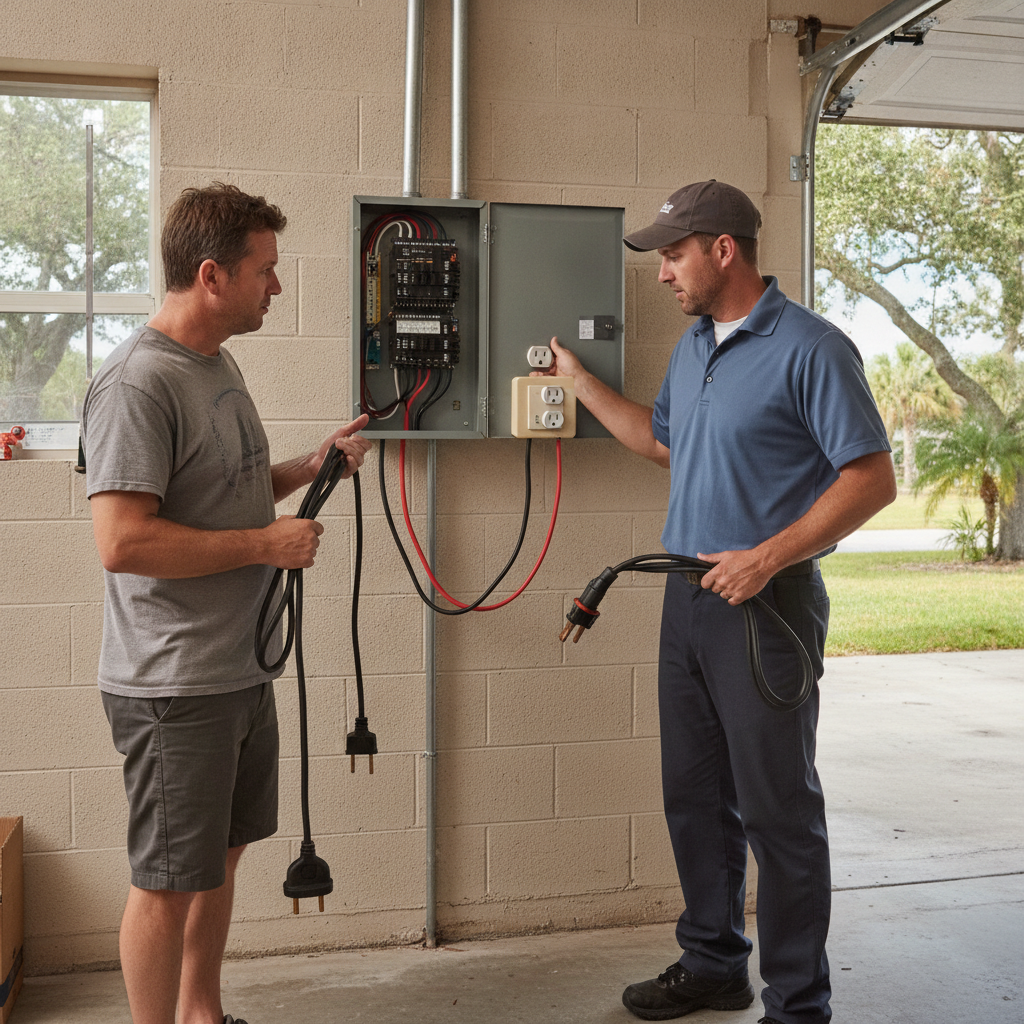
The new dryer is sitting on a Brandon garage slab with a four-prong cord in the box, and the wall receptacle has three slots. That mismatch is not a style problem. Three-prong dryer outlets share the cabinet bond with the neutral. Four-prong outlets keep those paths apart, and the cord has to follow the cable that is actually in the wall.
Why older Tampa houses still have a 3-prong dryer plug
A three-prong dryer receptacle is a 120/240-volt appliance outlet with two hot slots and one neutral slot, and no separate equipment-ground slot. You still find that pattern in Tampa Bay laundry rooms because that is how electric dryers were wired for a long stretch: two hots for the heating element, and a neutral that also bonded the metal cabinet.
The weakness is in that shared job. The dryer’s motor, timer, and controls run on 120 volts, so the neutral carries current during ordinary use. An equipment ground is supposed to stay quiet until something fails. When those two jobs share one conductor, a loose or broken neutral can put the dryer cabinet at a dangerous potential relative to the washer beside it, a water line, or a wet hand on the door.
That does not mean the three-slot outlet in a Hyde Park bungalow or a Lutz ranch is failing because of the neighborhood or the year on the tax card. A build year does not establish the cable in the laundry wall. The electrician has to see the conductors, how they land, and whether the terminations are tight.
A three-prong dryer receptacle is also not a bigger cousin of a living-room duplex. It is a 240-volt appliance connection. Ungrounded 120-volt outlets are a different problem with a different fix. Do not read the dryer wall the way you read a lamp receptacle.
Tampa Electric’s home-safety guidance is blunt about a plug that sits loose in the wall: the outlet needs repair, and unless you are a qualified electrician you should not repair electrical products yourself. A wobbly dryer plug is not a cord problem you solve by shoving harder. Heat, discoloration, buzzing, or a burning odor at that receptacle is a reason to stop using it and have a licensed electrician look, not a reason to keep drying one more load.
What a 4-prong outlet changes
A four-prong dryer outlet adds a dedicated equipment grounding conductor. Two hots still feed the 240-volt heat. The neutral still returns the 120-volt control current. The fourth conductor is the fault path back to the panel, so a breaker can open if a hot conductor contacts the cabinet.
On the dryer, that change has a matching detail. Four-wire installations keep the neutral terminal isolated from the cabinet. Three-wire installations used a bonding connection between the neutral and the frame. The dryer’s own installation sheet governs which way that strap or jumper sits. A four-prong cord with the frame still bonded to the neutral, or a three-prong cord with that bond removed, puts the safety path in the wrong place.
| What differs | 3-prong dryer outlet | 4-prong dryer outlet |
|---|---|---|
| Conductors in the wall | Two hots and a neutral | Two hots, a neutral, and a separate equipment ground |
| What the extra path is for | The neutral also bonds the dryer frame | The ground is the fault path; the neutral stays off the cabinet |
| Cord and strap | Three-prong cord, bonding set for three-wire per the dryer instructions | Four-prong cord, bonding set for four-wire per the dryer instructions |
| What a faceplate cannot do | The slot pattern has to match the cable | A four-slot cover on three-wire cable does not create a ground |
A four-slot receptacle is only doing its job if that fourth slot is landed on a real equipment grounding conductor that runs with the circuit. The extra hole in the plastic is not the protection. The conductor behind it is.
The wall decides the cord, not the carton. New dryers often arrive with a four-prong cord. If the laundry receptacle is three-slot, that cord does not belong on this circuit until the cable is four-wire. If the receptacle is four-slot, the dryer needs a four-prong cord and the four-wire bonding setup. A three-prong plug will not seat in a four-prong outlet, and the reverse is also true. That is the point of the different patterns.
A dryer receptacle is a 240-volt appliance outlet, not a larger version of a bedroom duplex. The electrician matches the receptacle, the cord, the cable, and the breaker as one circuit, not as four separate shopping-list items.
Cord swap vs a new home run
A cord swap is the smaller job, and it only works when the wall already has the conductors the new pattern needs. If the cable already contains two hots, a neutral, and a separate ground, the electricians we send can often install a four-prong receptacle after checking the box, the terminations, and the breaker against the cable and the dryer nameplate. The dryer then gets a four-prong cord, with the bonding set the way the maker shows for four-wire.
If the cable has only three conductors, a four-prong outlet at the end of it is cosmetics. The honest upgrade is a new four-conductor run from the laundry to the panel. That is where Tampa construction shows up as a route problem, not as a diagnosis. Slab houses in Riverview and FishHawk have no basement to fish through. A dryer on an interior Westchase wall with the panel in the garage can mean attic work, a long surface path, or opening finishes. A Hyde Park plaster wall changes how that run gets routed. None of that tells you what the house “should” already have. It tells you what the new cable actually has to do.
The breaker has to match the cable and the dryer. Putting a larger breaker on an undersized cable to stop trips overheats the wire. Do not keep resetting a dryer circuit that trips. Tampa Electric’s same home-safety page says that if one appliance repeatedly trips a breaker, or if it has given a shock, unplug it and have it repaired or replaced.
Panel capacity is a separate question from the receptacle pattern. The dryer is one 240-volt load. If the same panel is also being asked to feed an EV charger or a whole-home generator, the electrician is looking at service capacity and spare circuit space as two different problems. A panel upgrade is sometimes part of that picture. It is not automatic just because the laundry outlet is three-slot.
A new home run is licensed electrical work. Florida certified electrical contractors can work statewide, and registered contractors work in their authorized local jurisdictions. Specialty licenses have bounded scope. The electrician confirms the permit and inspection steps with the authority for that address. In Pinellas, which department reviews the job depends on the city. Largo has its own Building Division. A Tampa mailing address does not decide the reviewing office.
An adapter that only rearranges pins does not pull a ground conductor out of a three-wire cable. If the fourth prong has nowhere real to land, the adapter has not made the installation four-wire.
This is what the electrician has to identify at the property, not what a neighborhood implies.
The cable in the dryer box shows how many conductors actually reach the laundry. The dryer nameplate and the cord instructions set the bonding and the cord pattern. The breaker has to match the cable already in the wall, not the trip history. Heat, a loose plug, or a burning odor at that receptacle is a reason to stop using the outlet until it is repaired.
Questions about dryer cords and adapters
Can I hook up a 3-prong dryer cord to a 4-prong dryer?
The dryer usually has terminals that can accept either cord. The wall outlet still decides which cord belongs. A machine that shipped with a four-prong cord does not override a three-slot receptacle. If you keep the three-slot outlet, the cord has to be three-prong and the bonding has to follow the three-wire instructions. If you want the four-prong cord that came in the box, the circuit in the wall has to be four-wire first.
How do you know if you need a 3-prong or 4-prong dryer?
Look at the receptacle in the laundry wall. Three slots means a three-prong cord and the three-wire bonding setup. Four slots means a four-prong cord and the four-wire setup, and only if that fourth slot is on a real equipment ground. The carton, the model year of the dryer, and the age of the house do not settle it.
Will a 3-prong plug work in a 4-prong outlet?
No. The patterns are different on purpose, so the plug will not seat. Forcing a mismatch or stacking an adapter that does not add a real equipment ground leaves the cabinet on the wrong path. Match the cord to the receptacle, or rebuild the receptacle to match a real four-wire cable.
Are 4-prong to 3-prong dryer adapters safe?
An adapter that only changes the pin layout does not add the missing ground conductor. The protection of a four-prong outlet is the separate equipment grounding path, not the extra hole in the plastic. If that path is not in the cable, the adapter cannot invent it. The electricians we send treat the cable, not the adapter aisle, as the real decision.
When to call us
A dryer cord on a 240-volt receptacle is licensed electrical work when the cord and the wall do not match, when the plug is loose, or when that circuit trips, heats, or smells. The electricians we send are licensed and insured, and the selected contractor prices the job after seeing the cable and the panel. Call us at (813) 850-0320.