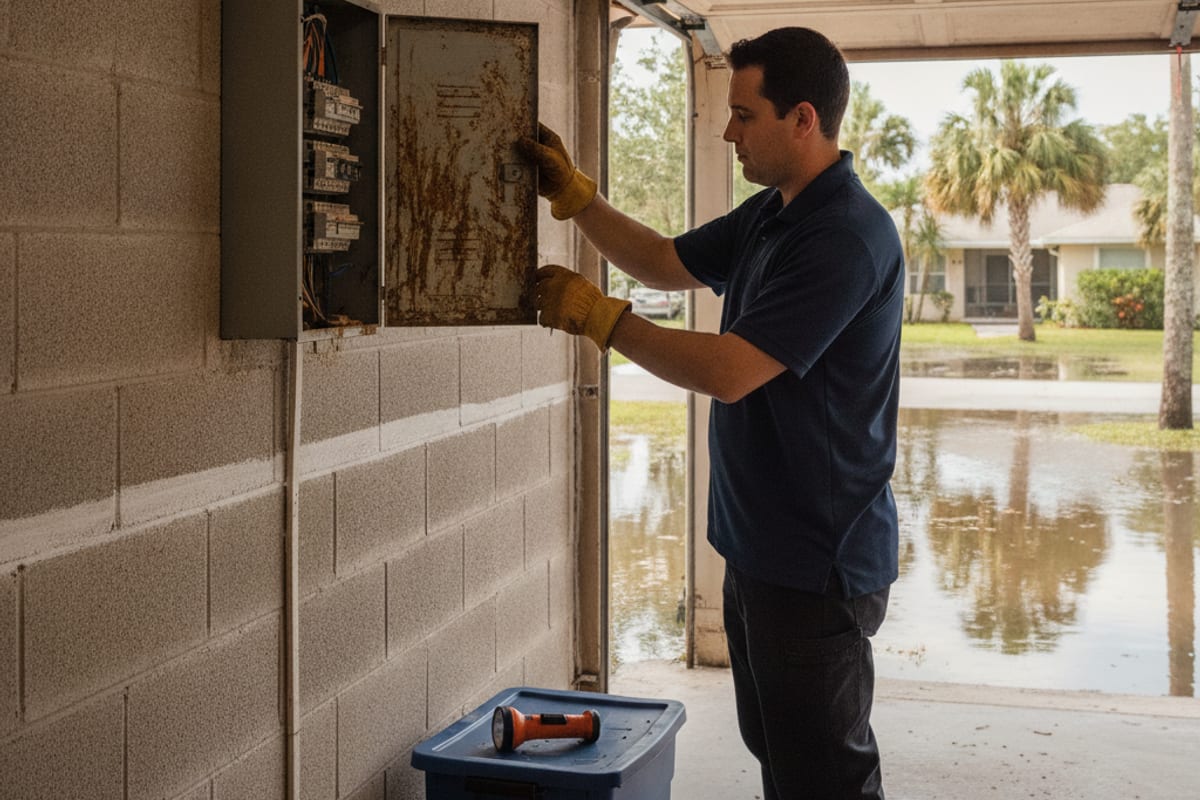
If storm water reached your outlets and your panel, most of the electrical parts that got wet are not dried out and put back. They are thrown away and replaced. Breakers, receptacles, switches, dimmers, GFCIs, AFCIs, surge protectors and ordinary NM-B house wiring are all on the replace side of NEMA’s guide to evaluating water-damaged electrical equipment. The steel can the breakers sit in is one of the few things that may survive.
And the power does not come back on your schedule. Tampa Electric’s own storm guidance says that if your home or business is flooded, “we cannot reconnect power until the electrical system has been inspected by a licensed electrician,” and that after the repairs the electrician has to get verification from your local building inspection authority before service is restored.
Water does not just wet a breaker, it changes how it works
A breaker looks like a solid plastic block, which is why people assume a few dry days fix it. Inside that block is a mechanical trip assembly that depends on lubrication, clean contact surfaces and insulation that has stayed dry. Flood water attacks all three at once. NEMA describes water exposure as affecting the operation of the mechanism through corrosion, through foreign particles left behind, and through loss of lubrication, while the contact condition degrades and the dielectric insulation of the internal materials weakens.
None of that shows on the outside. The breaker will still click. It will still feel normal in the hand. What you cannot see is whether it will still open in the quarter second that matters during a fault, and there is no field test a homeowner can run to find out. That is the whole reason the guidance says replace rather than clean and reuse: a protective device you cannot verify is not protection.
A GFCI or AFCI is worse, because it is a small electronic circuit sitting in a box that just filled with water. The test button proves the button works. It does not prove the sensing electronics survived.
What gets replaced, and what might be saved
| Part of the system | After it goes under water |
|---|---|
| Breakers, fuses, GFCIs, AFCIs, surge protective devices | Replaced. These are protective devices whose condition cannot be confirmed by looking at them. |
| Receptacles, switches, dimmers | Replaced. Contacts corrode and the internal paths carry conductive residue. |
| Outlet boxes, junction boxes, fittings, connectors | Replaced. A torqued mechanical connector cannot be cleaned and re-terminated reliably. |
| Light fixtures, dry-type transformers, batteries and UPS units | Replaced. |
| NM-B and other wire listed for dry locations | Replaced. That is the ordinary cable behind the drywall in most Tampa Bay houses. |
| Wire or cable suitable for wet locations | May be reconditioned, but only if the ends never got wet and the wire itself is undamaged. |
| The panelboard enclosure, conduit and tubing | May be reconditioned, with the manufacturer consulted first. |
The row that surprises people is the second-to-last one. A panel can be reconditioned while every single breaker inside it is scrap, and the romex feeding the flooded half of the house is scrap too. That combination is why a flood repair so often turns into a panel and service conversation rather than a parts swap: once the breakers, the devices and the branch wiring on the wet side are all being replaced, you are rebuilding that portion of the system anyway, and an old panel with no available breakers on the market decides itself.
Two practical notes on the table. The “may be reconditioned” column is not a green light, it is permission to ask the manufacturer, and NEMA is a consensus guide from manufacturers rather than a code or a permit rule. The authority having jurisdiction still governs, and for insurance purposes, NEMA notes that an insurance inspection department or company representative can be the authority having jurisdiction on your claim.
Salt water is its own category
A Tampa Bay flood is frequently not rain. Storm surge pushes bay water into Shore Acres, Davis Islands, the low blocks off Bayshore, the canal streets in Apollo Beach. NEMA singles this out: ocean water and salt spray are particularly damaging because the salt residue is both corrosive and conductive.
Conductive is the word that matters. Fresh water floods leave silt. Salt water leaves a film that keeps conducting after everything looks and feels bone dry, which is how a system can test fine on day three and start tracking and arcing weeks later. A house that took two feet of bay water and a house that took two feet of runoff from a blocked storm drain are not the same repair, even at the same depth on the same wall.
Salt also reaches things the water line suggests it missed. Wind-driven spray coats the exterior meter can, the service conductors at the weatherhead and the outdoor disconnect on a house that never had an inch of standing water inside. If the meter enclosure is pitted and streaked white after a surge event, that is a real finding and not cosmetic.
Where the water line falls decides the scope
The first thing a licensed electrician does is establish the high-water mark, then work out what the water touched on the way to it. A few inches across a slab floor is a very different job from water that reached the receptacles at 12 or 16 inches, and different again from water that reached a panel mounted low in a garage.
Depth is not the whole story though. Water wicks up inside a wall cavity past the visible line. It runs downhill inside conduit and pools at the low point of a run, which can be a box in a room that never flooded. In a home with the panel in the garage and a subpanel in a detached workshop, the underground feeder between them is often the part nobody thinks about and the part sitting in saturated ground.
This is also where the difference between “the circuit works” and “the circuit is safe” gets decided. A flooded branch circuit will happily carry power and light a lamp while its insulation is compromised and its grounding path is corroded. Working outlets after a flood are not evidence of anything. They are the reason people skip the inspection and find out later.
Getting the power turned back on in Hillsborough County
Hillsborough County’s own storm recovery guidance sets out the path for unincorporated county addresses. Keep the power off until a licensed electrician has inspected the system, and confirm the contractor holds a valid license and is insured to work in Hillsborough County. From there it splits two ways.
If the electrician finds no damage, or the repairs are minor and need no permit, Tampa Electric customers in unincorporated Hillsborough County have the electrician complete the Tampa Electric Company Service Release Agreement Residential/Commercial, Form E-268, which goes to TECO’s One Source team at [email protected]. If the damage needs a permit, the electrician makes the repairs and calls for the required Hillsborough County building inspections before power is restored. That permitted path is the normal one for anything structural in the system, and it follows the same permit logic as any other panel or circuit work in the county.
Addresses inside the city limits of Tampa, Plant City or Temple Terrace go through their own city government instead, and Pinellas and Pasco homeowners should call their own county building department rather than assume the Hillsborough form applies. Ask one question when you call: does this address need a permit and inspection, or a service release form.
If the house is being reinspected for insurance afterward, the electrical section of a four point inspection covers the same ground an adjuster will ask about, and an electrical repair visit after a flood is usually scoped around that documentation as much as around the wiring.
Can I just dry out my breaker panel with a fan and turn it back on?
No. Drying restores appearance, not function. The corrosion, the lost lubrication and the degraded insulation inside a molded-case breaker stay after the moisture is gone, and none of it is visible or testable in the field. The enclosure may be salvageable after proper cleaning and drying, but the breakers in it are replaced.
The flood only came up a few inches. Does anything really need replacing?
It depends on what those few inches reached. If the water never touched a receptacle, a box, a fitting or the low end of a cable run, the scope can be small. If it reached a floor-level outlet, a panel mounted low in a garage, or the bottom of an underground feeder, those parts are in scope regardless of how briefly they were wet. An electrician establishes the water line first and works out from there.
My lights and outlets work fine after the flood. Is that proof the wiring is okay?
It is not. A circuit with compromised insulation, corroded grounding or salt residue on its conductors will keep delivering power normally right up until it faults. Function after a flood tells you the conductors are still connected. It tells you nothing about whether the protective devices will still trip or whether the insulation will still hold.
Is a whole home surge protector worth replacing after a flood?
Yes, and it is one of the clearer calls. Surge protective devices sit in the replace column after water exposure, and a device that has already absorbed a flood is not the one you want in place for the next lightning season. Replacement is normally folded into the same visit as the panel work, and this site covers layered surge protection separately.
When to call us
A flooded electrical system is one of the few situations where the answer is simple: nobody should be energizing that system except a licensed electrician, and in Tampa Bay the utility will not reconnect it until one has been through it and the building authority has signed off. If storm water reached your panel, your outlets or your wiring, leave the main off and get a licensed pro out to establish the scope before anything else happens.
We match Tampa Bay homeowners with licensed, insured electricians who handle flood assessments, panel and device replacement, and the county inspection paperwork that gets the power back on. Call us at (813) 850-0320.