An electrical burning smell with no visible smoke or fire means a prompt qualified inspection, and if that smell is coming from outside at the service equipment the first call may not be to an electrician at all. Smoke or active fire means leaving the hazard area and contacting emergency services.
The odor can sit on either side of the meter. A partial outage that takes out half the house can start on the utility supply or in customer-owned equipment, and a smell can sit in that same unclear place. Stay away from damaged or wet equipment. Do not open covers, pull the meter, or treat turning the main breaker off as a disconnect from Tampa Electric.
Why you cannot find where it is coming from
You are trying to find a smell. The U.S. Fire Administration’s Residential Building Electrical Fires (2014-2016) report is about fires that already happened and were reported to fire departments. It is not a diagnosis of the odor in your house. Keep that line in mind as you read the numbers.
The report is a December 2018 analysis of National Fire Incident Reporting System records for 2014 to 2016. Its own subject includes electrical distribution, wiring, transformers, meter boxes, power switching gear, outlets, cords, plugs, surge protectors, lighting fixtures, and electrical arcing as the source of heat. Those are the fires in the dataset. They are not a list of what your house is doing right now.
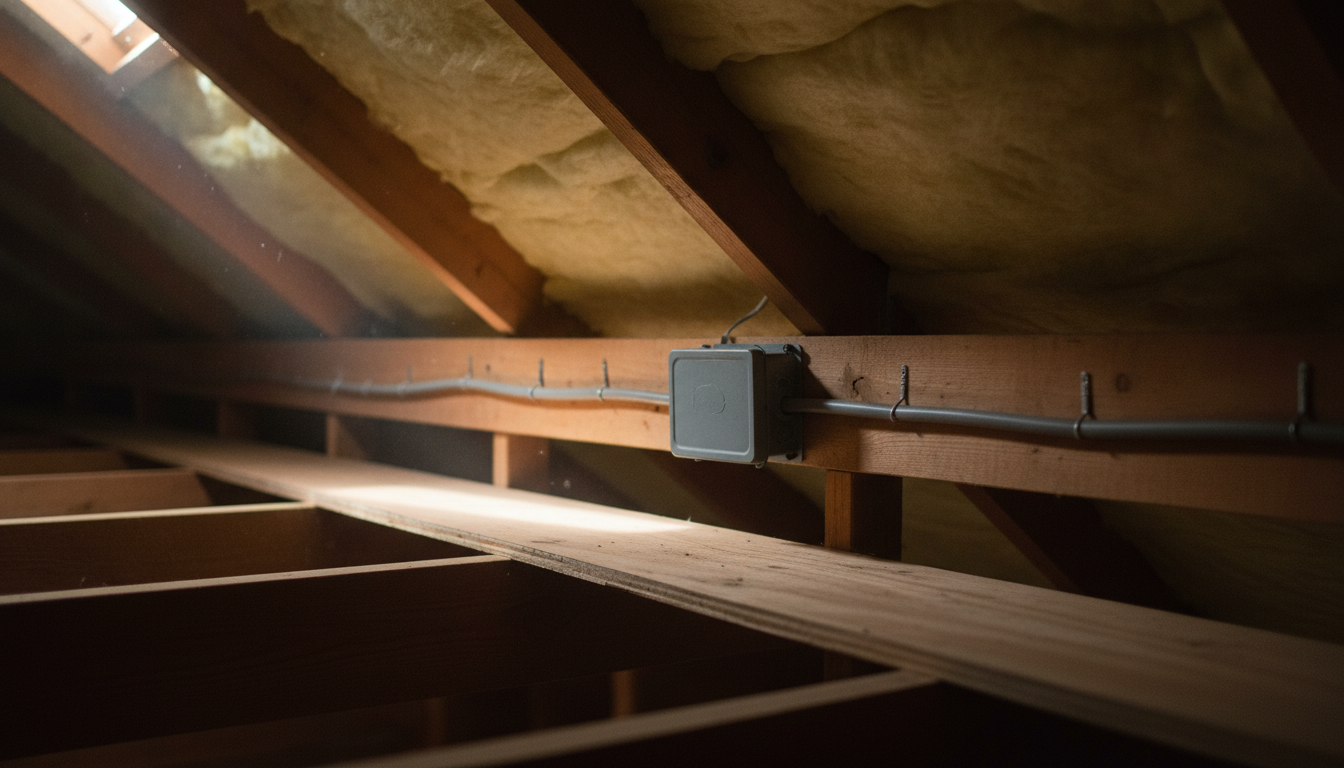
The leading areas of origin were “bedrooms (15 percent); attics or vacant crawl spaces (13 percent); walls or concealed wall spaces (9 percent)”. Two of those three are places you cannot inspect from the hallway. The items most often first ignited were “Electrical wire, cable insulation (31 percent) and structural member or framing (18 percent)”. The thing that burns first is often the insulation on a wire inside a cavity you cannot see.
The report states it outright: “electrical fires that start in walls can smolder for some time and cause smoke not to be seen immediately and detection to be delayed”. By the time smoke is seen, the flames may have “already spread behind and within walls”. That is why a smell with no visible plume is a poor reason to keep opening closet doors.
If you cannot locate the source, stop hunting through hatches and cover plates. Request an emergency electrician referral so a licensed electrician can inspect the house rather than leaving it in a wait-and-see loop.
What the published data says about waiting
“See if it gets worse” looks like a calm choice. The same report is why it is not a neutral one.
“While 64 percent of nonelectrical fires were limited to the object of origin”, “only 17 percent of electrical fires were limited to the object of origin”. Electrical fires also “resulted in almost twice as many fatalities per thousand fires and over twice as much dollar loss per fire than nonelectrical fires”. The report’s own discussion of that spread points back to detection: fires that start in walls can go unseen until they have already moved.
Those figures describe a hazard class in a national incident dataset. They do not tell you what is happening in your walls, and they do not turn an odor into a fire. They are why waiting for a louder smell, a visible mark, or a breaker trip is a poor plan for the class of event the report is measuring.
A smoke alarm detects smoke, not an odor
A common assumption is that the detectors will handle this. The report’s smoke-alarm numbers do not support that assumption for an odor, and they have to be read as what fire departments reported, not as a national rate.
“Smoke alarms were reported as present in 51 percent of electrical fires in occupied residential buildings.” When that present share was broken down, the report lists present and operated at 26 percent. The report states in its own words that these smoke-alarm figures “are not scaled to national estimates”. They are raw NFIRS counts from the incidents in the file. They are not a claim about how often alarms fail, and they are not a reading of your house.
The honest takeaway is narrower than that table. A smoke alarm is a smoke detector. An odor is not smoke. If you are smelling something and seeing nothing, the detector has not been given the condition it is built to notice.
What was involved when these fires started
This is still the fires that happened, not a checklist for the smell in the room.
The leading types of equipment involved in ignition were other electrical wiring at 31 percent, outlets and receptacles at 12 percent, and “electrical branch circuits (8 percent)”. “Extension cords (5 percent), panel (fuse) boards (4 percent), and other lamps and lighting (4 percent) were also leading types of equipment involved in ignition.” Heat from powered equipment accounted for 88 percent of the total, and “Within this category, electrical arcing accounted for 74 percent”.
Read that last split as nested. Arcing is the large share inside the heat-from-powered-equipment category. It is not a statement that your odor is arcing, and it is not a reason to start swapping breakers or outlets yourself.
Outlets appear in that equipment list because they appeared in the fires, not because a receptacle is the likely source in your hallway. If a receptacle is the place you first noticed heat, a loose plug, or a burned smell at the face, the separate outlet warning-sign guide covers what to stop using. It does not replace an inspection of the house.
Tampa Electric makes the same point from the homeowner side on its own safety page, quoted below: a loose-fitting plug means the outlet needs repair, and extension cords are not permanent wiring. Those are things to tell the electrician. They are not a home diagnosis.
Who to call first in Tampa Electric territory
This is the part a generic burning-smell page cannot answer, because Tampa Electric publishes the boundary.
For storm-related damage, Tampa Electric’s Damaged Meter Equipment page says: “Tampa Electric is responsible for any storm-related damage to the electric meter and service line.” It also says: “Customers are responsible for damage to the Weatherhead, riser and meter box.” The page exists so a customer knows “whether to call Tampa Electric or a licensed electrician to make repairs”. The meter box is “Where your meter is mounted and encases the cable connection to your breaker panel.”
That split is what Tampa Electric says about damaged equipment after a storm. It is not a general fair-weather ownership rule, and it does not decide who pays for a rusted or burned enclosure on a clear day. The longer ownership and replacement picture is in who replaces the electric meter box in Tampa.
The tariff on file adds the hard limit that applies either way: “Customers are not allowed to make connections to or disconnections from Tampa Electric equipment.” For the exemplified case of a single self-contained meter, “the ownership line shall be the load side terminals of the metering equipment”. If the odor is at the meter, at the riser, or at the service head outside, that is not a thing to open, pull, or disconnect. The utility is in the conversation. Inside the house, toward the panel, you are looking at customer-side equipment in that exemplified arrangement, and a licensed electrician is the right trade. Neither fact is permission to open the can.
Do not invent a call sequence beyond that. Tampa Electric does not publish, in the pages behind this post, a fee, a form, or a restoration clock for a smell at the service equipment. State the published boundary and stop.
What Tampa Electric tells homeowners, including never using water
Tampa Electric’s Home Safety page is blunt: “Electrical fires in our homes claim lives year after year.” “Some of these fires are caused by electrical system failures and appliance defects, but many more are caused by the misuse and poor maintenance of electrical appliances, incorrectly installed wiring, and overloaded circuits and extension cords.”
The same page tells you what to do with the parts you can see without opening anything:
“If plugs seem to fit loosely into a wall outlet, the wall outlet needs repair. Have an electrician check the outlet.”
“Check to see that extension cords are not overheated. Only use extension cords on a temporary basis; they are not safe as permanent household wiring.”
“If one appliance repeatedly blows a fuse or trips a circuit breaker, or if it has emitted an electric shock, unplug it and have it repaired or replaced.”
“Unless you are a qualified electrician, never try to repair electrical products yourself.”
If the situation later includes fire, do not reach for water. The U.S. Fire Administration report is direct: “Since they involve electricity, and water conducts electricity, using water to put out the fire can cause electrocution unless power is reliably disconnected.” Leave the hazard area and contact emergency services. Unplugging one appliance, when you can do that from a dry, undamaged place, is not the same thing as putting water on energized equipment.
Signs that travel with an odor
Electrical Safety Foundation International’s Switch to Safety warning-sign panel puts an odor when a switch is used alongside other facts: a wall plate that is hot to the touch, discoloration of or around the plate, crackling, popping or buzzing from an outlet, a shock when operating a switch, and breakers that trip when the switch is turned on. A home showing any of them should have its “electrical system inspected by a qualified electrician as soon as possible”.
Those are things to report accurately when you call. They are not a test to run. Do not keep operating the switch to confirm the smell. Do not pull the plate. If buzzing is part of what you heard at the panel, the separate intermittent panel buzzing guide is the place for that sound. It does not make the odor something you can wait on.
This report is national, not a Tampa calendar
The report is national. It contains no Florida, Tampa Bay, Hillsborough, Pinellas, or Pasco breakout of any kind.
Its highest month is January at 12 percent and its lowest is September at 6 percent. The report’s own explanation is cooler-weather indoor activity plus cold, dry, low-humidity air that can dry out framing. Florida has neither of those conditions. That does not mean Tampa has fewer electrical fires, a different seasonal shape, or a safer September. The report gives no Florida figure. It tells you nothing about Tampa’s month-by-month shape, in either direction.
Age gets the same narrow reading. The report says: “This may be particularly true for homes more than 40 years old that have older wiring, electrical systems, and devices.” It also says “any home can be at risk of an electrical fire as wire insulation ages, connections loosen, receptacles and switches come loose”. Those are national general observations. They are not a statement about Tampa Bay neighborhoods, and they are not a reason to treat a newer house as clear.
Work after the inspection is electrical repair scoped to what the electrician actually finds. Tampa Electrical Pro refers homeowners to independent licensed and insured electricians serving Tampa Bay. The selected contractor sets scheduling, scope, permits, workmanship, and price. Call (813) 850-0320 to request a referral.
Frequently asked questions
Does an electrical burning smell mean there is already a fire?
No. The U.S. Fire Administration report is an analysis of fires that were reported to fire departments in 2014 to 2016. It does not diagnose an odor, and it does not assign a probability that a smell will become a fire. A burning smell with no visible smoke or fire still means a prompt qualified inspection. If you see smoke or fire, leave the hazard area and contact emergency services.
Should I wait to see if the smell gets worse?
No. In that same national report, only 17 percent of electrical fires stayed limited to the object of origin, compared with 64 percent of nonelectrical fires. Electrical fires also resulted in almost twice as many fatalities per thousand fires. Those figures describe a hazard class, not your house. They are why waiting for the smell to get louder is a poor plan.
If the smell is coming from the meter, who do I call?
For storm-related damage, Tampa Electric is responsible for the electric meter and the service line, and customers are responsible for the Weatherhead, riser, and meter box. The Damaged Meter Equipment page exists so you know whether to call Tampa Electric or a licensed electrician. Do not open, pull, or disconnect that equipment. Customers are not allowed to make connections to or disconnections from Tampa Electric equipment.
Will a smoke alarm warn me about this smell?
A smoke alarm detects smoke. An odor is not smoke. In occupied residential electrical fires in this NFIRS dataset, smoke alarms were reported as present in 51 percent of incidents, and present and operated in 26 percent. Those are raw counts from fire-department reports, not a national rate and not a reading of your detectors.
Can I put water on it if I later see fire?
No. The same report states: “Since they involve electricity, and water conducts electricity, using water to put out the fire can cause electrocution unless power is reliably disconnected.” Leave the hazard area and contact emergency services. Do not treat a garden hose, a sink, or a household extinguisher as a substitute for that call.
Does an older Tampa home make this more likely?
The report’s sentence about homes more than 40 years old is a national observation, not a statement about Tampa Bay housing. It also says any home can be at risk as wire insulation ages and connections loosen. Neighborhood age does not diagnose your wiring. The next step is still a qualified inspection of the actual house.