A built-in grill, an undercounter fridge, and a blender station on a South Tampa lanai are not leftover outdoor receptacles. Electrical for that cooking station is a real load list, wet-location equipment, GFCI protection, and a path back to the panel that can carry it. The electricians we send size the work from what you plan to plug in or hardwire, then from how far that gear sits from the house panel.
What outdoor cooking equipment actually draws
Most outdoor cooking stations mix small 120-volt appliance loads with one or two heavier pieces, and those groups do not belong on one shared cord from the house.
Lights, a TV, and a blender are short bursts. An undercounter refrigerator and an ice maker sit in the afternoon heat and cycle all day. An electric grill, a pizza oven, or a warming drawer is a different load. Those often want their own 240-volt circuit because they pull hard the whole time they are on. Park the fridge and the blender on one leftover receptacle and you get a trip in the middle of Saturday cooking.
The electrician builds that list from the actual equipment. A Carrollwood screened lanai with a gas grill and a small fridge is one job. An uncovered Apollo Beach island with an electric grill, a sink, lights, and a fridge is another. The gas grill still needs an igniter, lighting, and receptacle space. The electric grill needs a dedicated run and a disconnect the installer can reach. A build year and a neighborhood name do not tell anyone what is already in the wall.
Service capacity and circuit space are two different problems. Capacity is whether the service and the main panel can supply the new load without starving the air handler and the rest of the house. Circuit space is whether there are spare breaker slots, or a clean way to add them. A panel can have empty slots and still be short on capacity. A panel can have capacity and be packed. That is why a load calculation belongs in the visit, and why a panel upgrade is a capacity conversation, not a default add-on.
Tampa Electric is plain about cords. Extension cords are for temporary use, not as permanent household wiring. A folding table and a plug-in griddle for one party is appliance-cord use. A built-in grill station is house wiring. Those are different jobs. If an existing outdoor receptacle already trips, feels warm, or shows a burning odor, that is electrical repair work. Have it inspected rather than resetting it through the cookout.
Routing is what turns a short visit into a long one. A cooking station against the back wall of a Lutz block house, a few feet from the panel, is a short chase. A cooking station at the far end of an Odessa backyard, past the pool equipment pad, is a long feeder, outdoor-rated wiring, and a decision about a subpanel on site. Slab-on-grade in Riverview and South Shore means there is no basement to fish. The run goes in conduit on the wall, under a patio, or in a trench the contractor plans with the hardscape.
GFCI and a Tampa wet location
GFCI protection is shock protection, and a Tampa outdoor cooking station is a wet location whenever rain, washdown, or standing water can reach the devices.
Overcurrent protection, GFCI shock protection, and AFCI arc-fault protection do different jobs. The Electrical Safety Foundation International’s outdoor electrical safety booklet puts it that way, and it also notes that GFCI protection can sit at different points on a circuit. A receptacle without test and reset buttons is not proof that nothing upstream is protecting it. The electrician traces the circuit instead of guessing from the face of one device.
Matching the equipment to the exposure is the other half. A covered Carrollwood lanai still takes wind-driven rain in a summer storm. A Palm Harbor summer cooking station under a solid roof can stay dry at the back wall and still get wet at the island. An open South Tampa patio is a wet location in ordinary weather, not only during a named storm. Covered does not mean water cannot reach the receptacle, the switch, or the outlet behind the undercounter fridge. The listing on the device and the actual exposure govern, not the brochure word outdoor.
An in-use cover is the lid that closes over a cord so the slots are not sitting open in the rain. That is equipment matched to a wet location. Same idea as a wet-location enclosure for a subpanel on an exterior wall. This site publishes GFCI outlet installation as its own service because the device, the box, the cover, and the circuit path are the work. This site’s published range for a GFCI receptacle is $100 to $175 per outlet. That is a site-published band, not a Tampa average and not a quote for a whole cooking station. A whole-home update of wet-location GFCIs publishes here at $400 to $900, which is a different scope from building a new outdoor cooking station.
Test GFCI devices the way the instructions say. A trip that keeps coming back is a fault to find. Repeated trips, heat at a plate, buzzing, or a burning odor call for a qualified inspection. Tampa Electric tells homeowners the same thing on its home safety page: if an appliance repeatedly trips a breaker or has given a shock, unplug it and have it repaired or replaced. Outdoor receptacles that have already failed in weather are a related repair, which is why corroded outdoor outlets show up on this site as their own problem.
Pool equipment on the same patio does not make the cooking station a weekend project. Pool, spa, and dock circuits stay with a licensed electrician. The cooking station may share a wall with the pool pad. It still gets its own load list and its own protection.
When a subpanel beats extra home-run circuits
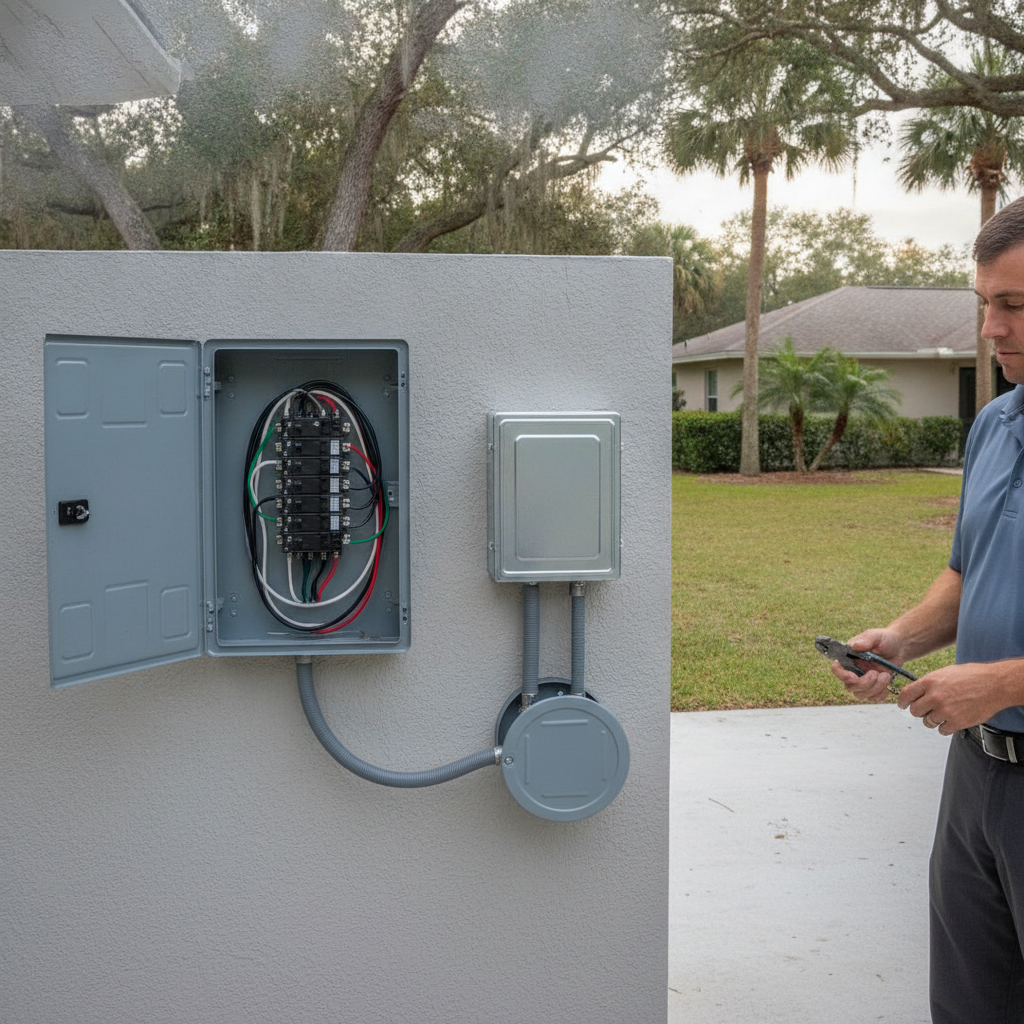
A subpanel at the outdoor cooking station is the cleaner layout when you need several new circuits and the house panel is a long run away.
Each home-run circuit from the main panel is a full-length pull: conductor, conduit, and labor for the whole distance. Two circuits to a cooking station against the house can be reasonable. Five circuits to an island at the back of a Wesley Chapel lot is a bundle of long pulls and a main panel that may not have the slots. A feeder to a subpanel puts the breaker spaces next to the loads. Short branches then serve the fridge, the receptacles, the lights, and the 240-volt appliance.
| Question | Home-run circuits | Outdoor subpanel |
|---|---|---|
| How power reaches the cooking station | Each circuit travels the full distance from the main panel | One feeder travels once, then short circuits serve the cooking station |
| What it uses at the main panel | A spare slot for every new circuit | Spare slots for the feeder breaker |
| When it fits | One or two circuits near the house | Several loads, or a cooking station far from the panel |
An outdoor subpanel still depends on the main service. If the service is already at its limit, adding a subpanel does not create capacity. Capacity is a panel upgrade conversation. This site publishes a 100 amp to 200 amp panel upgrade at $2,500 to $4,500. That is this site’s published range, not independent market evidence, and it is not a claim that every house needs 200 amp service. The selected contractor prices the actual work after seeing the panel, the load list, and the route.
This site also publishes a marine-grade outdoor panel and receptacle upgrade at $1,500 to $3,500. Same caveat: site-published, not a Tampa average, not a quote. What moves that number is the enclosure rating, how many receptacles, how far the feeder runs, and whether the existing panel has both space and capacity. Two weatherproof receptacles on a nearby wall is not that job. A new wet-location panel feeding an island cooking station is.
The electrician reads the panel legend, the spare slots, the conductor already in the wall, and the real equipment list. A Hyde Park plaster wall changes how a new circuit gets routed. A Palm Harbor HOA can decide where an enclosure can sit. Those are site conditions. They are not a diagnosis of the wiring inside.
Florida certified electrical contractors can work statewide. Registered contractors work in their authorized local jurisdictions, and specialty licenses have bounded scope. The person on site is not assumed to hold a contractor license just because they are an electrician. The licensed contractor on the job confirms the permit and inspection steps with the authority for that address. Largo has its own building division. Pinellas County serves unincorporated areas and specified partner cities. Temple Terrace publishes its own electrical applications. A mailing city does not pick the reviewer.
What the quote includes
The quote is a scope list: new circuits, wet-location devices, a feeder or subpanel if the layout needs one, the route through block or stucco or slab, and the permit path for that property.
It is not a brand flat rate. Tampa Electrical Pro matches you with independent licensed and insured electricians. Scheduling, scope, permits, workmanship, and price belong to the selected contractor after they see the house. Grill and fridge hardware is separate from the electrical labor unless the quote says otherwise.
What moves the number, and in which direction:
The distance from the panel to the cooking station sets conduit and labor. A long backyard run costs more than a chase on the back wall. Each extra 120-volt circuit, and any 240-volt appliance, adds a homerun or a subpanel branch. A main panel with neither spare slots nor spare capacity turns the cooking station into panel work. Surface conduit on a block wall is a different day than a trench under a finished patio. A wet-location subpanel enclosure is a different enclosure than two receptacles on the house wall.
If the visit is a repair of outdoor cooking circuits that already trip or are dead, this site publishes electrical repair including the diagnostic visit at $150 to $450, again as a site-published range, not a quote. New work is a different scope. Nearby landscape lighting on the same patio can share a trench conversation. It still needs its own circuit plan.
Does outdoor cooking equipment need its own subpanel
Not always. One or two circuits on the house wall can come from spare slots in the main panel when the service has the capacity. A subpanel earns its keep when the cooking station needs several circuits or sits a long run from the house, which is the same fork laid out on this site’s subpanel installation page.
Can you run outdoor cooking equipment from an existing outdoor outlet
A single existing receptacle can run a temporary plug-in appliance. A built-in cooking station with a fridge and a grill is new wiring, GFCI protection matched to the exposure, and a load the panel can actually supply. Tampa Electric’s rule on cords still applies: they are not a substitute for permanent household wiring.
Who pulls the permit for outdoor cooking electrical
The licensed contractor, never this brand. They confirm the steps with the building department that actually reviews that address, which may be the city, unincorporated county, or a partner office such as Largo rather than the city on the mailing label.
When to call us
New outdoor cooking circuits, a wet-location subpanel, or a cooking station that already trips, heats, or smells like burning need a licensed electrician, not a leftover receptacle and a cord. Tampa Electrical Pro matches you with licensed and insured electricians who price the job from the real load list and the real route. Call us at (813) 850-0320.