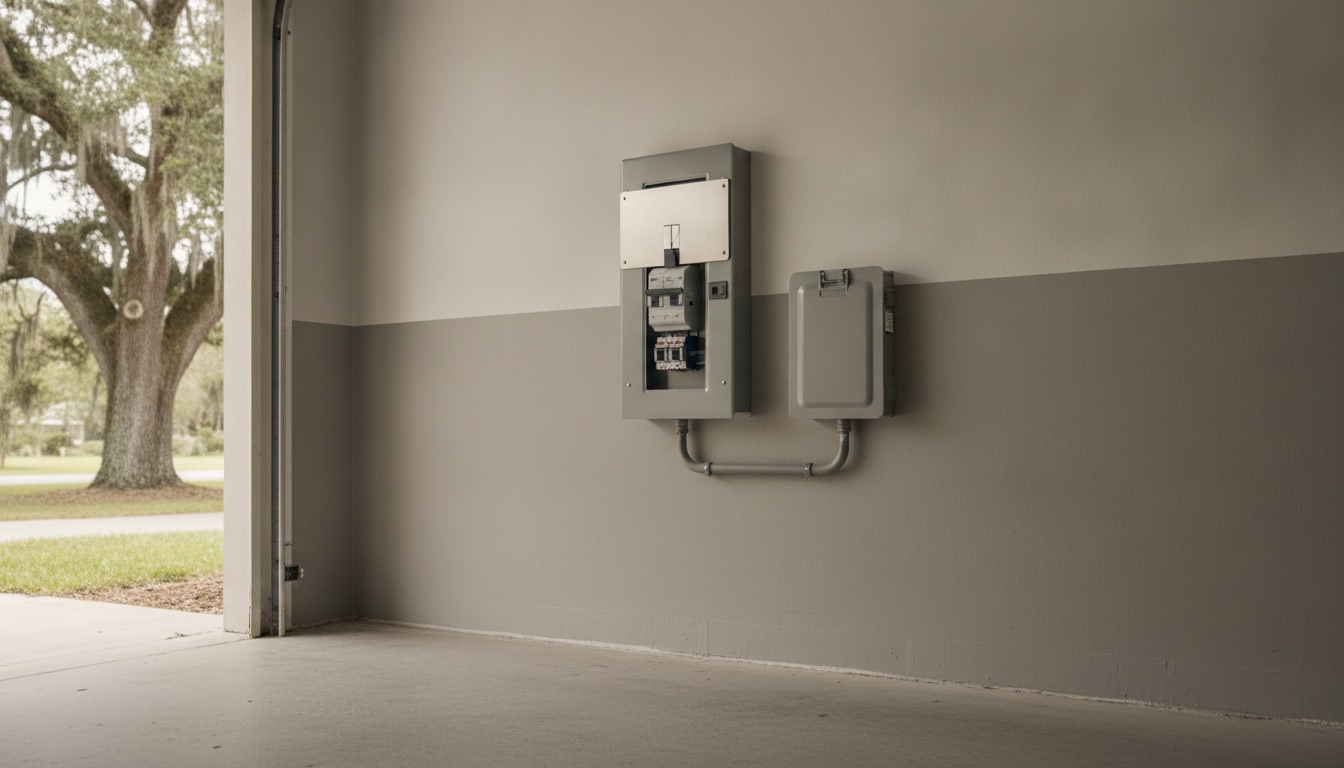
Smaller portable-generator interlock kits start around $1,200 to $2,000 on this site, plus typical permit fees of $75 to $150. That is a published starting band, not a quote for every Tampa Bay panel. The actual price depends on the panel, the equipment that matches it, the inlet location, the wiring route, access, and the permitting process for the property’s jurisdiction.
An interlock can provide a safe way to connect a compatible portable generator to selected house circuits, but it is panel work. A qualified electrician needs to inspect the equipment and define the installation before pricing it.
What does a generator interlock do?
A generator interlock is a mechanical device installed at the electrical panel. It prevents the main breaker and the dedicated generator breaker from being on at the same time.
That separation matters because generator power must not feed back onto utility lines. Turning off the main breaker by itself is not a substitute for approved transfer isolation.
With an interlock setup, the portable generator connects through an inlet installed for that purpose. The generator becomes an alternate source of power for the panel while the utility source is isolated.
The interlock does not increase generator output, add utility service capacity, or decide which loads the generator can support. Generator capability and the home’s intended essential loads need to be evaluated separately.
A portable generator does not always connect to house wiring. It can power individual appliances through properly rated outdoor cords. An interlock or transfer switch becomes relevant when generator power will be connected to the home’s electrical system. Directly backfeeding a receptacle is unsafe.
What affects generator interlock installation cost?
The most useful estimate separates the required installation from optional or corrective work. These are the main scope questions:
| Scope question | Why it changes the work |
|---|---|
| Which panel and model are installed? | The electrician needs the equipment label, model information, and applicable instructions to evaluate the interlock and breaker arrangement. |
| Is suitable breaker space available? | The panel layout determines whether the generator breaker can be accommodated. Open spaces alone do not establish electrical capacity. |
| Where will the inlet be located? | Distance, routing, wall construction, exterior exposure, and access affect the wiring and installation path. |
| What equipment is included? | The written scope should identify the interlock, generator breaker, inlet, wiring, fittings, permit handling, and inspection coordination that are included. |
| Does the panel need separate repair? | Corrosion, heat damage, damaged components, or other observed defects can require correction before generator connections are added. |
Ask for a written proposal that identifies what the electrician inspected and what the price includes. That makes it easier to compare two proposals without assuming both contractors allowed for the same equipment, routing, permit work, and inspections.
Does a full panel require a service upgrade?
Not automatically.
Breaker space and electrical service capacity are different questions. A panel can lack convenient circuit spaces without proving that the utility service is undersized. A subpanel may add circuit spaces, but it does not add service capacity.
A generator also supplies backup power rather than creating a new utility load by itself. The generator breaker and interlock arrangement still need to fit the actual panel, but a full panel does not automatically mean the service must be replaced.
The electrician should evaluate the panel configuration, equipment condition, intended loads, and generator connection before recommending panel work. If a separate service change is genuinely needed, the panel upgrade service page and Tampa panel upgrade cost guide explain that broader project.
Where should the generator inlet go?
The inlet location affects both usability and installation scope. The electrician needs a route between the inlet and panel that suits the property and the equipment’s exposure.
That inlet location is not permission to operate the portable generator beside it. Fuel-burning portable generators belong outdoors, far from the home and away from doors, windows, vents, and other openings. They should never run inside a home, garage, basement, crawlspace, or shed. The Consumer Product Safety Commission’s generator guidance explains the carbon-monoxide risk.
Plan the cord path and generator operating location together. The inlet can be convenient while the running generator remains safely separated from the building.
Does an interlock require an electrical permit?
The filing path depends on the authority responsible for the property. A Tampa Bay mailing address does not by itself identify the permitting jurisdiction.
For Hillsborough County properties, the county’s work-exempt-from-permits list provides a narrow electrical exemption for qualifying low-voltage work in an existing single-family residence. Panel work for a generator interlock is not low-voltage work.
Pinellas County states that work changing a home’s electrical system requires a permit. Properties inside municipalities such as Largo may use their own building departments rather than the county process.
Before the work is scheduled, confirm which jurisdiction serves the property and ask the selected electrician to identify the permit and inspection steps included in the proposal. Scheduling and filing requirements come from that authority and the actual project scope.
Florida Building Code Residential M1905 flood, wind, and exhaust rules are written for permanently installed standby generators. An interlock-only portable hookup is not that equipment, so those placement rules are not what the interlock is measured against. That is not a claim that the interlock needs no permit. It is still permitted electrical work.
What does Hillsborough County publish for generator inspections?
Hillsborough County’s residential backup generator checklist calls for an electrical rough-in inspection and an electrical final inspection. It also asks for installation manuals and documents containing the manufacturer’s clearance requirements.
That checklist covers residential generator projects broadly. Items concerning generator placement, fuel, easements, wetlands, flood conditions, or site plans relate to the parts of a project that actually involve those issues. Their appearance on the checklist does not establish that every interlock-only installation needs every generator-placement document.
Keep the equipment labels and installation documents available for the contractor. The panel model and manufacturer instructions are part of evaluating the proposed arrangement, but they do not guarantee that a particular kit is suitable or will be approved.
Other Tampa Bay jurisdictions may use different submittal and inspection procedures. Hillsborough County’s sequence should not be presented as a Pinellas or Pasco requirement.
Interlock kit or transfer switch?
Both approaches isolate house wiring from the utility before generator power is introduced, but they operate differently.
| Decision point | Interlock kit | Transfer switch |
|---|---|---|
| Common setup | Portable generator connected through an inlet | Portable or fixed standby equipment, depending on the system |
| Utility isolation | Mechanical arrangement prevents the main and generator breakers from being on together | Transfer equipment changes the home’s source from utility to generator |
| Operation | The homeowner follows the installed system’s operating procedure | May be manual or automatic, depending on the equipment |
| Load planning | Limited by the generator and the loads selected during use | Limited by the generator, transfer equipment, and system design |
| Generator placement | Portable unit must be moved outdoors and operated safely for each use | Fixed equipment has model-specific placement, fuel, exhaust, and maintenance requirements |
An automatic transfer switch does not create backup power by itself. The generator, fuel supply, controls, transfer equipment, and selected loads all have to work as a system.
An interlock also does not prove that every breaker can run from a portable generator at once. Before choosing either route, identify the loads that matter during an outage and have the electrician compare them with the actual generator and panel arrangement.
The interlock and transfer switch comparison explains the operating differences in more detail. For fixed equipment, see the whole-home generator service page and whole-house generator cost guide.
Warning signs that need attention first
Generator planning should pause if the panel or connected equipment shows signs of an active electrical problem. Buzzing or crackling, a burning odor, heat or discoloration, shocks, repeated trips, or unexplained widespread flickering call for prompt inspection by a qualified electrician.
Do not remove the panel cover, touch wet or damaged electrical equipment, or keep resetting a fault. If there is smoke or fire, leave the hazard area and contact emergency services.
For non-emergency defects that need evaluation, start with electrical repair.
Questions to ask before approving the work
A useful proposal should answer questions tied to the observed installation:
- What panel make and model did the electrician inspect?
- What equipment is included in the proposed generator connection?
- Where will the inlet be installed, and what route will the wiring take?
- Which jurisdiction handles the permit for this property?
- Which permit and inspection tasks are included in the proposal?
- Where can the portable generator operate outdoors without directing exhaust toward the building?
- Which essential loads are intended to run, and how will they be managed?
- What operating instructions and equipment documents will be provided?
These answers reveal more than a single headline price because they show whether the proposal covers the same installation you expect.
Frequently asked questions
Can an interlock increase my electrical capacity?
No. It changes which power source can feed the panel. It does not increase utility service capacity or generator output.
Does a portable generator always need an interlock?
No. A portable generator may power individual appliances through properly rated outdoor cords. Connecting it to house wiring requires proper transfer isolation, such as a suitable interlock or transfer switch. Never backfeed a receptacle.
Does an empty breaker space prove the panel can accept the installation?
No. Breaker space, equipment compatibility, panel condition, and electrical capacity are separate considerations. The electrician needs to evaluate the actual panel and proposed arrangement.
Does a full panel automatically require an upgrade?
No. A full panel may require a different circuit-space solution, but that alone does not prove the service capacity must increase. A subpanel can provide additional spaces without increasing service capacity.
Can I install the interlock myself?
Panel wiring exposes hazardous electrical components and is not an appropriate homeowner installation guide. A qualified electrician should evaluate the panel, install the equipment, and address the applicable permit and inspection process.
Will an interlock start the generator automatically?
No. An interlock is a mechanical source-isolation device. A portable generator still has to be placed outdoors, connected, started, fueled, and operated according to its instructions.
Get matched with a Tampa Bay electrician
Tampa Electrical Pro refers homeowners to independent licensed and insured electricians serving Tampa Bay. The selected contractor determines the installation scope, permit handling, scheduling, workmanship, and price.
Call (813) 850-0320 to discuss the panel, generator, inlet location, and loads you want available during an outage.