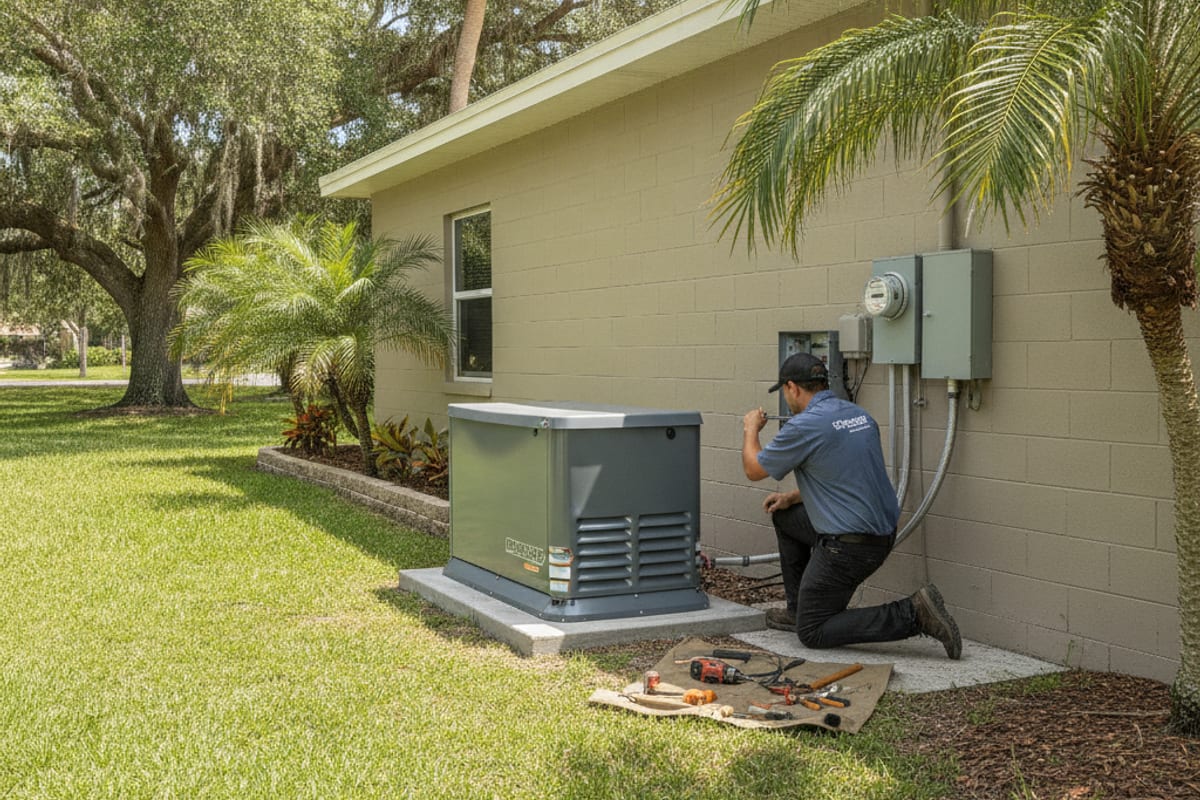
This site’s published whole-home generator installed range is $10,000 to $18,000. That is this site’s published band, not a quote for every house and not a blend of other published figures. A whole-house generator quote in Tampa still depends on more than the generator itself. The planned backup loads, transfer equipment, fuel delivery, placement, wiring route, existing electrical equipment and permit requirements can all change the scope.
A portable generator with a permitted interlock is a different job. That published band is $1,200 to $2,000 on the generator interlock installation guide.
Start by deciding what must operate during an outage. An electrician can then match the equipment and installation plan to the home’s actual loads instead of relying on a generic generator size or package price.
Start with the backup plan
The phrase “whole-house generator” doesn’t always describe the same level of coverage. One proposal may support selected essential circuits. Another may manage larger loads so they don’t operate at the same time. A broader plan may be designed around more of the home’s equipment.
Ask each contractor to identify:
- Which circuits and appliances the proposal supports
- Which loads require manual choices or automatic management
- Whether air conditioning or other large equipment is included
- What happens if several planned loads try to start together
- Which assumptions came from equipment labels and which still need field verification
Reducing the number of simultaneous loads can reduce generator and fuel-system scope. Broader coverage can require different equipment, transfer controls and fuel delivery. That distinction is more useful than comparing generator labels alone.
Generator size follows the actual loads
The electrician should inventory the equipment you want backed up and account for operating demand and starting characteristics. Air-conditioning equipment, pumps, cooking appliances and other larger loads can materially affect the plan, but none should be assumed from the home’s neighborhood, age or floor plan.
A standby generator supplies backup power when utility power is unavailable. It does not add utility service capacity by itself. The electrician must separately evaluate the home’s service capacity, circuit space, equipment condition and proposed transfer arrangement.
This is also why an empty breaker position doesn’t prove that more load can be added, while a full panel doesn’t automatically prove that the electrical service must be upgraded. A subpanel can provide circuit space, but it does not increase service capacity. If the evaluation identifies separate service or equipment work, ask for it to be itemized from the panel upgrade scope.
Fuel setup can change the project substantially
Natural gas and propane cannot be ranked as universally cheaper without inspecting the property and selected generator. Existing gas service does not by itself prove that the meter, regulator and piping can supply the required flow. A propane plan must account for the selected equipment, planned load, desired runtime, tank arrangement and refill plan.
A useful proposal states:
- The fuel specified for the selected model
- The fuel demand used for planning
- What existing piping or storage equipment was evaluated
- Whether fuel-side modifications are part of the proposal
- Who is responsible for any separate fuel work or coordination
There is no universal propane-tank size for every home, and the electrical proposal should not quietly assume that existing fuel equipment is suitable.
Transfer equipment is a core safety decision
A fixed standby system must be professionally installed with transfer isolation from the utility. The transfer arrangement determines which circuits receive backup power and whether load-management controls are part of the design.
A manual transfer arrangement can be considered for some portable-generator plans, but it is a different setup from an automatic standby system. Turning off the main breaker is not sufficient protection against backfeeding house wiring. Tampa Electric’s generator safety guidance explains why a generator must be isolated from the utility.
When comparing proposals, confirm whether the transfer equipment, control wiring, related electrical modifications and commissioning are included or priced separately. Don’t assume every advertised generator package contains the same scope. The transfer-switch guide explains the practical differences between automatic and manual arrangements.
Placement and access affect the installation
The selected generator’s installation instructions and the property’s local review determine the fixed equipment layout. Access for conduit and fuel piping, the route back to the electrical equipment, site preparation and protection of the equipment can all affect the work.
Portable-generator operating rules are different from fixed standby placement requirements. A portable fuel-burning generator belongs outdoors, away from the home and openings, never in a home, garage, crawlspace, basement or shed. The U.S. Consumer Product Safety Commission explains the carbon-monoxide, fire and electrical hazards. A fixed standby system still produces combustion exhaust, so its model-specific instructions and approved location matter.
Surge protection is a separate decision
A generator and a surge-protective device perform different jobs. Having electrical work underway near the panel may make it convenient to evaluate whole-house surge protection, but that does not establish that the device is required or compatible with every installation.
Ask the electrician to price it separately and explain where it would be installed, what equipment it must work with and which part of the electrical system it protects. That keeps an optional protection decision from being confused with the generator’s transfer and load plan.
Is a portable generator the lower-scope option?
A portable generator can power individual appliances through properly rated outdoor cords. Connecting one to house wiring requires professionally installed transfer isolation. Direct backfeeding is unsafe.
Portable and standby systems also differ in setup, fuel handling, supported loads, storage, maintenance and how power reaches the equipment. A portable model should not be dismissed as incapable of every large load, nor should it be treated as suitable for whole-home coverage without checking its output and connection plan. The useful comparison is what the selected system can safely support at this property.
See the detailed standby and portable generator comparison before deciding which operating routine fits your household.
Permits, inspections and credentials
The authority responsible for a property depends on its actual jurisdiction, not just its mailing address. The selected contractor should identify the correct building department and state which permits, inspections or other approvals apply to the proposed installation.
Tampa Electrical Pro is a referral service. The independent contractor determines the installation scope, handles the work and explains responsibility for permitting and scheduling.
Florida electrical credentials also have different scopes. Certified electrical contractors can work statewide, registered contractors work within their authorized local jurisdictions, and specialty licenses have bounded scopes. Verify the business’s active status, authorized scope and applicable jurisdiction through Florida’s license lookup. The matched professional should also confirm current insurance coverage for the work.
Compare written scopes, not package names
Two proposals can use similar generator descriptions while covering different work. Ask for a written breakdown of:
- Generator model and planned backup loads
- Transfer equipment and load-management controls
- Electrical modifications and wiring route
- Fuel piping, storage or utility coordination
- Site preparation and fixed-equipment placement
- Permit and inspection responsibility
- Startup, owner orientation and maintenance responsibilities
- Equipment, installation and service warranty terms
- Optional work priced separately
If financing is offered, compare the cash price with the financed total, payment term, fees and cancellation terms. Financing changes how the project is paid for, not which installation work is necessary.
Frequently asked questions
How much does a whole-house generator cost in Tampa?
This site’s published whole-home installed band is $10,000 to $18,000. The total still cannot be determined from generator size alone. Coverage goals, transfer equipment, fuel delivery, site access, wiring, existing electrical equipment and local approval requirements all shape the proposal. A site evaluation should produce an itemized scope tied to the home’s actual loads. The portable interlock band of $1,200 to $2,000 is a separate project on the interlock installation guide.
Does every standby generator require a panel upgrade?
No. Existing service capacity, circuit space, equipment condition and the transfer design are separate questions. A full panel may need a circuit-space solution without a service-capacity increase, while empty spaces do not prove that additional utility load is available.
Does a generator increase the home’s electrical service capacity?
No. A standby generator is a backup supply, not an increase in utility service capacity. The electrician evaluates utility load capacity separately from the generator’s planned outage loads.
Is natural gas always cheaper than propane?
Not necessarily. The answer depends on available fuel service, the selected model’s requirements, piping or storage changes, planned runtime and which fuel-side work is included in the proposal.
Can a portable generator connect to house wiring?
Only through a professionally installed arrangement that isolates the home from the utility. Never backfeed house wiring through a receptacle, and don’t treat switching off the main breaker as a substitute for proper transfer isolation.
Get a generator scope you can compare
Call Tampa Electrical Pro at (813) 850-0320 to be connected with an independent licensed and insured electrician. The matched contractor can evaluate the property’s loads, electrical equipment, fuel plan and installation route, then provide the price and scope for the proposed whole-home generator system.