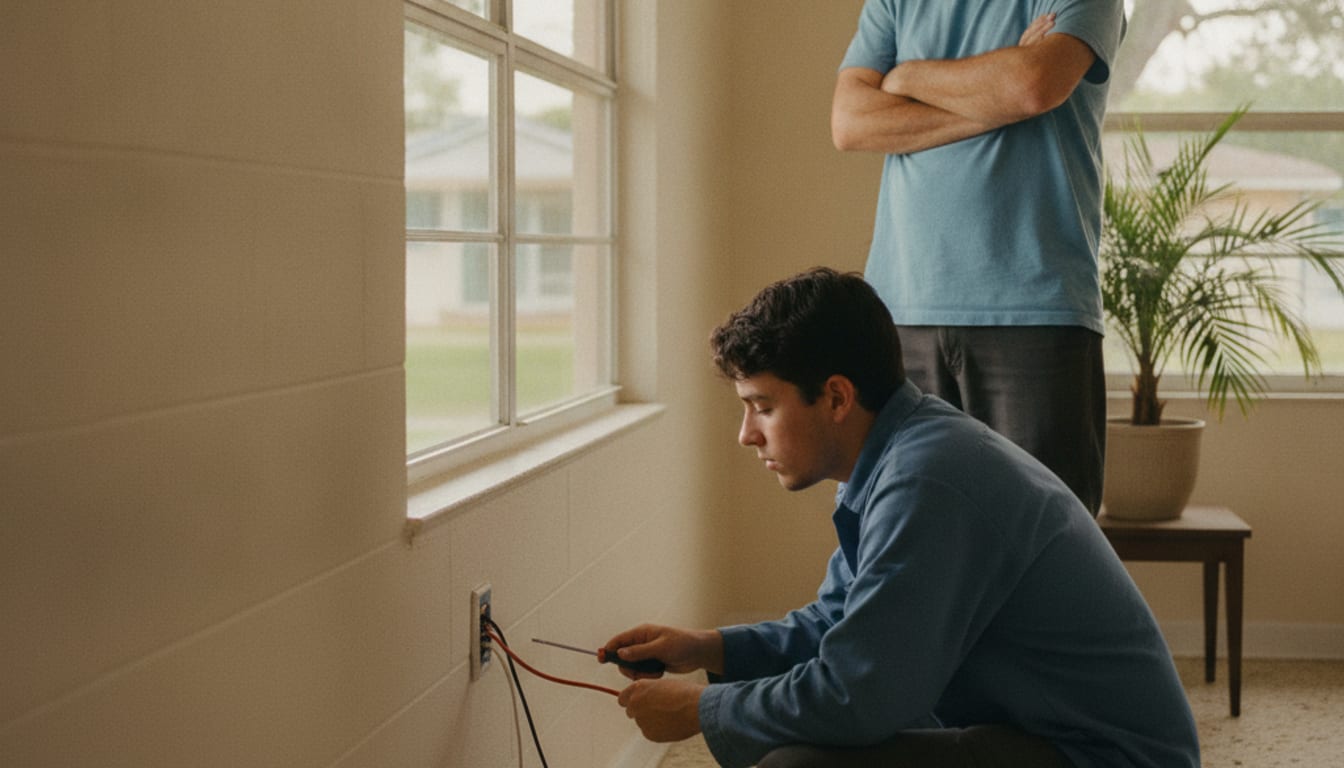
An unlicensed handyman cannot perform covered electrical work for compensation in Florida. The rule turns on payment, not whether the job appears small. A homeowner has a separate owner-builder exemption, but the permit, occupancy, and intended-use conditions must all be satisfied.
Can a handyman do electrical work in Florida?
Not for compensation unless the person or business has the license required for the proposed work. The price, duration, and apparent difficulty of the job do not create a small-job exception.
Florida Statutes 489.505(9) defines “Contracting” this way:
“Contracting” means, except where exempted in this part, engaging in business as a contractor or performing electrical or alarm work for compensation and includes, but is not limited to, performance of any of the acts found in subsections (2) and (12), which define the services which a contractor is allowed to perform. The attempted sale of contracting services and the negotiation or bid for a contract on these services also constitutes contracting. If the services offered require licensure or agent qualification, the offering, negotiation for a bid, or attempted sale of these services requires the corresponding licensure.
The phrase “for compensation” controls the hiring decision. The statute does not create an exception for quick or inexpensive work.
It also covers offering, negotiating, or bidding covered services. An unlicensed person does not need to complete the work before the licensing rule applies.
A person who advertises as a handyman may also hold an appropriate electrical credential. In that case, the authorization comes from the qualifying license, not the handyman label.
Florida Statutes 489.505(12) describes an electrical contractor’s scope with this opening clause:
“Electrical contractor” or “unlimited electrical contractor” means a person who conducts business in the electrical trade field and who has the experience, knowledge, and skill to install, repair, alter, add to, or design, in compliance with law, electrical wiring, fixtures, appliances, apparatus, raceways, conduit, or any part thereof, which generates, transmits, transforms, or utilizes electrical energy in any form
Installing, repairing, altering, and adding to electrical systems can therefore fall within licensed contracting even when the proposed task is limited to one device.
Which handyman jobs require a DBPR license?
The Florida Department of Business and Professional Regulation places compensated wiring and installation work on the licensed side. Its consumer guidance says:
“If you pay someone to perform even the simplest of electrical work, such as connecting two wires, you must hire a licensee.”
DBPR provides these examples:
| Needs a DBPR license | Does not need a DBPR license |
|---|---|
| “Install ceiling fans and light fixtures for compensation.” | “Change the light bulbs in fixtures.” |
| “Install or replace electric outlets and switches for compensation.” | “Change the cover plates on outlets.” |
| “Install or monitor alarms systems for compensation.” | “Set up home theater components (excluding wiring).” |
| “Install cable or satellite television wiring for compensation.” | “Hang a flat screen TV on a wall.” |
| “Install computer network wiring for compensation.” | “Set up wireless computer networks.” |
| “Install solar powered landscape lighting or low voltage landscaping lighting with a factory installed cord and plug as described in 489.503 (24), F.S.” |
DBPR states that “The list is not all inclusive.” A task is not automatically exempt simply because it does not appear in the table.
The examples still provide a useful dividing line. Compensated installation and wiring appear on the licensed side, while changing a bulb, replacing a cover plate, or setting up equipment without wiring does not.
The landscape-lighting example is narrow. It applies to the factory-cord-and-plug arrangement described by DBPR, not every outdoor lighting repair. Our guide to low-voltage landscape lighting problems explains how the observed equipment and fault location affect the next step.
DBPR also advises checking with the county or city for local requirements that may apply to services outside state electrical licensing. A local business tax receipt or competency certificate does not replace a state license when the electrical work itself requires one.
Does Florida issue a handyman license?
Florida does not issue a statewide handyman license. DBPR’s list of licensed professions contains no handyman category.
“Handyman” describes a type of service business rather than a state electrical credential. The label does not authorize compensated outlet, switch, fixture, or building-wiring work.
Local requirements for work that does not need a state license are a separate issue. They do not expand the electrical work an unlicensed person may offer or perform.
Competing pages often treat Florida’s Part I casual-job cap as permission to do small electrical work. Florida Statutes 489.103(9) is an exemption from Part I construction contracting for “Any work or operation of a casual, minor, or inconsequential nature in which the aggregate contract price for labor, materials, and all other items is less than $2,500,” and it does not apply if the work is part of a larger operation or if the person advertises as a contractor. That Part I dollar cap does not authorize compensated electrical work. Electrical contracting stays under 489.505(9) and DBPR’s list, which turn on payment rather than job size.
Can homeowners perform their own electrical work?
Florida provides an owner-builder exemption, but its conditions must travel with it. Florida Statutes 489.503(6)(a) begins:
“An owner of property making application for permit, supervising, and doing the work in connection with the construction, maintenance, repair, and alteration of and addition to a single-family or duplex residence for his or her own use and occupancy and not intended for sale”
The owner must apply for the permit and do the work. The residence must be for the owner’s own use and occupancy and cannot be intended for sale.
That exemption does not extend to a rental the owner does not occupy or a house being prepared for sale.
This creates an important distinction. An owner may replace an outlet when the complete owner-builder conditions are satisfied. A paid, unlicensed handyman cannot quote and perform the same replacement.
The difference is not the difficulty of the outlet replacement. It is the legal role of the person performing the work and whether that person receives compensation.
Homeowners comparing the scope of a project can review GFCI outlet installation work and electrical repair services. Work involving service equipment can be reviewed with qualified panel upgrade contractors, but full breaker spaces alone do not establish that a service-capacity upgrade is necessary.
Does Hillsborough County exempt small electrical jobs?
Hillsborough County does not publish a general small-job exemption for electrical wiring work. Its work-exempt-from-permits guidance lists one electrical exemption:
“The installation or repair of a low-voltage system in an existing single-family residence when the work is performed by the property owner or the work is performed by a non-owner, provided the total cost of labor and materials does not exceed $5,000.”
That narrow exception concerns low-voltage systems. Replacing a standard wall receptacle or adding a branch circuit is not low-voltage work and does not fit that exemption.
The county’s permit rules and Florida’s licensing rules answer different questions. A permit exemption does not by itself authorize an unlicensed person to perform compensated electrical contracting.
Homeowners should confirm the authority serving the property and the permit requirements for the actual scope. The Tampa Bay electrician service hub provides regional navigation, and homeowners near Brandon can review Brandon service information.
What happens after unlicensed electrical contracting?
The criminal classifications in Florida Statutes 489.531(3) apply to the unlicensed person:
“(a) Any unlicensed person who violates any of the provisions of subsection (1) commits a misdemeanor of the first degree, punishable as provided in s. 775.082 or s. 775.083.
(b) Any unlicensed person who commits a violation of subsection (1) after having been previously found guilty of such violation commits a felony of the third degree, punishable as provided in s. 775.082 or s. 775.083.
(c) Any unlicensed person who commits a violation of subsection (1) during the existence of a state of emergency declared by executive order of the Governor commits a felony of the third degree, punishable as provided in s. 775.082 or s. 775.083.”
A violation under paragraph (a) is a first-degree misdemeanor. A later violation after a previous guilty finding is a third-degree felony.
The classification also changes if the Governor has declared a state of emergency. DBPR’s unlicensed-activity guidance summarizes the conditional rule this way:
“During a declared state of emergency, the penalty for unlicensed activity is elevated from a misdemeanor to a third-degree felony.”
That statement does not establish that a state of emergency is currently in effect. The condition applies when an executive order declaring one exists.
The cited penalty falls on the unlicensed person. It does not say that a homeowner commits a crime merely by hiring that person.
For a homeowner, the practical issues include whether the work was properly authorized, permitted when required, inspected, and documented. Our guide to electrical inspections in Tampa explains what an inspection can address without predicting an insurance or sale outcome.
How should homeowners evaluate an electrical quote?
Ask for the name of the licensed contractor or business responsible for the electrical work. Verify that the credential is active and that its scope and jurisdiction cover the proposed task.
Florida certified electrical contractors can work statewide, while registered contractors work within their authorized local jurisdictions. Specialty credentials have defined scopes. An unlimited EC credential is not the only lawful category for every electrical task, and every field worker does not necessarily hold the contractor credential individually.
The written scope should identify the outlets, fixtures, circuits, or equipment involved and distinguish repair from new wiring. It should also state who will determine and handle any required permit.
Do not treat a business card, handyman label, or low quote as proof of electrical authorization. For more hiring guidance, read choosing a licensed Tampa electrician.
Frequently asked questions
Can a handyman replace an outlet in Florida?
Not for compensation without the required license. DBPR specifically lists compensated outlet and switch replacement as work requiring a license. Hillsborough County’s low-voltage permit exemption does not cover a standard wall receptacle replacement.
Can a handyman install a ceiling fan in Florida?
Not for compensation without the required license. DBPR lists compensated ceiling-fan and light-fixture installation on the licensed side. The existing electrical box must also be verified as fan-rated and securely supported because a box that holds a light is not automatically suitable for a fan.
Can I do electrical work in my Tampa home?
The owner-builder exemption can apply when all its conditions are satisfied. You must apply for the permit, supervise and perform the work, and use the single-family or duplex residence for your own occupancy. The property cannot be intended for sale.
Is there a price threshold for handyman electrical work?
Florida’s contracting definition does not provide a dollar threshold for compensated electrical work. The $2,500 casual, minor, or inconsequential cap in 489.103(9) is a Part I construction exemption, not an electrical-work license. Hillsborough County’s $5,000 condition belongs only to its narrow low-voltage permit exemption for work performed by a non-owner. It is not a handyman electrical-license threshold.
What happens if an unlicensed handyman performs covered electrical work?
The cited statute classifies a violation by an unlicensed person as a first-degree misdemeanor. A violation after a previous guilty finding is a third-degree felony. A violation during a state of emergency declared by the Governor is also a third-degree felony.
Does unpermitted electrical work matter during a sale?
Permitted and inspected work creates documentation a homeowner can produce if a later transaction calls for it. No insurance or sale outcome can be predicted from that fact alone. The owner-builder exemption also excludes a home intended for sale, so it cannot be used for work performed to prepare such a property for sale.
Get matched with a licensed electrician
Tampa Electrical Pro refers homeowners to independent licensed and insured electricians. The selected contractor determines scheduling, scope, permits, workmanship, and pricing. Call Tampa Electrical Pro to discuss the work and property location.