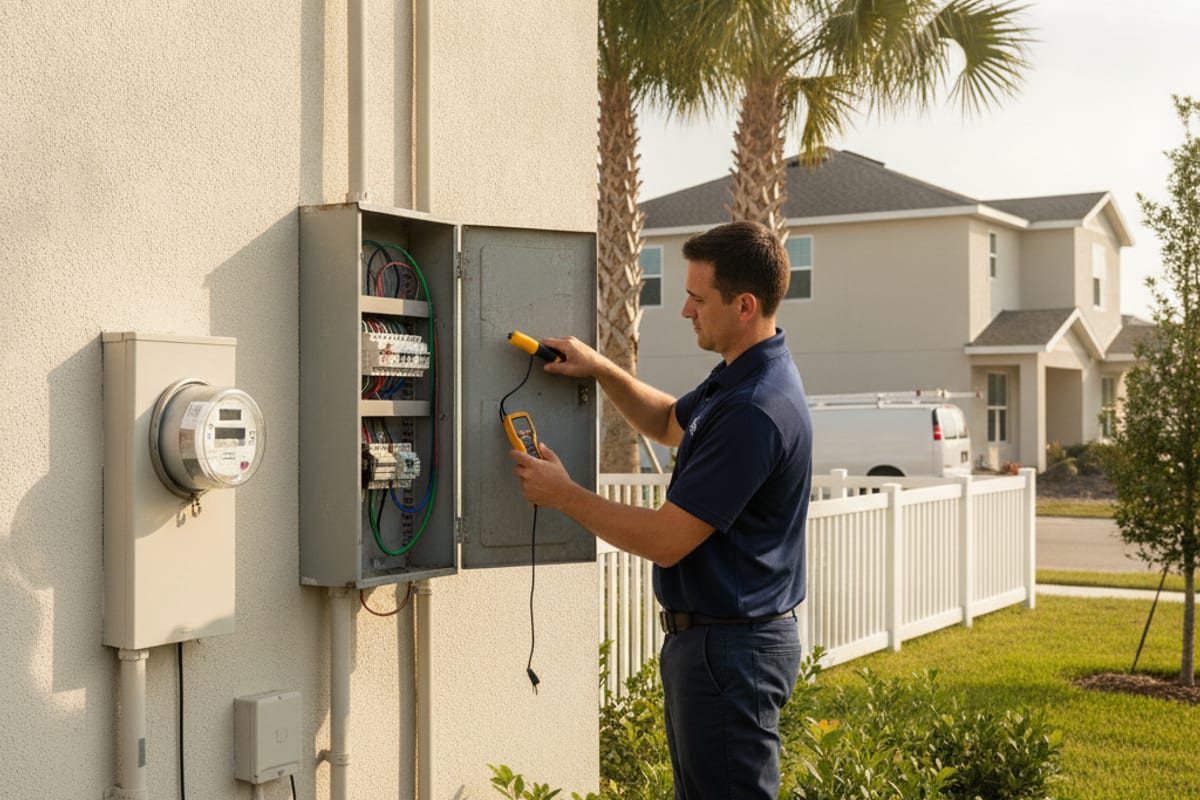
Electrical work in Land O’ Lakes should begin with the conditions at your property, not assumptions about the neighborhood or the age of the home. The electrician needs to identify the affected circuit, actual connected loads, panel configuration, equipment requirements, access, and any signs of damage before recommending a repair or upgrade.
Tampa Electrical Pro is a referral service. We connect Land O’ Lakes customers with independent licensed and insured electricians who evaluate the property and determine the appropriate scope. The selected contractor sets scheduling, pricing, permit responsibilities, and workmanship terms.
Land O’ Lakes property conditions
A home near Lake Padgett may need a straightforward repair, while a larger Bexley or acreage property may involve a detached garage, well-pump circuit, or outdoor equipment. Those features affect load calculations, circuit routes, access, and backup-power priorities without automatically requiring a panel upgrade. See the Land O’ Lakes electrician page for that local assessment.
Start with the symptom, not an assumed diagnosis
One dead receptacle can have several causes. It may be controlled by a switch, protected by a GFCI device elsewhere, damaged at the receptacle, or affected by another connection on the circuit. A plain receptacle without test and reset buttons may still have upstream GFCI protection.
A breaker that trips repeatedly may be responding to an overloaded circuit, damaged wiring, a connection problem, or faulty equipment. Do not keep resetting it or replace it with a larger breaker as a shortcut. Breaker size must match the conductors, circuit design, and connected equipment. A qualified electrician can test the circuit and identify what needs correction.
Unexplained flickering or dimming across several areas deserves prompt inspection. The cause could be within a branch circuit, at the service equipment, in connected equipment, or on the utility side. Timing alone does not identify the cause or show that the condition is harmless.
Hot or discolored plates, buzzing or crackling, burning odors, shocks, and recurring trips also call for qualified inspection. Do not open a panel, remove covers, touch damaged electrical equipment, or approach equipment that is wet. If there is smoke or fire, leave the hazard area and contact emergency services.
Check what EV charging preparation actually includes
A conduit, an unused breaker position, installed cable, a receptacle, and a working charger circuit are different things. Seeing one of them does not prove the rest are present or suitable. Existing preparation needs to be traced and tested before equipment is connected.
Level 1 charging can cover daily driving for some people when the vehicle has suitable dedicated power and enough parked time. Level 2 charging uses 240 V. The right choice depends on the vehicle, daily range needs, available charging time, equipment instructions, and the home’s electrical capacity.
An electrician evaluating an EV charger installation should confirm:
- Whether the charger will be hardwired or connected through a compatible receptacle
- The equipment’s electrical requirements and manufacturer instructions
- Whether an existing conduit or cable reaches the intended location and is suitable for the installation
- The route and access needed for a new circuit
- Whether the equipment will be indoors, in a protected damp location, or exposed to weather
- The panel’s circuit space and the home’s available electrical capacity
Circuit space and service capacity are not the same. An open breaker position does not establish that the service can support the proposed load. A subpanel can add breaker positions, but it does not add utility service capacity. A panel upgrade should be recommended only when the actual load evaluation and equipment condition support it.
A charger with timers, data, or an app is not automatically a service-load management system. If load management is part of the plan, the electrician should identify the equipment and explain how that system controls charging demand.
Plan new circuits around the actual equipment
Renovations and new appliances can change how a home’s circuits are used. The important questions are specific: Is the equipment replacing something or adding a new load? Does it require a dedicated circuit? What does its label require? Where is the panel, and what route is available for the wiring?
For recurring trips, an electrician can map the affected circuit, identify what is connected, inspect accessible connections, and compare the circuit with the equipment requirements. The answer may involve correcting a fault, moving loads, repairing a connection, or installing a properly designed circuit. Installing a larger breaker is not a safe substitute for that evaluation.
Dimming that occurs when equipment starts also needs diagnosis. It does not, by itself, prove that the home needs a larger service. The electrician should consider the equipment, branch circuit, service conditions, and whether the issue may be outside the home.
Confirm permit and inspection responsibilities
Permit and inspection requirements depend on the exact work and the authority responsible for the property. A device replacement, a new branch circuit, and a service change should not be treated as the same scope.
Before work begins, ask the contractor to state in writing:
- The work included and excluded
- Whether a permit or inspection applies
- Who will handle any required filing and coordination
- The equipment and materials included
- How changes to the approved scope will be discussed
- What workmanship or manufacturer warranties apply, if any
The selected contractor should determine the applicable jurisdiction and requirements for the actual address rather than relying on a mailing address or a general rule about Land O’ Lakes.
Separate surge protection from backup power
Surge protection and outage backup solve different problems. A compatible whole-home surge-protection device is installed at electrical equipment to help limit certain transient voltage events. It does not keep the house powered during an outage and does not guarantee that every connected device will avoid damage.
A whole-home generator supplies backup power to a defined set of loads when properly designed and installed. It does not add utility service capacity. Essential loads, fuel, equipment maintenance, transfer isolation, placement, and exhaust all affect the plan.
Portable generators require a different setup. They belong outdoors, away from the house and openings, and can power individual appliances through properly rated outdoor cords. Never connect a portable generator directly to house wiring without professionally installed transfer equipment. Turning off the main breaker alone is not adequate backfeed protection.
Choose a contractor by scope, not promises
Florida electrical contracting licenses have different categories and limits. Verify that the contracting business has active status and the proper scope and jurisdiction for the proposed work through the Florida Department of Business and Professional Regulation. Do not assume every person on a crew must hold the same contractor-license category.
Ask for evidence of insurance and a written proposal. A useful proposal should identify the observed problem, testing or work to be performed, materials, exclusions, permit responsibilities, total price, and how additional work would be authorized. Availability and project duration should come from the contractor after the scope is understood.
What happens after you contact us
When you call Tampa Electrical Pro, we gather the basic details and connect you with an independent licensed and insured electrician serving Land O’ Lakes. Be ready to explain what is affected, when it happens, whether the problem repeats, and whether you have noticed heat, odors, sounds, moisture, or visible damage.
For planned work, share the equipment model or label when available, the desired installation location, and whether any conduit, wiring, receptacle, or panel space already exists. The contractor will evaluate the property and provide the actual recommendation, schedule, and price.
Questions about electrical service in Land O’ Lakes
What affects the cost of an electrical repair?
Cost depends on the fault, testing required, access, wiring route, equipment, materials, permit or inspection requirements, and whether the original scope changes after evaluation. A written proposal should distinguish diagnostic work from the approved repair.
Does a new outlet require a permit?
Requirements depend on the work and the authority responsible for the property. Adding a new circuit is different from replacing an existing device. The contractor should verify the requirement for the actual address and list permit responsibilities in the proposal.
What does a GFCI do?
GFCI protection responds to current leaving its intended path and helps reduce shock risk. It is different from overcurrent protection and AFCI protection. A receptacle can be protected by an upstream GFCI even when it does not have its own test and reset buttons.
Does an empty breaker slot mean an EV charger will fit?
No. The open position addresses physical circuit space only. The electrician must also evaluate the existing service, calculated load, proposed charger, circuit route, and installation conditions. Adding a subpanel can create more positions without increasing service capacity.
What should I do if a breaker will not stay reset?
Leave it off and arrange qualified inspection. Do not keep resetting it, install a larger breaker, or open the panel. Tell the electrician what was operating when it tripped and whether you noticed heat, odor, noise, moisture, or damaged equipment.
Get connected with an electrician
For electrical repairs, new circuits, EV charging, surge protection, or panel evaluation in Land O’ Lakes, call Tampa Electrical Pro at (813) 850-0320. We will connect you with an independent licensed and insured electrician who can inspect the property and define the work.