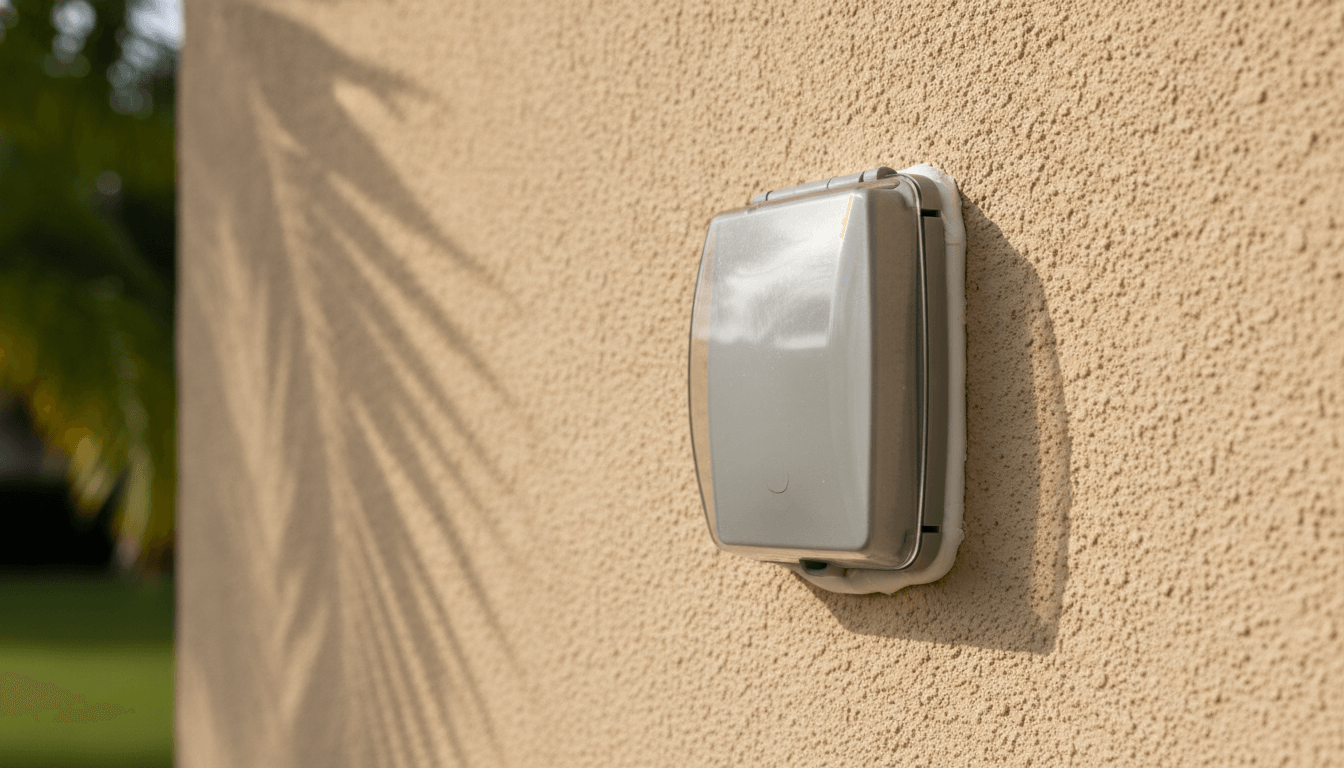
Outdoor outlet installation cost in Tampa depends first on whether an electrician is replacing an existing receptacle or creating a new location. A replacement can stay focused on the device, enclosure, and condition of the existing circuit. A new location may require circuit work, a cable route through finished materials, outdoor-rated equipment, and permit handling.
Those projects may look similar after installation, but they involve different decisions. Comparing them as if they were the same job can produce misleading estimates.
What changes the cost of an outdoor outlet?
The biggest cost distinction is the electrical scope behind the receptacle.
| Project condition | What the electrician needs to evaluate |
|---|---|
| Existing receptacle needs replacement | Device condition, enclosure, wiring, protective devices, and signs of damage |
| Existing outlet has no power | Whether the fault is at the receptacle, upstream protection, wiring, or another part of the circuit |
| Outlet is moving along the same wall | Cable routing, wall construction, access, and whether the existing circuit can serve the intended use |
| No outlet exists nearby | Panel capacity, circuit space, actual load, cable route, and permit requirements |
| Location receives direct water exposure | Wet-location receptacle and enclosure requirements |
| Covered location is protected from direct water | Product selection based on the actual damp-location conditions |
A store price for a receptacle doesn’t describe this work. The device is only one part of the installation.
For an existing device, compare the scope with GFCI outlet installation. A dead, damaged, or unreliable receptacle may instead need an electrical repair assessment before anyone knows which component failed.
Replacement or new circuit: why the distinction matters
Replacing an existing outdoor receptacle begins with the wiring and box already at that location. The electrician still needs to check whether those components are suitable and whether the replacement must add current GFCI, tamper-resistant, or weather-resistant protection.
Adding an outlet where none exists introduces a cable route. Stucco, concrete block, interior finishes, attic or crawl access, and the distance from a suitable circuit can all change the work involved. The intended use matters too. An occasional yard tool and permanently connected outdoor equipment may present different load and routing questions.
A new circuit also requires more than finding an open breaker position. Circuit space and electrical service capacity are separate issues. An open position doesn’t prove the service can accept the proposed load, while a subpanel can add circuit space without increasing utility service capacity.
The electrician should evaluate the actual loads and equipment information before deciding whether the outlet can use an existing circuit or needs a dedicated circuit. That is why a firm estimate for a new location normally depends on seeing the property and the proposed route.
A receptacle intended to support landscape lighting should be evaluated as part of that equipment plan rather than treated as an interchangeable convenience outlet.
How weather exposure changes the installation
Outdoor receptacles need equipment suited to their exposure. GFCI shock protection, overcurrent protection, and weather resistance perform different jobs, so one doesn’t replace the others.
The weather-resistant rule covers 15- and 20-amp, 125- and 250-volt nonlocking receptacles installed in damp or wet locations. These receptacles are listed as weather-resistant and commonly marked WR.
A wet location needs an enclosure that remains weatherproof while a plug is inserted. When an outlet-box hood provides that protection, it must be listed and identified as extra-duty. That marking requirement has a narrow carve-out for other listed products, enclosures, or assemblies that don’t use an outlet-box hood.
Damp and wet conditions aren’t interchangeable. A protected location without direct water exposure may be damp, while a location exposed to rain or washdown is wet. A covered lanai shouldn’t be classified from its roof alone because wind-driven rain, drainage, and the receptacle’s exact position can change the exposure.
The authority serving the property can resolve a borderline classification. The electrician can then match the receptacle, box, cover, and installation method to that decision.
Distance from the bay doesn’t establish the condition of an outlet. Existing covers, fasteners, boxes, and conductors should be inspected for actual water entry, corrosion, or physical damage. The guide to corroded outdoor outlets in Tampa explains what to look for without assuming every coastal property has the same equipment or wear.
Do replacement outlets have to meet current protection rules?
A replacement receptacle isn’t automatically allowed to copy every feature of the old device. Under NEC 406.4(D), replacements must provide GFCI, tamper-resistant, or weather-resistant protection when those requirements apply to the location.
GFCI protection also may be installed upstream. A plain receptacle without test and reset buttons doesn’t by itself prove that the location lacks GFCI protection. An electrician can test the circuit and identify where that protection is provided.
Our Florida GFCI code guide explains the protection issue in more detail. The GFCI outlet cost guide covers the narrower task of replacing or updating GFCI devices.
Does adding an outdoor outlet require a permit?
Permit authority depends on the property’s actual jurisdiction, not only its mailing address.
For properties governed by Hillsborough County, the county’s work exempt from permits list doesn’t provide an exemption that covers adding a standard exterior receptacle. Its electrical exemption is limited to qualifying low-voltage work in an existing single-family residence. A new 120-volt branch-circuit outlet isn’t a low-voltage system.
The county also states that its residential exemption doesn’t apply when the work includes electrical, plumbing, structural, mechanical, or gas work. Adding an outdoor outlet is electrical work.
That county guidance shouldn’t be applied automatically to a property governed by the City of Tampa or another municipal building department. Pinellas County also contains separate municipal jurisdictions, including Largo’s own Building Division. The electrician should identify the authority serving the property and confirm the permit process for the actual scope.
Permit requirements for a new location and a like-for-like device replacement may differ. The applicable department should answer that question for the specific job rather than relying on a county name alone.
What should an outdoor outlet estimate describe?
A useful estimate should make the electrical scope visible. It should identify:
- whether the work is a replacement, extension, or new circuit
- the intended use and equipment load
- the proposed cable route and any finished surfaces involved
- whether the panel has suitable capacity and circuit space
- the receptacle, box, cover, and protective devices included
- whether the location is treated as damp or wet
- permit responsibility for the property’s jurisdiction
- any repair needed because of water entry, corrosion, heat, or damaged wiring
This information makes two estimates easier to compare. A lower figure may describe only a device swap, while another may include circuit work, wall access, weatherproof hardware, and permit handling.
When does an outlet need inspection instead of a simple replacement?
A receptacle that is merely worn or physically broken may still require only localized work, but symptoms elsewhere on the circuit can change the starting point.
Unexplained flickering or dimming, hot or discolored plates, buzzing, crackling, a burning odor, shocks, or repeated breaker trips call for prompt inspection by a qualified electrician. These symptoms don’t identify one specific fault from a description alone.
Don’t open the panel, remove device covers, touch wet electrical equipment, or repeatedly reset a breaker that continues to trip. If there is smoke or fire, leave the hazard area and contact emergency services.
Frequently asked questions
Can an electrician price a new outdoor outlet from a photo?
A photo can show the proposed location and surface material, but it may not reveal the cable route, panel capacity, circuit space, existing loads, or conditions inside the wall. A new or extended circuit usually needs an on-site evaluation before the full scope is clear.
Is replacing an outdoor GFCI the same as adding an outlet?
No. A replacement uses an existing outlet location and circuit, subject to inspection of those components. Adding an outlet may require new wiring, panel evaluation, wall access, weather-rated equipment, and a permit.
Does every outdoor receptacle need its own GFCI device?
Not necessarily. GFCI protection can be provided at the receptacle or upstream elsewhere on the circuit. The absence of test and reset buttons at one outlet doesn’t prove that it is unprotected.
Is a covered lanai automatically a damp location?
No. The actual exposure controls. A protected location without direct water exposure may be damp, while rain or washdown exposure can make it wet. The local authority can resolve a borderline condition for the property.
Who can help evaluate an outdoor outlet project?
Tampa Electrical Pro connects homeowners across Tampa Bay with independent licensed and insured electricians. Call (813) 850-0320 to discuss the location, intended use, and existing electrical setup.