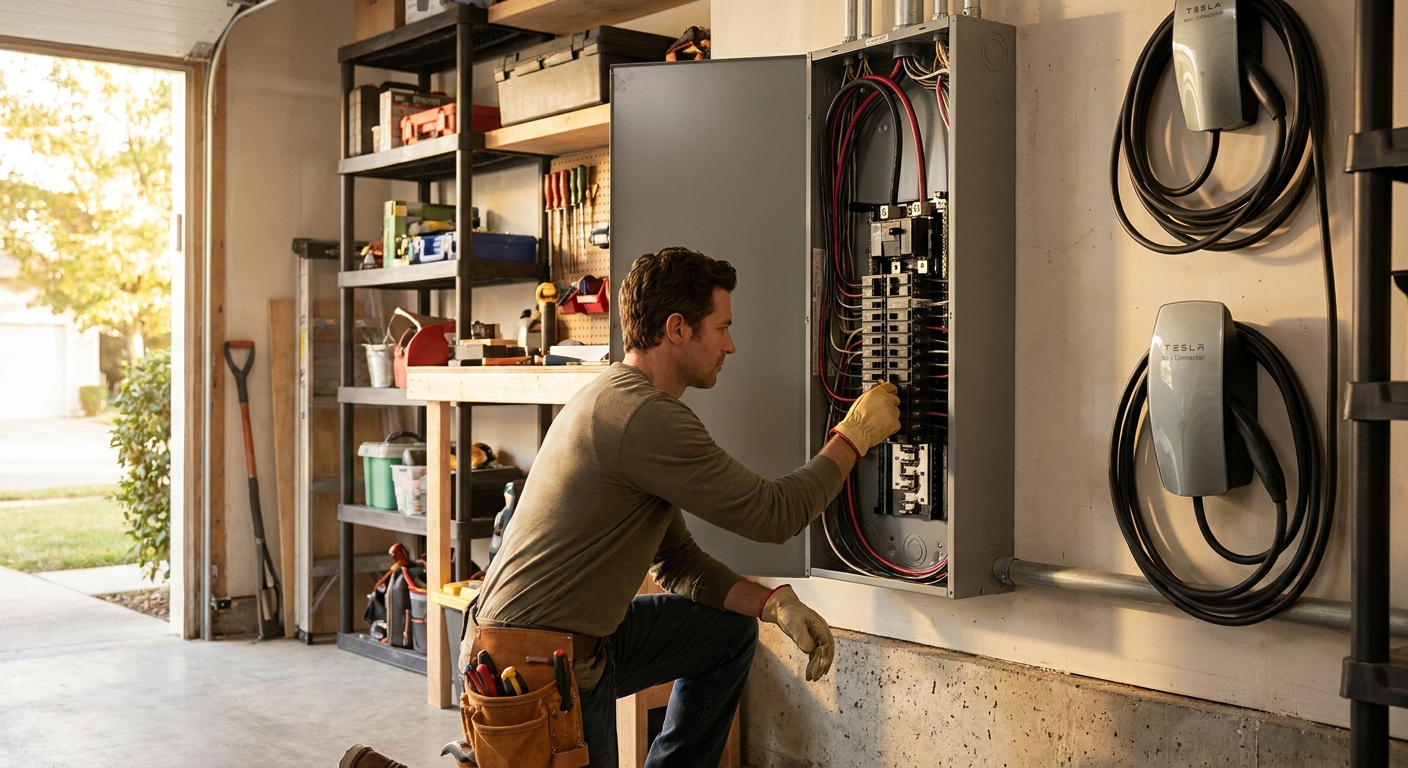
Preparing your electrical panel for an EV charger starts with the charger specification, the vehicle’s needs, and the home’s actual electrical loads. An electrician checks whether the existing service can support the added continuous load, then selects a compatible circuit, load-management plan, or panel upgrade. A spare breaker space alone doesn’t answer that question.
How does preparing your electrical panel for an EV charger work?
The electrician begins with the charger, vehicle, panel, and planned parking location. Those details determine the electrical design more reliably than the home’s age or the amperage printed on the panel label.
The assessment should cover:
- The charger manufacturer’s installation requirements and adjustable settings
- The vehicle’s charging capabilities and typical daily driving needs
- Existing electrical loads, including cooling, water heating, cooking, and pool equipment
- The panel rating, condition, breaker compatibility, and available spaces
- The wiring route between the panel and the parked vehicle
- Indoor, damp, or wet exposure at the charging location
- Plans for another EV, backup power, or other major electrical equipment
Tampa Electrical Pro connects customers with independent licensed and insured electricians for EV charger installation. The selected contractor determines the final scope, permitting, equipment, and price.
Should you choose Level 1 or Level 2 charging?
Level 1 may cover daily driving for some households when the vehicle remains parked long enough. Level 2 uses 240-volt power and may better suit drivers with greater daily range needs. The right choice depends on the vehicle, required range, available parking time, and the home’s electrical capacity.
The U.S. Department of Energy’s home charging guidance explains these differences without promising one charging result for every vehicle.
Before buying equipment, confirm the exact model and installation method. The electrician needs its electrical specifications, manufacturer instructions, maximum configured output, and any approved load-management features. For an outdoor location, the equipment must be rated for outdoor use and installed according to its listing.
Why is EV charging treated as a continuous load?
EV charging can draw power steadily for an extended period. That sustained demand affects how the electrician selects the circuit, conductors, breaker, and configured charging output.
There isn’t one universal circuit size for every Level 2 charger. The correct design depends on the charger’s specifications, its configured output, the manufacturer’s instructions, and applicable electrical requirements. Choosing a circuit from a generic online chart can miss important equipment-specific conditions.
Do spare breaker spaces mean the panel has enough capacity?
No. Empty spaces only show that the panel may have physical room for another breaker. They don’t prove that the electrical service can support the added load.
An electrician evaluates the home’s actual loads and the proposed charger together. A panel can have open spaces but insufficient service capacity. Another panel can look full yet support a different distribution arrangement after a proper assessment.
The electrician also checks the panel label, compatible breaker types, visible condition, and connection points. If the equipment requires separate attention, the assessment may include FPE or Zinsco panel replacement options. Age or brand alone shouldn’t be used to invent a complete diagnosis.
When does load management make sense?
Compatible load management may help when unrestricted charging would exceed the capacity available under certain operating conditions. The selected system can monitor electrical demand and reduce or pause EV charging when other loads need priority.
This capability must be confirmed for the charger and management equipment involved. An app, timer, or energy-use display doesn’t automatically provide service-load management. The electrician should verify that the devices are designed to work together and configure them under the manufacturer’s instructions.
Charging schedules can still be useful for household routines. They just shouldn’t be treated as proof that the service is protected from excessive combined demand.
Can a subpanel create more electrical capacity?
No. A subpanel distributes available capacity to additional circuits, but it doesn’t increase the capacity of the electrical service.
A subpanel may improve circuit organization or serve a garage with a practical feeder route. The electrician must still determine whether the existing service and feeder can support the proposed EV load. If more capacity is genuinely required, the options may include compatible load management, a lower configured charging output, or a panel and service upgrade.
No upgrade should be automatic because of the home’s age, neighborhood, or panel rating alone. The decision belongs to the completed load assessment and the actual equipment condition.
How should a second EV affect the plan?
Tell the electrician if a second EV is likely. Two vehicles may not need unrestricted charging at the same time, but that depends on daily driving, parked time, charger compatibility, and household priorities.
Possible designs include separate charging circuits, compatible shared-power equipment, or coordinated load management. Manufacturer confirmation matters because not every charger supports the same sharing or control method.
The useful planning question is how much energy each vehicle needs before its next trip. That answer is more informative than assuming both batteries must charge from empty to full every night.
How does a backup generator change the priorities?
A planned generator should be discussed during the same assessment, but it serves a different purpose. Backup planning starts with a defined list of essential loads, an appropriate fuel plan, maintained equipment, and transfer isolation from the utility.
EV charging may be a lower backup priority than refrigeration, lighting, communications, or other essential needs. The final priority list depends on the household. A generator shouldn’t be assumed to support every normal load during an outage.
Tampa Electric’s generator and home electrical safety guidance explains why fixed standby equipment needs professional installation and utility isolation. Direct backfeeding into house wiring is unsafe.
What affects the installation scope and price?
The charger model is only one part of the project. The electrician also considers panel capacity, circuit routing, wall or ceiling access, parking location, outdoor exposure, equipment compatibility, load management, and any required service work.
The selected contractor determines pricing after reviewing the actual scope. Our EV charger installation cost guide explains a published installation benchmark and the conditions that change the scope.
Permitting also depends on the property’s jurisdiction and the work involved. The selected contractor identifies the applicable authority and handles the project according to its requirements.
What should you confirm before ordering a charger?
Record the vehicle model, charger model, normal parking position, daily driving needs, and typical overnight parking time. Photograph the panel label without removing its cover. Note any planned second EV, generator, pool equipment, or other major electrical addition.
Don’t open the panel or remove its cover yourself. Burning odors, buzzing, shocks, hot or discolored plates, unexplained flickering, and repeated trips call for prompt inspection by a qualified electrician. For smoke or fire, leave the hazard area and contact emergency services.
Frequently asked questions
Does every Level 2 charger require a panel upgrade?
No. The electrician determines whether the existing service can support the charger’s configured load. Some homes can use the existing panel, while others need load management or additional service capacity.
Can I select the circuit from the charger’s advertised speed?
No. Charging claims don’t replace the manufacturer’s electrical specifications. The vehicle, charger configuration, circuit design, and applicable requirements all affect the result.
Is a smart charger the same as a load-management system?
No. Smart features may provide schedules, usage data, or app controls. Service-load management requires compatible equipment specifically designed and configured for that function.
Should I buy the charger before the electrical assessment?
You can compare models first, but confirm compatibility before committing to one. The electrician should review the exact charger specifications, installation location, panel, and future load priorities.
Request an EV charging assessment
Tampa Electrical Pro connects Tampa Bay customers with independent licensed and insured electricians. Call (813) 850-0320 to request an assessment for the panel, charging location, and equipment you’re considering.