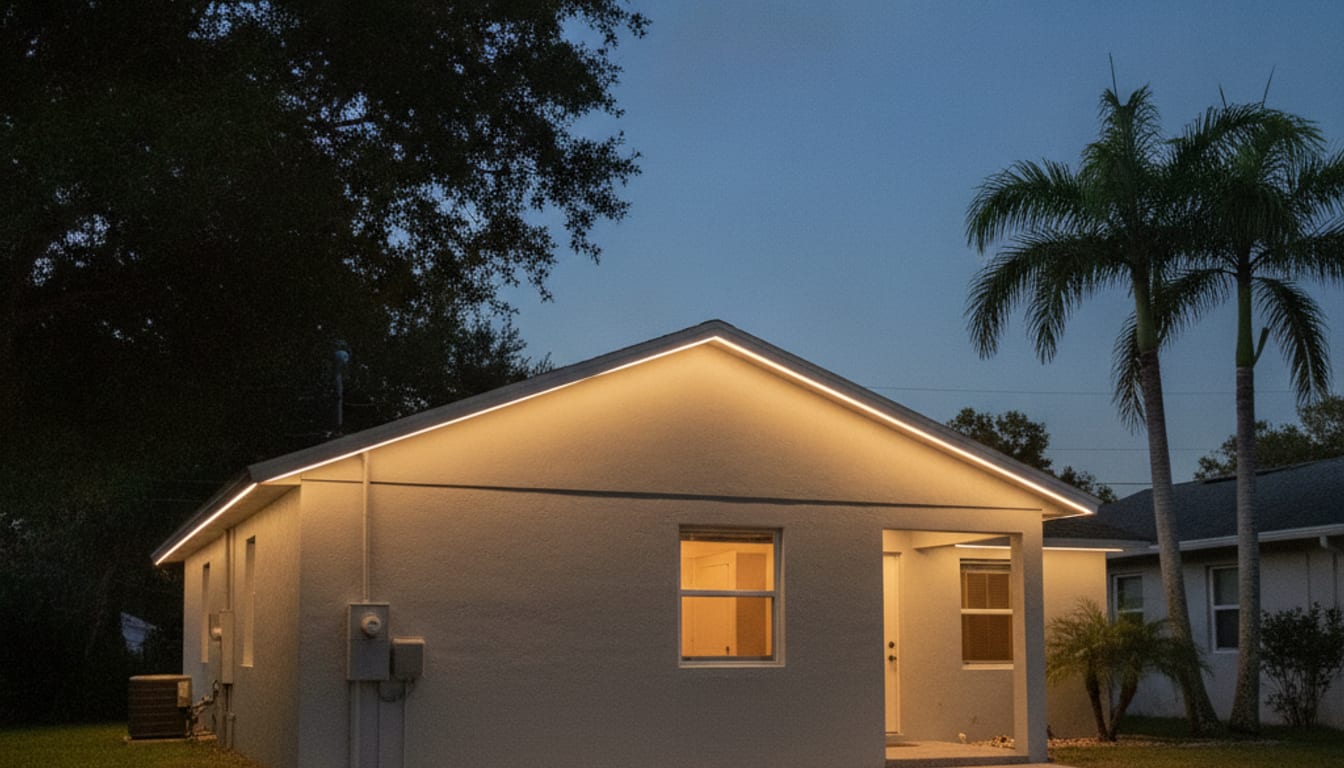
Published figures vary widely because they describe different products and installation scopes. Eufy publishes an estimate of $20 to $40 per foot for professional permanent holiday-light installation. JellyFish Lighting publishes $25 to $35 per linear foot for its installed system and says most homeowners spend $3,000 to $6,000 on the street-facing sides of a home.
Those are national, source-specific benchmarks. They aren’t Tampa market averages or Tampa Electrical Pro quotes. A local proposal still needs measured footage and a clear description of the roofline, installation method, equipment, access, and electrical work.
What do permanent Christmas lights cost when professionally installed?
The most useful comparison starts with the scope behind each published figure.
| Published source | Published figure | What it describes |
|---|---|---|
| Eufy | $20 to $40 per foot | Eufy’s estimate for professional permanent holiday-light installation |
| JellyFish Lighting | $25 to $35 per linear foot | Installed pricing for the company’s own system |
| JellyFish Lighting | $3,000 to $6,000 for most homeowners | The company’s system on the street-facing sides of a home |
| JellyFish Lighting | Around $4,600 on average | The company’s published average for its system |
A Tampa quote may change with:
- The measured sections of roofline being illuminated
- Roof height, pitch, and safe access
- Corners, peaks, dormers, and other layout changes
- Mounting channels and how they integrate with the eaves or soffit
- Controller quantity and placement
- Concealed versus exposed routing
- The condition and location of the electrical feed
- Whether the project can use an existing receptacle or needs wiring changes
Ask installers to quote the same measured sections and identify the product being installed. The proposal should separate the lighting system, controllers, mounting components, installation labor, and any electrical feed work. That makes unlike bids easier to spot.
Permanent roofline lighting also differs from a conventional residential landscape-lighting project. The systems may share an outdoor electrical supply, but their layouts, mounting methods, controls, and installation access aren’t interchangeable.
What does a DIY permanent-lighting kit cost?
Eufy publishes a price of $2.99 per foot for its own DIY permanent outdoor lights. That figure applies to eufy’s product, not every DIY kit, and it doesn’t include the homeowner’s time or corrections to the property’s electrical feed.
A plug-in kit is the clearest DIY case when a suitable outdoor receptacle is already in the right location and no house wiring needs to be installed or altered. Before ordering, confirm the required footage, controller location, cord routing, outlet condition, and the product’s exposure rating.
DIY becomes a different decision when the plan calls for a new receptacle, a new circuit, a hardwired controller, or changes to existing wiring. Those tasks should be separated from mounting and configuring the lighting itself.
For ideas about coordinating roofline and yard lighting without treating them as the same system, see these Tampa landscape-lighting ideas.
Does permanent roofline lighting require a license or permit?
The answer depends on the system and whether the project changes the building’s electrical wiring.
Florida Statutes 489.503(24) describes an exemption for low-voltage landscape lighting with a factory-installed cord and plug when installation doesn’t require wiring or another modification to a structure’s electrical wiring. The wording specifically addresses qualifying landscape lighting. It shouldn’t be treated as automatic approval for every permanent roofline-lighting product.
Florida DBPR’s low-voltage guidance also treats licensure as the general rule unless the system fits an applicable exemption. A hardwired controller, new receptacle, new circuit, or other house-wiring change doesn’t fit the no-modification condition in the cited exemption.
Permit requirements depend on the work and the authority serving the property. The city or county identified by the project’s actual jurisdiction should review questions about a particular installation. A mailing address alone may not identify the correct permitting authority.
For electrical work, verify that the selected contractor has an active Florida license with the appropriate scope and authority for the project. Florida has statewide certified contractors, locally authorized registered contractors, and specialty licenses with defined scopes, so one license prefix isn’t the only lawful category for every task.
How does Tampa’s outdoor exposure affect the project?
Permanent roofline equipment remains outdoors through rain, humidity, sun, and wind-driven moisture. Properties near salt water may also expose metal components and connections to salt. No honest calendar can predict when corrosion or seal failure will appear at a particular home.
Match the product and its components to the actual exposure. A location protected from direct rain isn’t the same as an edge, peak, or wall where wind can drive water onto the equipment. Product listings and installation instructions should guide controller placement, connections, mounting, and permitted use.
From the ground, watch for loose or displaced channel sections, damaged visible cable, staining around entries, broken covers, moisture inside a clear enclosure, or visible corrosion. Don’t remove electrical covers or open energized equipment to investigate. The guide to corroded outdoor outlets in Tampa explains warning signs at the feed point.
What should be checked at the electrical feed?
The feed point should match its outdoor exposure and the lighting manufacturer’s requirements. Its condition matters as much as its location.
GFCI shock protection, overcurrent protection, and equipment weather ratings perform different jobs. A receptacle without TEST and RESET buttons may still receive GFCI protection from an upstream device, so appearance alone doesn’t settle the question. Protective devices should be tested according to their instructions.
An electrician evaluating the feed can check:
- Whether the proposed system can use the existing circuit
- The receptacle and enclosure’s condition and suitability for the exposure
- Whether GFCI protection is present and functioning as intended
- Cord routing and controller placement
- Signs of heat, arcing, water entry, or damaged wiring
- Whether a new receptacle, circuit, or hardwired connection is part of the scope
Stop using a feed point that shows heat damage, arcing, a burning odor, buzzing or crackling, shocks, or recurring trips. Don’t keep resetting a fault or approach wet or visibly damaged electrical equipment. Arrange prompt inspection by a qualified electrician. For smoke or fire, leave the hazard area and contact emergency services.
Tampa Electrical Pro refers homeowners to independent licensed and insured electricians. The selected contractor determines scheduling, scope, permits, workmanship, and pricing. See GFCI outlet installation or electrical repair when the feed point needs professional evaluation.
Is permanent roofline lighting worth it?
It can be a practical fit when you want repeatable roofline scenes throughout the year and the installation suits the home. Compare the complete project rather than treating a per-foot product figure as the final installed total.
| Your situation | What to compare |
|---|---|
| Suitable existing outlet with no wiring changes | Plug-in products, measured footage, mounting, controls, and exposure rating |
| Complex or difficult-to-reach roofline | Measured professional proposals covering the same roof sections |
| Corroded, damaged, or poorly located feed point | Electrical correction as a separate scope before lighting installation |
| Hardwired controller or new circuit | Qualified electrical work and jurisdiction-specific permit review |
| Direct rain or salt exposure | Product suitability, connection protection, mounting condition, and maintenance instructions |
Ask each provider to state what isn’t included. Product cost, lighting installation, and electrical feed work are separate items unless the proposal expressly combines them.
Frequently asked questions
How much do permanent Christmas lights cost per foot?
Eufy publishes an estimate of $20 to $40 per foot for professional installation. JellyFish Lighting publishes $25 to $35 per linear foot installed for its own system. These are source-specific national benchmarks, not Tampa rates or quotes from Tampa Electrical Pro.
What does a DIY permanent-lighting kit cost?
Eufy publishes a price of $2.99 per foot for its own DIY permanent outdoor lights. It isn’t a category-wide DIY price, and electrical feed corrections would be separate.
Is there a standard Tampa installation price?
No independently verified Tampa-wide figure is available here. A useful local quote should be based on measured roofline sections, access, mounting, controllers, routing, product choice, and electrical feed requirements.
Does a plug-in kit require a licensed electrician?
Mounting and connecting a qualifying plug-in product without changing house wiring is different from adding a receptacle, installing a circuit, or hardwiring a controller. Florida’s cited exemption specifically describes qualifying factory-corded low-voltage landscape lighting, so don’t assume every roofline product falls within it. Confirm borderline work with DBPR and the property’s permitting authority.
How can I compare two installation proposals?
Give both providers the same roofline sections to measure. Compare the named product, footage, controllers, mounting method, routing, included electrical work, exclusions, and the treatment of areas exposed to direct rain or salt.