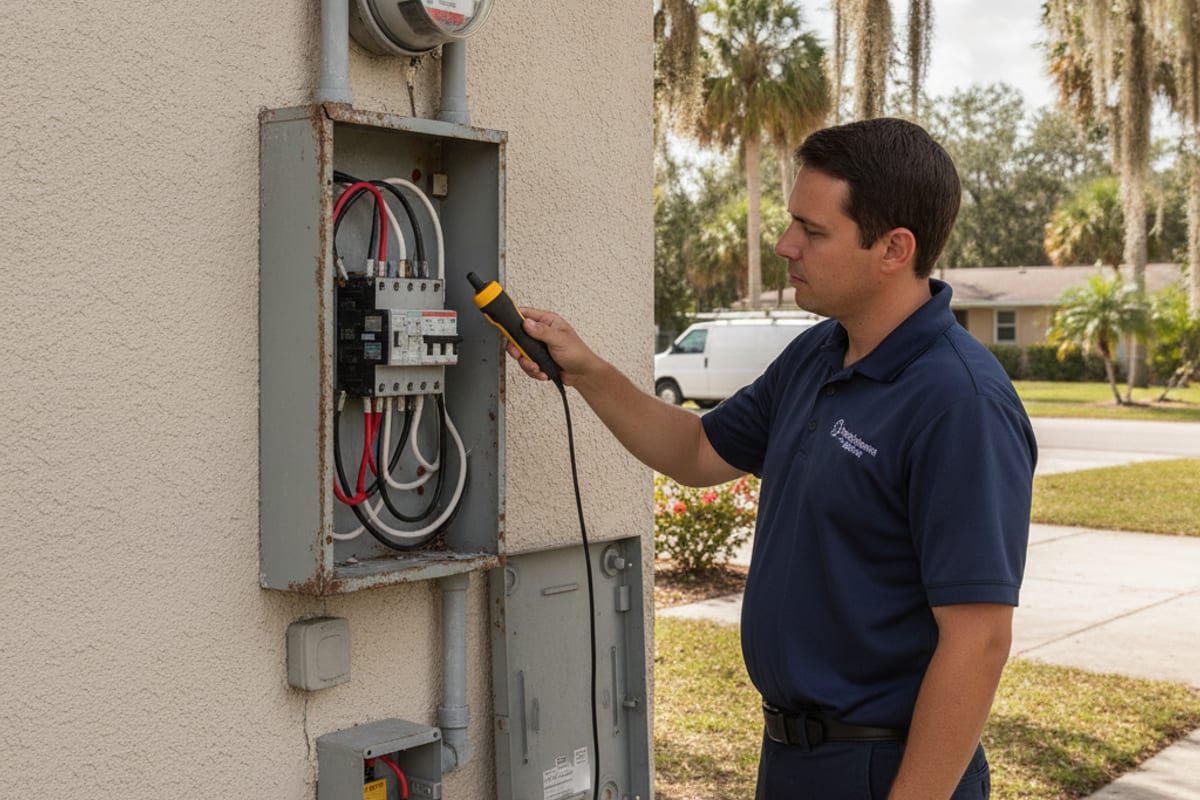
Electrical problems rarely explain themselves. A dead receptacle, repeated breaker trip, flickering light, or warm wall plate can have several possible causes, and the right repair depends on what an electrician finds at the property.
Tampa Electrical Pro connects New Port Richey customers with independent licensed and insured electricians. For city-intent work, start with the New Port Richey electrician page. A New Port Richey East mailing address still needs the contractor to name the actual permitting office, because the mailing city does not settle jurisdiction. The selected contractor evaluates the system, explains the available options, and determines scheduling, pricing, permits, and the work required.
Help is available for troubleshooting, new circuits, fixture and fan installation, panel upgrades, EV charger installation, generator planning, and other electrical projects.
Start with the symptom, not a guessed diagnosis
One dead receptacle might involve the receptacle itself, an upstream GFCI device, a breaker, or another connection on the circuit. A room without power could have a tripped protective device or a fault that requires further testing. Describing what stopped working, when it happened, and whether it has happened before gives the electrician a useful starting point.
Do not repeatedly reset a breaker that trips again. Unexplained widespread flickering or dimming, frequent trips, shocks, buzzing or crackling, burning odors, and hot or discolored plates call for prompt inspection by a qualified electrician. If there is smoke or fire, leave the hazard area and contact emergency services.
Customers should not remove panel covers or approach electrical equipment that is wet, damaged, or arcing. Those conditions require professional assessment.
Outdoor equipment needs a property-specific inspection
Equipment installed outdoors can be affected by rain, wind-driven moisture, physical damage, and corrosion. The actual exposure matters more than a broad assumption based on the property’s distance from the Gulf.
An electrician can inspect exterior receptacles, disconnects, panels, lighting, and related enclosures for damage or deterioration. The equipment’s labeling, installation instructions, condition, and exact location help determine whether repair or replacement is appropriate.
GFCI protection can be provided upstream, so a receptacle without its own test and reset buttons is not automatically unprotected. Testing the circuit and tracing its protective devices provides a more reliable answer than appearance alone.
Panel work depends on capacity and condition
A crowded panel and an undersized electrical service are different problems. A panel can run out of circuit spaces while the service still has adequate capacity. A subpanel may create additional circuit spaces, but it does not increase the amount of power available from the utility service.
Before recommending a panel upgrade, an electrician should consider the existing service, panel condition, available spaces, calculated load, planned equipment, and the requirements of the proposed installation. A full panel does not automatically mean the property needs a larger service.
EV charging is one example. The vehicle, daily driving needs, parked time, charger requirements, available circuit capacity, and wiring route all affect the appropriate installation. Level 2 charging uses 240 volts, but panel amperage alone does not establish that a service upgrade is necessary.
A standby generator also should not be treated as a new utility load. It supplies selected loads when utility power is unavailable. Generator planning instead considers the essential-load list, equipment requirements, transfer isolation, fuel, installation location, and maintenance needs.
Repairs, circuits, fans, and fixtures
The scope of a repair depends on the component that failed and whether the problem is isolated or affects more of the circuit. Useful details include which devices are affected, whether a breaker or GFCI tripped, whether the issue is constant or intermittent, and whether any heat, odor, sound, or visible damage is present.
For a new circuit, the electrician needs to evaluate the intended load, route, panel connection, access through finished areas, and any outdoor exposure. Existing circuit spaces do not prove that the service can support the new load.
A ceiling fan installation requires more than confirming that a light fixture already works at the location. The existing box must be rated and securely supported for the fan. Wiring access, support, controls, ceiling conditions, and the selected fan all affect the work. An outdoor fan must also be suitable for its actual exposure. Damp-rated and wet-rated products are not interchangeable in every location.
Surge protection and backup power solve different problems
Surge protection helps limit certain voltage surges. It does not keep the property powered during an outage, and no surge device can promise protection from every electrical event.
A whole-home generator supplies backup power through professionally installed transfer equipment that isolates the property from the utility. Portable generators are different. They may power individual appliances through properly rated outdoor cords, but they must not be connected to house wiring by backfeeding a receptacle.
Fuel-burning generators create carbon monoxide, fire, and electrical hazards. Portable units belong outdoors, far from the home and away from doors, windows, and other openings. Turning off the main breaker is not a substitute for proper transfer equipment.
What to check before hiring an electrician
Florida electrical contractor licenses differ by category and authorized scope. Certified contractors can work statewide, while registered contractors work within authorized local jurisdictions. Specialty licenses also have limited scopes. Verify that the business has an active license appropriate for the proposed work and property jurisdiction.
Ask the contractor to provide a written scope that identifies the work, equipment, exclusions, price, and payment terms. For a project that changes after inspection or troubleshooting, ask for the revised scope before authorizing additional work.
Permit and inspection requirements depend on the project and the authority responsible for the property. New Port Richey addresses are not all governed by a single permitting office merely because they share a mailing city. The contractor should identify the correct jurisdiction and explain who will handle any required applications and inspections.
Warranty terms also vary. Ask the selected contractor to put any labor coverage in writing and identify which manufacturer terms apply to supplied equipment.
Questions to answer before the appointment
A few property-specific details can make the initial conversation more productive:
- What stopped working, and is the problem constant or intermittent?
- Which rooms, receptacles, lights, or appliances are affected?
- Did a breaker or GFCI device trip?
- Is there heat, discoloration, buzzing, crackling, an odor, or visible damage?
- Is the project a repair, replacement, or completely new installation?
- What equipment model will be installed?
- Will the wiring route pass through finished walls, ceilings, an attic, or an outdoor area?
- Are future loads such as EV charging, HVAC equipment, or backup power part of the plan?
Do not open electrical equipment to gather this information. Photos of accessible labels and the visible installation can be useful when they can be taken safely.
Aluminum branch wiring requires a complete evaluation
A property’s age or neighborhood does not prove that it contains aluminum branch-circuit wiring. If aluminum branch wiring is actually present, the electrician should evaluate the wire and its connections throughout the affected circuits rather than judging a single visible device.
Repair options depend on the conductors, connections, equipment, and approved method. Aluminum branch-circuit concerns should not be confused with every aluminum feeder or service conductor, which requires its own evaluation.
Get connected with an electrician serving New Port Richey
Call Tampa Electrical Pro at (813) 850-0320 when you need electrical help in New Port Richey. We will connect you with an independent licensed and insured electrician who can inspect the property and explain the appropriate next step. The selected contractor determines the work scope, schedule, permits, workmanship terms, and price.