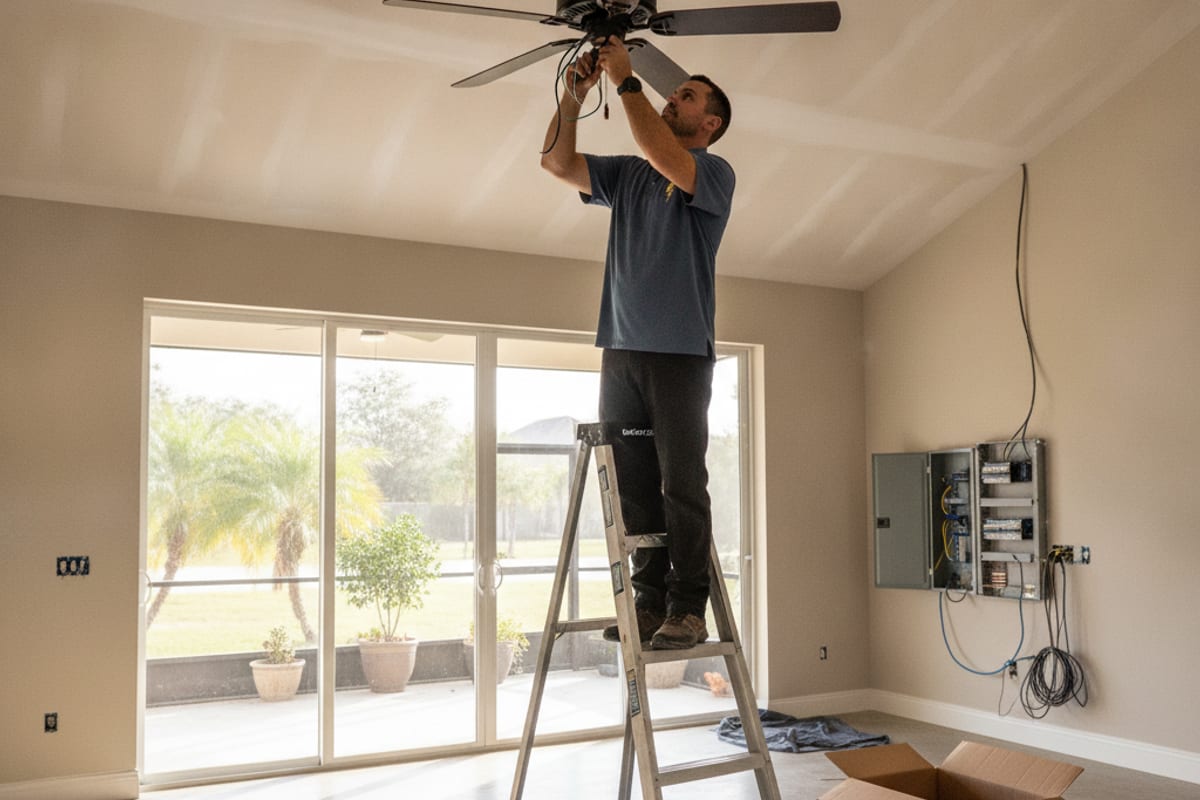
Ceiling fan installation cost in Tampa depends mainly on what already exists above the ceiling. Replacing a fan on confirmed rated support is usually a simpler scope than adding a new location, wiring, structural support, controls, or outdoor-rated equipment. The selected electrician determines the final price after reviewing those conditions.
A published labor benchmark
Home Depot’s Pro Referral ceiling-fan service page gives a national estimate of $100–$300 for installation labor, with the price depending on difficulty and an assessment of the work. This is a published service-page benchmark, not a Tampa average or a quote from Tampa Electrical Pro. Budget separately for the fan and confirm which support, wiring, controls, and access work the proposal includes.
This site’s published ceiling-fan figures are $150 to $250 to swap a fan on existing wiring and $350 to $600 when new wiring is part of the job. Those are this site’s published ranges, not a quote for a particular Tampa house and not a replacement for the Home Depot national labor benchmark.
What determines ceiling fan installation cost in Tampa?
The ceiling opening tells only part of the story. A qualified electrician must identify the existing box, its structural attachment, the available wiring, and the controls serving the location.
An electrical box that safely supported a light may not be suitable for a moving fan. Hunter explains that a ceiling fan needs an appropriately fan-rated box with secure structural support. The fan manufacturer’s mounting instructions also govern the installation.
Tampa Electrical Pro connects homeowners with independent licensed and insured electricians. The selected contractor evaluates the scope, provides the price, and completes the work.
| Installation condition | What the electrician evaluates | How it affects the scope |
|---|---|---|
| Replacement on confirmed fan-rated support | Existing box, attachment, wiring, fan condition, and control compatibility | Usually the most direct installation because power and suitable support are already present |
| Light fixture replaced with a fan | Box rating, structural attachment, conductor condition, and available controls | The box or support may need correction before the fan can be mounted |
| New fan location | Power route, switch route, ceiling access, framing, and finish surfaces | Requires more planning and may involve new wiring and structural support |
| High, vaulted, or difficult ceiling | Safe access, mounting angle, downrod compatibility, and wiring reach | Access and model-specific mounting parts can expand the work |
| Wall control or remote | Existing conductors, receiver space, fan compatibility, and desired light control | May require a compatible control, receiver, or wiring change |
| Lanai or other outdoor location | Direct water exposure, product rating, mounting surface, and wiring condition | Requires equipment matched to the actual exposure and installation instructions |
| Customer-supplied fan versus included equipment | Fan, downrod, mounting hardware, brace, controls, and accessories | Changes which materials and equipment are included in the contractor’s quote |
When is a fan replacement the simpler option?
A replacement is most straightforward when the existing location has confirmed fan-rated support, suitable wiring, compatible controls, and safe access. The electrician can then remove the old fixture, inspect the connection point, and install the compatible fan according to its instructions.
A visible ceiling box doesn’t confirm its rating or attachment. The electrician may need to inspect the label, mounting method, and surrounding structure before proceeding. If the box isn’t suitable, replacing or reinforcing the support becomes part of the job.
Homeowners comparing this scope can review the site’s ceiling fan installation service for the information to gather before speaking with a contractor.
What changes when no ceiling fixture exists?
A new location requires decisions about both power and support. The electrician considers the route from an appropriate electrical source, access above the ceiling, framing near the proposed location, switch placement, and any finished surfaces along the route.
Open attic access can make the route easier to inspect. Finished ceilings, limited access, masonry, or unusual framing may require a different approach. If new wiring is needed, the project includes electrical wiring work rather than only fan assembly and mounting.
Placement also matters. The fan must fit the room, ceiling, mounting system, and intended use. The separate guide to ceiling fans and Florida heat covers placement and sizing considerations without duplicating the cost comparison here.
How do ceiling height and access affect the quote?
Ceiling height can change the access method and the compatible mounting hardware. Sloped or vaulted ceilings may require a suitable adapter or downrod specified for the chosen fan. The electrician also needs enough safe working space to inspect the box, structure, and conductors.
Before requesting a quote, note whether the ceiling is flat or sloped and whether attic access exists. Photos of the room, ceiling opening, wall controls, fan label, and included parts can help the contractor understand the likely scope. An onsite inspection may still reveal concealed conditions that affect the final price.
Does a remote or wall control change the scope?
It can. A pull-chain fan, handheld remote, smart control, and separate wall controls don’t all use the same wiring arrangement. Compatibility depends on the fan model, receiver, available conductors, and whether the fan also includes a light.
A remote may reduce the need for separate wall-control functions in some layouts, but it doesn’t automatically eliminate wiring work. The electrician must confirm that the selected control is approved for the fan and fits the available installation space.
Tell the contractor how you want to control the fan and light. Also mention whether an existing wall switch should remain, be replaced, or control separate functions.
How does an outdoor fan differ from an indoor installation?
Outdoor exposure changes the equipment choice. A damp-rated fan is intended for protected damp locations without direct water exposure. A wet-rated fan is designed for outdoor water exposure. Hunter’s damp-rated and wet-rated fan guidance explains this distinction.
A covered lanai isn’t automatically protected from direct water. Wind-driven rain, the mounting location, and the fan’s listing all matter. The electrician should compare the actual exposure with the product label and installation instructions.
Outdoor wiring also requires attention to the protective devices serving the circuit. GFCI, AFCI, and overcurrent protection perform different functions, and protection may be located upstream rather than on the visible receptacle. The Electrical Safety Foundation International provides an outdoor electrical safety guide. Related service information is available on the GFCI installation page.
What should a ceiling fan quote include?
Ask for a written scope that identifies the installation location and known conditions. It should make clear whether the contractor’s price includes:
- Removing and handling the existing fixture
- Confirming or replacing the ceiling box and structural support
- Installing new wiring or modifying existing wiring
- Supplying the fan or installing a customer-supplied model
- Providing a downrod, brace, adapter, receiver, or wall control
- Addressing a sloped, high, or difficult-to-access ceiling
- Using equipment suitable for indoor, damp, or wet exposure
- Handling finish repairs if access affects drywall or another surface
- Determining applicable permit requirements for the property’s jurisdiction
These details make competing quotes easier to compare. A low initial number may cover only assembly and mounting, while another quote may include support, controls, wiring, and accessories.
Can several fans be evaluated together?
Yes. Tell the contractor about every proposed location during the initial conversation. Each location still needs its own review because support, wiring, access, controls, and exposure can differ from room to room.
Providing a room-by-room list helps prevent assumptions. Note which locations already have fans, which have lights, which have no ceiling fixture, and which are outdoors. The contractor can then define the included scope for each location.
Frequently asked questions
Can a ceiling fan use an existing light fixture box?
Only when the box and its attachment are suitable for ceiling-fan support. The presence of an existing light doesn’t establish that. A qualified electrician should verify the support before mounting the fan.
Is replacing an existing fan different from adding a new one?
Yes. A replacement may reuse suitable support, wiring, and controls. A new location may require a power route, switch wiring, structural support, ceiling access, and finish work.
Does a covered lanai need a damp-rated or wet-rated fan?
The answer depends on actual water exposure and the product instructions. Damp-rated fans suit protected damp areas without direct water. Wet-rated fans are designed for outdoor water exposure.
Should I buy the fan before requesting a quote?
You can, but confirm that the model suits the location, ceiling, support, exposure, and preferred controls. Sharing the model information before the visit helps the electrician identify compatible mounting parts and controls.
Why can two ceiling fan quotes differ?
The included work may differ. Compare support, wiring, access, controls, mounting parts, outdoor rating, supplied equipment, and finish repairs instead of comparing only the final number.
Get a quote based on the actual installation
Gather photos, the fan model, ceiling details, control preferences, and information about existing fixtures. Call Tampa Electrical Pro at (813) 850-0320 to be connected with an independent licensed and insured electrician. The selected contractor will evaluate the installation, determine the scope, and provide the price.