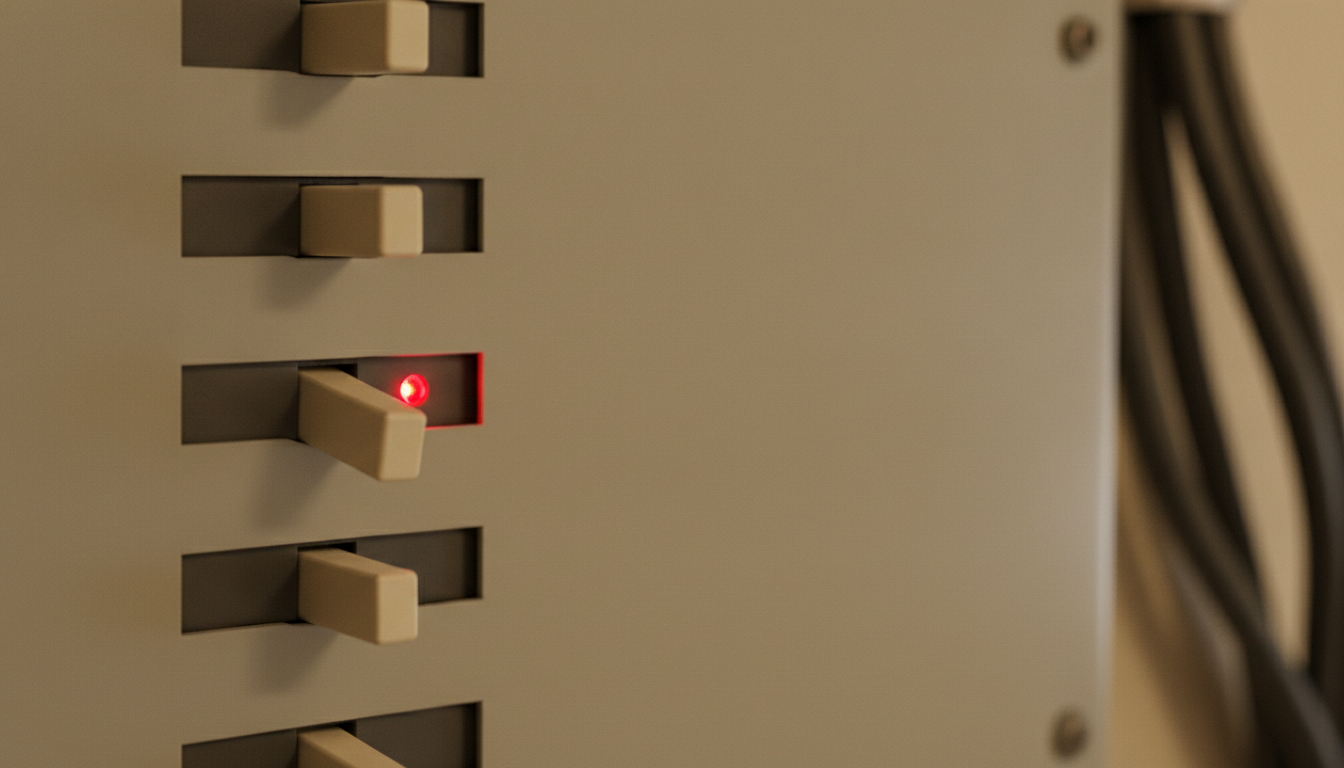
An AFCI breaker that keeps tripping is reporting a condition it detected, and Square D QO AF/AFGF Time Saver Diagnostics and Eaton Type CH dual purpose AF/GF models also stored which condition. Repeated resetting isn’t a fix. Leave the circuit off until a licensed electrician can read that record.
You’re looking at a handle that won’t stay on. If the trip might be an ordinary overload, a short, or a GFCI event, start with the broader breaker-trip guide. This page is for the AFCI or dual-function breaker that logged the last event.
What is the breaker actually reporting?
An AFCI looks for electrical patterns associated with arcing. A dual-function breaker also watches for current leaving its intended path. Overcurrent protection, GFCI shock protection, and AFCI arc-fault protection do different jobs. The Florida GFCI guide covers that shock-protection side.
A series arc points at a cord, an appliance, or a connection. Eaton describes a low-current arc in one current pathway, typically in worn appliances, extension cords, poor connections, or contacts in equipment. Eaton’s own resolution is: “Identify the equipment causing the tripping, and repair or replace.”
A parallel arc points at the building wiring. Eaton describes a high-current arc between two conductors, usually where installed wiring was compromised by a nail or screw, a tight staple, or damaged insulation. Eaton’s own resolution is: “Locate fault location and replace wire.”
A ground-fault code is a different protective function. A thermal overload or a mechanical short can trip the breaker without storing an arc code at all. Square D’s solid LED reports “Arc fault” without saying series or parallel. Eaton’s codes 1 and 2 make that split.
Can you tell which fault it stored?
Yes, on breakers with a diagnostic indicator. Schneider Electric publishes the LED table for Square D QO combination arc-fault (AF) and dual-function (AFGF) breakers with Time Saver Diagnostics. Eaton publishes numbered trip codes for Type CH dual purpose AF/GF breakers.
Those two published tables are what this page can stand behind. A breaker with no diagnostic indicator on its face stores nothing a person can read, so the first thing to check is whether yours has one. And don’t treat a blink count as universal. Read the brand on the handle first.
An electrician reads the tables below. Stop resetting so that record is still there.
What do Square D QO arc-fault and dual-function LEDs mean?
These rows belong only to Square D QO AF and AFGF breakers with Time Saver Diagnostics. Schneider’s own wording is that on power up, the LED will indicate the cause of the previous trip event, without pressing the TEST button. So on those breakers, nobody has to press anything to see it.
| LED indication | Stored event |
|---|---|
| LED lights on solid for 10 seconds then turns OFF | Arc fault |
| LED pulses 2 times | Ground fault |
| LED pulses 4 times | Grounded neutral |
| LED pulses 7 times | Arc-fault protection unresponsive, follow the manufacturer’s testing section |
| LED does not turn ON | No fault stored, thermal overload, short circuit |
Schneider also states: “An automatic reset of Fault Indication will occur if the AFGF circuit breaker has been powered continuously for 27 days.” A code you notice weeks later can be stale.
Schneider also publishes a second read: hold the TEST button down, move the handle to ON, and time how long the breaker takes to trip. The timing is the answer. An electrician performs that one. It isn’t a reset method, and it isn’t a homeowner step.
What do Eaton Type CH dual purpose AF/GF trip codes mean?
These codes belong only to Eaton Type CH dual purpose AF/GF breakers. Eaton’s document says the trip codes are displayed through a diagnostic LED trip code indicator, that “The code will repeat 30 iterations”, and that a code of 6 appears as six short blinks followed by a pause while a code of 1 appears as one blink followed by a pause. So you count blinks, then pauses.
Code 1, series arc. “A low current arc has been detected within one of the current pathways.” Resolution: “Identify the equipment causing the tripping, and repair or replace.”
Code 2, parallel arc. “A high current arc has been detected between two conductors.” Resolution: “Locate fault location and replace wire.”
Code 4, overvoltage. “The breaker will trip if it experiences voltage of 160 V rms or greater.” Resolution: “Investigate utility power for imbalance in the phases or loss of neutral.”
Code 5, ground fault. “Current has found an alternate path to ground, which could cause harm to people or property.”
Code 6, self test failure. “The breaker continually tests the internal electronics and software to ensure that the arc fault detection technology is working properly. If the self-diagnostics fail, the breaker will trip.” Resolution: “Replace the breaker.”
Here’s the trap. Eaton does not record a trip code for thermal overload detected by the mechanical portion of the breaker, short-circuit detection by the mechanical portion, pressing the TEST button, or manually switching the breaker off. “If the breaker is tripped by one of these conditions, the LED will display the most recent recorded trip code.”
A new breaker can show a factory code, not a code from your house. Eaton says: “Upon installation, if the breaker has not experienced a trip that records a code, it will display the last trip code recorded from tests performed at the factory.”
If you already pressed TEST or switched the breaker off, tell the electrician. The LED may still be showing an older code.
Does the same blink count mean the same thing on both brands?
No. Two pulses on the Square D table is a ground fault. Code 2 on the Eaton table is a parallel arc.
Those are different faults in different places. A ground fault is current leaving its intended path. A parallel arc is a high-current arc between conductors, and Eaton’s next step is to locate the damaged wire. Reading the wrong brand’s chart sends you after the wrong fault. Match the table to the handle.
What if the code points at the service side?
On Eaton Type CH dual purpose AF/GF breakers, code 4 is overvoltage at 160 V rms or greater. Eaton’s own resolution names loss of neutral, or imbalance in the phases.
That 160 V rms figure is Eaton’s trip threshold for that breaker. It’s not a Tampa Electric rule. It doesn’t mean the utility caused the AFCI trip.
If lights have been dimming, brightening, or flickering across rooms, treat that as a voltage question. The flickering-lights guide covers that pattern. Unexplained flicker, heat, buzzing, or a burning odor still needs prompt qualified inspection. Don’t open equipment to chase a suspected service connection.
What about the code requirement itself?
Two honest points, and this page stops there.
First, editions move, and the copy you find may not be the current one. Florida’s arc-fault section is E3902.16, and the copy of it that surfaces most easily online is the 2017 edition. Largo’s building department publishes the 2020 National Electrical Code alongside the 2023 Florida Building Code. So check which edition a page is actually serving before you lean on it.
Second, the requirement depends on the property and the work. Which circuits need arc-fault protection, and whether a particular repair or replacement triggers it, is a question for the electrician and the building authority for that address. Jurisdiction matters here too. Largo runs its own building division rather than going through the county, so the authority follows the property, not the mailing address.
None of that changes the diagnosis in front of you. A breaker that keeps tripping is reporting something now, whatever the code required when the circuit was installed.
When does this stop being a troubleshooting question?
It stops being a puzzle the moment you notice smoke, a burning odor, unusual heat, buzzing, arcing, discoloration, visible damage, a shock, or a breaker that won’t hold. Any of those is a reason for prompt qualified inspection, not more reading.
If there’s smoke or fire, leave the hazard area and contact emergency services. Don’t approach a damaged or wet panel. Don’t keep resetting a fault to see whether it clears.
If the property has Federal Pacific Stab-Lok or Zinsco equipment, the panel type warrants a separate evaluation. Read the Federal Pacific panel guide without assuming that brand explains this trip.
What does having it diagnosed involve in Tampa Bay?
Tampa Electrical Pro connects homeowners with independent licensed and insured electricians serving Tampa Bay. The brand doesn’t perform the licensed electrical work. The selected contractor sets scheduling, scope, permits, workmanship, and pricing.
The electrician identifies the brand, reads the stored indication on Square D QO AF/AFGF Time Saver Diagnostics or Eaton Type CH dual purpose AF/GF devices, and inspects the circuit that code points to. A series-arc read and a parallel-arc read are different jobs.
Bring three things to that visit: the brand on the handle, what the indicator is doing, and whether anyone has pressed TEST or switched the breaker off since the trip. Each one changes how the stored code should be read. The contractor scopes and prices the actual work after seeing the circuit.
If the inspection turns to the panel’s condition or available spaces, that’s a different scope. See the panel upgrade service when that evaluation is on the table. For the circuit itself, start with electrical repair.
Frequently asked questions
Is it safe to keep resetting an AFCI breaker that keeps tripping?
No. Repeated resets re-energize a circuit before the cause is known. If the area is dry and there are no warning signs, one reset may show whether it holds. Stop if it trips again.
Do two blinks mean a ground fault?
Only on Square D QO AF and AFGF Time Saver Diagnostics breakers. On Eaton Type CH dual purpose AF/GF breakers, code 2 is a parallel arc. Use the chart that matches the brand.
Why does the LED still show a code after I pressed TEST?
On Eaton Type CH dual purpose AF/GF breakers, pressing TEST doesn’t record a new code. Neither does switching the breaker off, a thermal overload, or a short detected by the mechanical portion. The LED keeps showing the most recent recorded code, which can be an older event or a factory test.
Can LED lights or a dimmer cause an AFCI breaker to trip?
They can be the equipment on an Eaton Type CH series-arc (code 1) read. Eaton describes a low-current arc in one current pathway, typically in worn appliances, extension cords, poor connections, or contacts in equipment, and its own next step is to identify that equipment and repair or replace it. An LED fixture or dimmer on that kind of read is not proof the breaker is defective. A Square D QO Time Saver Diagnostics LED that lights solid for 10 seconds reports “Arc fault” without saying series or parallel, so the electrician still has to inspect the circuit. This page does not assign a nuisance-trip rate to LED lighting.
If nothing is plugged in, is the house wiring at fault?
Not automatically. Unplugging portable devices doesn’t remove lights, hardwired equipment, concealed cable, or connections. A series-arc code still points at equipment or a connection. A parallel-arc code points at installed wiring.
My older Tampa house has no arc-fault breakers. Is that a problem?
It isn’t a diagnosis either way, and this page won’t guess. Whether a given circuit or a given piece of work needs arc-fault protection at your address is a question for the electrician and the building authority for the property. What’s in front of you today is a breaker that already has one and keeps tripping, and that is worth reading.
How is AFCI protection different from GFCI protection?
AFCI protection looks for arcing. GFCI protection looks for current leaving its intended path. Overcurrent protection is a third function. A dual-function breaker can combine AFCI and GFCI.
Get the stored trip read before restoring the circuit
Tampa Electrical Pro connects customers with independent licensed and insured electricians serving Tampa Bay. The selected contractor determines scheduling, diagnosis, scope, permitting, and price.
If an AFCI breaker keeps tripping, leave that circuit off until the stored indication can be read. If there’s smoke or fire, leave the hazard area and contact emergency services. For sparking, burning odor, buzzing, heat, shocks, or visible electrical damage, request qualified help without another reset.